For the uncompromising cyclist, a tire is more than just a consumable; it is a critical component of your machine’s mechanical integrity. Whether you are descending a mountain pass on a Pinarello Dogma or navigating technical singletrack on an S-Works Epic, your tires dictate your limit of grip, rolling resistance, and safety.
At Componentry, we view tire maintenance not as a chore, but as asset preservation. By moving from reactive repairs to a predictive maintenance approach, you ensure your equipment operates at peak performance while protecting your high-performance investment.
The Science of Wear: Beyond the Visual Inspection
While many riders wait for a catastrophic failure (a flat) to address their tires, the Data-Driven Purist understands that performance degrades long before the tube shows.
- The "Check Engine" Light for Rubber: Unlike cassettes, tires don't always stretch, but they do lose material and structural supple-ness. Use Componentry to track the exact mileage of each tire in your stable, setting Service Triggers to alert you when a tire reaches its manufacturer-recommended lifecycle.
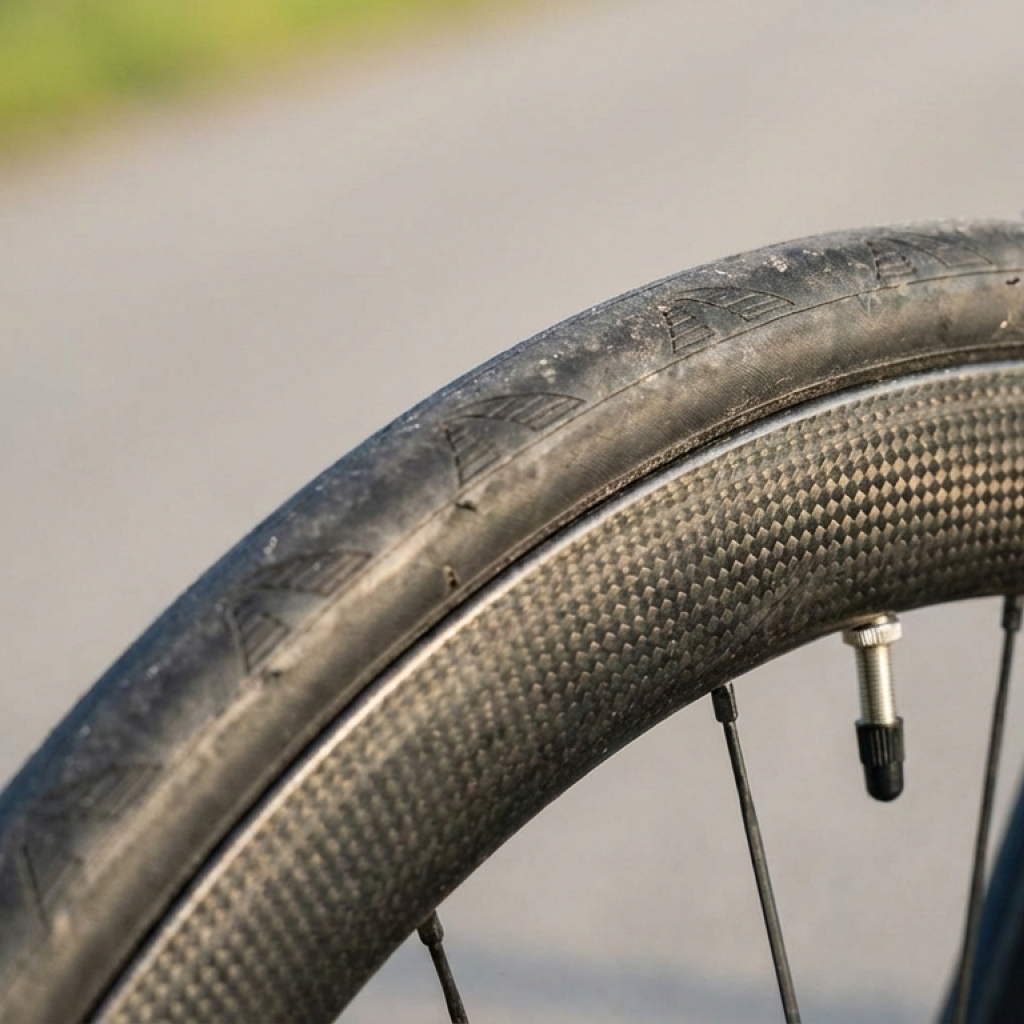
- The Flat-Spot Effect: High-mileage tires develop a squared-off profile, which increases rolling resistance and compromises cornering stability.
- Expert Insight: As noted by Park Tool, many modern tires include a Wear Indicator (TWI)—a small indentation in the tread. Once this disappears, your mechanical integrity is officially compromised.
Pressure as Performance: The Marginal Gain
For the Competitive Racer, tire pressure is the ultimate marginal gain. Incorrect pressure doesn't just feel bad; it wastes watts through casing deformation or suspension losses (vibration).
- Precision Telemetry: Your ideal pressure isn't a static number printed on the sidewall; it’s a variable based on your total system weight, rim width, and terrain.
- Optimizing Expenditure: Over-inflating tires accelerates center-tread wear, while under-inflating risks snake-bite punctures or sidewall damage.
- Expert Insight: SILCA's Professional Pressure Calculator is the gold standard for determining your optimal PSI/Bar based on real-world surface conditions.
The "Silent" Risks: Aging and Perishing
For the cyclist with a multi-bike stable, the primary enemy isn't mileage—it’s time.
- The Perishing Factor: High-end rubber compounds can dry out and perish even if the bike remains unridden. This leads to sidewall cracking and a loss of chemical grip.
- Digital Twin Monitoring: Componentry tracks the "age" of your components from the date of installation, ensuring you never head out for a ride on a "low-usage" bike with compromised rubber.
Tubeless Integrity: The Invisible Maintenance
If you’ve transitioned to tubeless—as most endurance cyclist have—your maintenance is now chemical as well as mechanical.
- The 90-Day Rule: Sealant eventually dries into a "latex monster" inside your tire, leaving you vulnerable to punctures.
- Predictive Reminders: Set a recurring Service Trigger in Componentry to refresh your sealant every 3-6 months, depending on your climate.
- Expert Insight: GCN’s Tubeless Maintenance Guide emphasizes that a "set and forget" mentality is the leading cause of mid-race mechanical failures.
How Componentry Fits Into Your Care Routine
Maintaining your tires shouldn't be a matter of guesswork or visual inspection alone. Componentry transforms your tire maintenance from a reactive task into a systematic part of your lifecycle management strategy.
- Automated Lifecycle Tracking: By creating your wheelset in Componentry and syncing your rides via Strava, you track the exact mileage of your rubber. No more wondering if those GP5000s have 1,000 or 3,000 kilometers on them—Componentry provides the precise telemetry you need to assess wear.
- Predictive Service Triggers: Set custom alerts for different tire types. For your racing slicks, set a Wear Inspection trigger at 2,500km. For your tubeless setups, configure a Sealant Refresh reminder every 90 days to ensure you never face a dried-out mechanical on the road.
- Asset Preservation: High-performance tires are an investment in speed and safety. By replacing tires at the optimal point in their lifecycle, you prevent the cascading failure of a blowout (aka. a serious crash) that could damage your premium carbon rims or, more importantly, compromise your safety during a high-speed descent.
Recommended Videos & Further Reading
For the deep-dive technician, we recommend these industry-stand`ard resources to help you optimize your contact patch:
- GCN: Are Your Bike Tires Worn Out? 4 Signs to Look For – A 30-second inspection routine to identify flat spots, casing threads, and UV damage.
- GCN Tech: When Should You Replace A Road Bike Tyre? – Expert insights into the performance trade-offs of aging rubber.
- Park Tool: How to Fix a Flat Tire – The definitive mechanical guide to tire and tube removal.
- SILCA: The Asymmetric Effects of Tire Pressure – Learn why being 5 PSI over-optimal is significantly slower than being 5 PSI under.
- Park Tool: Tire, Wheel, and Inner Tube Fit Standards – A technical breakdown of ETRTO standards and modern rim compatibility.
- SILCA Marginal Gains Blog: Tire Pressure: The Most Important Thing You Are Not Paying Attention To – A masterclass in treating pressure as a performance variable rather than a static setting.