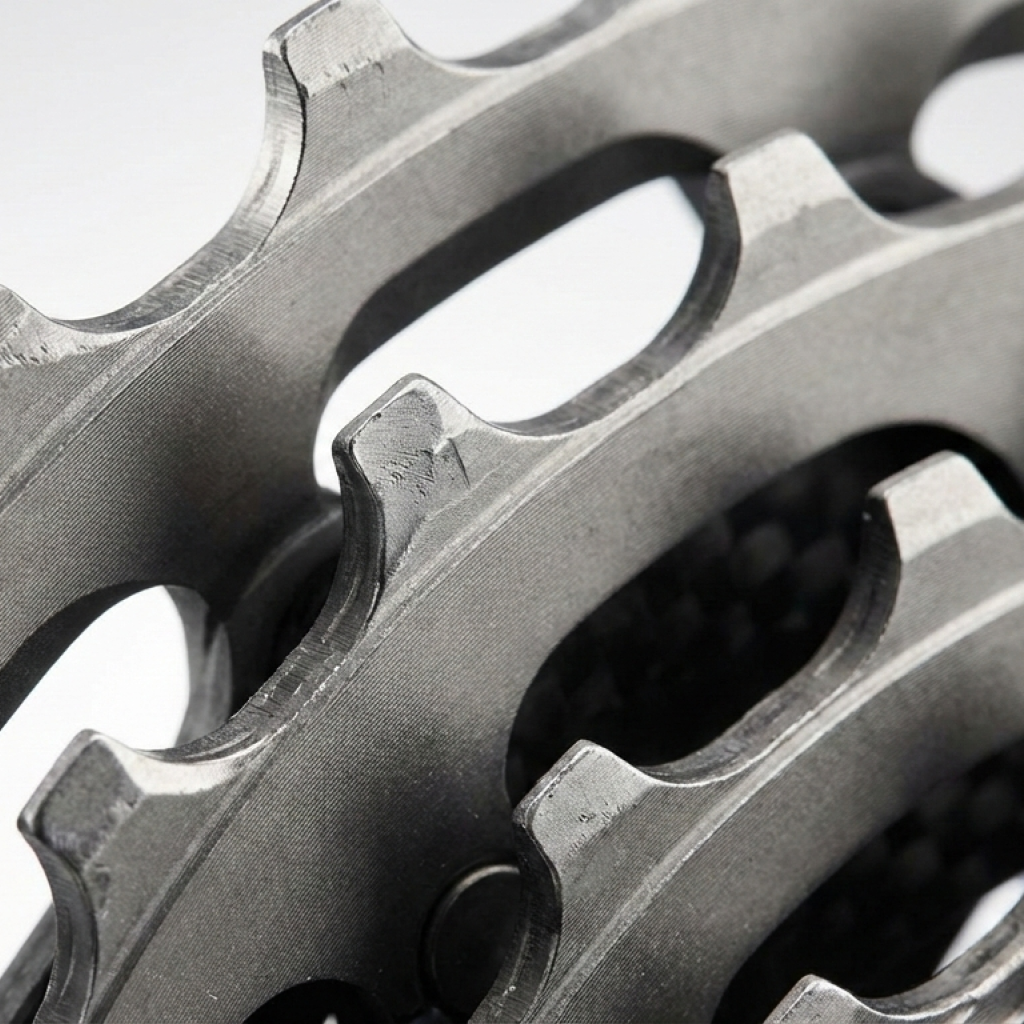
Why 0.5% Wear Is the Physics Breaking Point
The transition from acceptable wear to accelerated damage is not linear. At 0.4% chain wear, the drivetrain functions as designed. At 0.5%, measurable misalignment begins. At 0.6%, the wear rate on cassette teeth accelerates exponentially.
Park Tool, the industry standard for bicycle maintenance tools and guidance, provides explicit thresholds:
"For 11-speed and 12-speed chains, replace at 0.5% wear. For 10-speed and lower, replace at 0.75% wear. Exceeding these thresholds accelerates cassette and chainring wear exponentially." Park Tool: When to Replace a Chain
The reason 11-speed and 12-speed systems have stricter requirements is geometric. Narrower chains have less lateral compliance. The tolerances are tighter. The margin for error is smaller. A 12-speed chain running on a cassette with 10.2mm cog spacing cannot tolerate the same elongation as a 9-speed chain with 14mm spacing.
Zero Friction Cycling (ZFC), which has conducted over 300,000 kilometers of controlled drivetrain testing, quantifies this progression:
"Chain wear progression accelerates non-linearly. A chain at 0.5% wear shows measurable increases in friction and cassette interface stress. By 0.75%, wear rates on premium cassette materials increase by a factor of three to five compared to operation with a chain below 0.5%." Zero Friction Cycling: Chain Wear Testing
This is why waiting for symptoms is economically irrational. By the time you feel rough shifting or hear chain noise, you have already spent weeks or months grinding down expensive cassette teeth. The damage is done before the symptoms appear.
The 0.5% threshold is not arbitrary. It is the point where chain pitch deviation exceeds the tolerance for proper tooth engagement on narrow-pitch cassettes. Beyond this point, contact shifts from the optimized engagement surfaces to the sides of the teeth. Material removal accelerates. Shifting precision degrades. The cascade begins.
The Economics: Why Precision Saves Money
The cost analysis for drivetrain maintenance is straightforward. The only variable is whether you replace chains proactively or reactively.
Proactive Replacement Strategy (0.5% threshold):
- Chain: $50-$80 every 3,000-4,500 km
- Cassette: $400-$1,000 every 12,000-18,000 km (replaced after 3-4 chains)
- Chainrings: $150-$300 every 20,000-30,000 km (replaced after 5-6 chains)
Total cost per 15,000 km: Approximately $920 depending on component quality and riding conditions.
Reactive Replacement Strategy (wait until symptoms):
- Chain: $50-$80 every 4,500-6,000 km (if you are lucky)
- Cassette: $400-$1,000 every 6,000-9,000 km (damaged by worn chain)
- Chainrings: $150-$300 every 12,000-18,000 km (accelerated wear from misalignment)
Total cost per 15,000 km: Approximately $1,660, plus the cost of emergency replacements and potential mid-ride failures.
Savings from proactive approach: $740 over 15,000 km.
This calculation assumes premium components (Dura-Ace, SRAM Red, Campagnolo Super Record). For mid-tier groupsets with hardened steel cassettes, the differential is smaller but still significant. A proactive approach extends cassette life by a factor of three to four regardless of component tier.
Park Tool's maintenance guidance confirms this economic reality:
"Replacing a chain at the correct interval (0.5% for 11/12-speed, 0.75% for 10-speed and lower) extends cassette life by a factor of three to four times. Waiting until the chain skips typically results in cassette replacement at the same time." Park Tool: When to Replace a Chain
The hidden cost is not just parts. It is the mid-ride failures, the degraded shifting performance, and the gradual erosion of confidence in your equipment. It is checking your drivetrain before every long ride because you are not sure if today is the day it finally gives out.
For a performance cyclist with a $3,000 wheelset and premium components, proactive chain replacement is not maintenance. It is asset protection.
What Pro Teams Know
WorldTour professional teams do not wait for 0.5% wear. They replace chains based on distance, not measured elongation. According to Cyclingnews reporting on pro team maintenance practices, teams like Jumbo-Visma and UAE Team Emirates replace chains every 1,500 to 2,000 kilometers regardless of wear measurement.
This approach eliminates guesswork. A team mechanic tracks every kilometer ridden on every bike and swaps chains preemptively. The cost of a chain (approximately $80 wholesale) is negligible compared to the cost of a mechanical failure in a race or the performance degradation from a worn drivetrain.
Pro teams understand that the friction losses from chain wear cost more watts than the marginal weight savings of running a chain to its absolute limit. A chain at 0.5% wear shows measurable efficiency losses compared to a new chain under identical conditions. For riders pushing 350+ watts for hours at a time, that loss matters.
SILCA's technical analysis of chain friction mechanics explains why:
"The primary sources of friction in a bicycle chain are the articulation between the inner plates and the pins, and the rolling contact between the rollers and pins. As wear progresses, these interfaces lose precision, increasing friction and reducing power transfer efficiency." SILCA: Chain Friction Explained
For the average performance cyclist, replacing chains every 1,500 kilometers may not be economically practical. But the principle remains: distance-based proactive replacement beats symptom-based reactive replacement.
The challenge is tracking. Pro teams have mechanics who log every ride on every bike. Most cyclists do not have that infrastructure. They rely on memory, which is unreliable, or manual checking with a chain wear tool, which is inconsistent.
Why Manual Checking Fails
The industry-standard approach to chain maintenance is periodic checking with a chain wear tool. In theory, this works. In practice, it fails for three reasons:
Cognitive burden: You have to remember to check your chain. Most cyclists check when they think about it, which is often when something feels off. By that point, the chain is frequently beyond 0.75%.
Inconsistency: Manual measurements vary based on where you measure the chain, how much tension you apply to the tool, and whether the chain is clean. A dirty chain can show false readings. Measurement error of 0.1% is common.
Multiple bikes: If you own a road bike, a gravel bike, and a trainer setup, you have to track three chains independently. Most cyclists cannot accurately recall when they last replaced the chain on each bike or how many kilometers they have ridden since.
Zero Friction Cycling's testing data shows that manual checking intervals are poorly correlated with actual chain life:
"Riders who rely on periodic manual checking typically replace chains 20-40% later than optimal. This delay results in measurable cassette damage and increased total drivetrain replacement costs over the lifecycle of the cassette." Zero Friction Cycling: Chain Wear Testing
The solution is not more frequent manual checking. The solution is automatic tracking that removes the cognitive burden entirely.
Automated Tracking as Maintenance Engineering
Professional teams solve the tracking problem with meticulous record-keeping. They log every ride, track every chain, and replace components based on precise distance data. This approach is not guesswork. It is maintenance engineering.
Automatic tracking replicates this system without the manual labor. Connect your ride data source (Strava, Garmin, Wahoo) once. Every ride automatically updates your chain usage. No manual logging. No trying to remember when you last replaced your chain or how many kilometers you have ridden since.
The benefit is precision without burden. You ride. The system tracks. When your chain approaches 0.5% wear (based on distance and your component history), you receive an alert. Not after it starts skipping. Before it damages your cassette.
This is the difference between reactive maintenance (responding to symptoms) and proactive maintenance (preventing damage before it starts).
For cyclists with multiple bikes, automated tracking is even more critical. Road bike, gravel bike, trainer. Each has its own chain with its own usage pattern. Automatic tracking manages all of them independently, so you never have to guess which bike needs attention.
The economic benefit compounds over time. Replacing a chain at 3,500 kilometers instead of 5,000 kilometers costs $80 today but saves $400-$1,000 in cassette replacement over the next 15,000 kilometers.
How Componentry Fits Into Your Care Routine
Componentry automates the distance-based tracking that professional teams do manually. Connect your Strava, Garmin, or Wahoo account once, and every ride automatically updates your chain usage. No manual entry. No spreadsheets. No trying to remember when you installed the chain.
The platform tracks wear by distance, duration, and activity count. When your chain approaches the 0.5% threshold (or whatever interval you set based on your component type and riding conditions), you receive a proactive alert. You replace the chain at 3,500 kilometers. Your cassette remains in perfect condition. Your shifting stays crisp. You never pay the cascade damage cost.
Here is how it works in practice:
You install a new chain on January 1st and log it in Componentry. You ride 150 kilometers per week. By mid-March, you have 1,800 kilometers on the chain. Componentry shows you are at 60% of expected life. By late April, at 3,200 kilometers, you get an alert: "Chain approaching replacement threshold."
You replace the chain at 3,500 kilometers, well before cassette damage begins. Your cassette remains in perfect condition for three more chain cycles. Over 15,000 kilometers, you spend $920 on drivetrain maintenance instead of $1,660. You save $740.
The same logic applies to multiple bikes. Each chain is tracked independently. Each bike has its own usage pattern. Componentry manages all of them, so you never have to guess which bike needs attention.
The feature set includes:
- Automatic activity sync from Strava, Garmin, Wahoo
- Component-specific tracking for chains, cassettes, chainrings, and more
- Predictive alerts based on your riding patterns and component history
- Dashboard view showing wear status across all your bikes
- Service log to track maintenance history and replacement costs
For cyclists already using Strava to analyze performance, Componentry adds the maintenance layer that has been missing. You track your fitness. Componentry tracks your equipment.
The result is a proactive approach to drivetrain maintenance that protects both your performance and your investment. If you want to extend the life of your cassette by three to four times and stop guessing when to replace your chain, automatic tracking is the only rational approach.
Recommended Videos & Further Reading
Technical Deep Dives:
Manufacturer Resources:
Practical Maintenance:
Componentry Resources: