The Science of the Friction Tax
Chain wear is measured as a percentage of elongation. A new chain has 116 links (for standard road chains) with precise spacing. As the pins and bushings wear, that spacing increases. When measured over a standard length (typically 12 inches), a chain at 0.5% wear has elongated by 0.06 inches. At 0.75%, it has elongated by 0.09 inches.
These numbers sound trivial. They are not.
Park Tool, the industry standard for bicycle tools and maintenance guidance, provides clear thresholds:
"For 11-speed and 12-speed chains, replace at 0.5% wear. For 10-speed and lower, replace at 0.75% wear. Exceeding these thresholds accelerates cassette and chainring wear exponentially." Park Tool: When to Replace a Chain
But what does this wear progression cost in terms of actual power?
Zero Friction Cycling's data shows that a chain at 0.5% wear loses approximately 3-5 watts compared to a new chain under controlled conditions. At 0.75%, that loss increases to 5-10 watts depending on drivetrain configuration, lubrication state, and power output. For chains worn beyond 0.75% (a common scenario for riders who wait for skipping), the losses can exceed 12 watts.
To put this in perspective: if you are pushing 250 watts on a climb, a 7-watt loss represents a 2.8% reduction in effective power. Over a 20-minute climb, this translates to approximately 20-30 seconds of lost time, depending on gradient and rider weight.
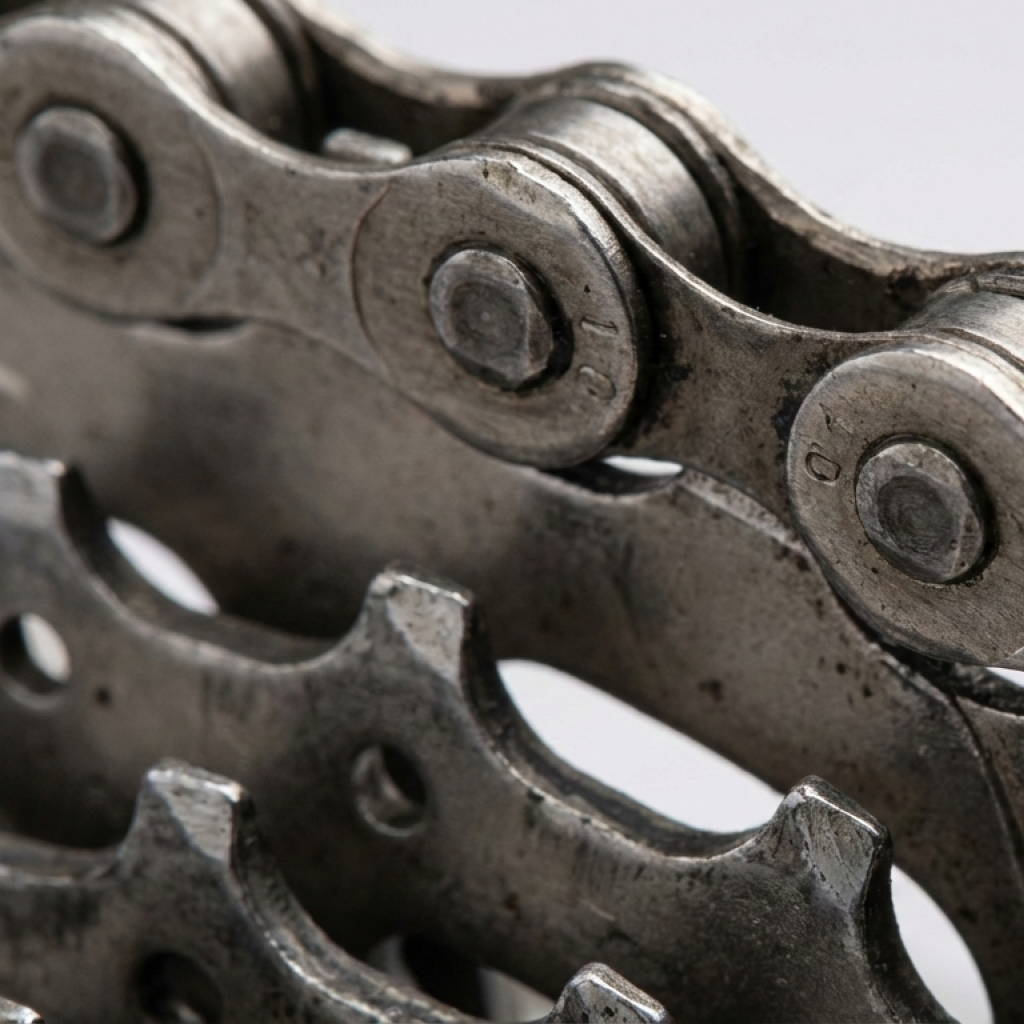
The compounding factor is cassette damage. As the elongated chain wraps around cassette cogs, it no longer seats correctly in the tooth valleys. The hardened steel of the chain begins to grind the softer alloy teeth. This damage is invisible at first, but accelerates rapidly once the chain exceeds 0.75% wear.
Why You Don't Feel It (But Your Strava Times Do)
The human body is remarkably poor at detecting gradual performance degradation. If your chain went from perfect to 0.75% worn overnight, you might notice the difference. But because the degradation happens over hundreds of kilometers, your neuromuscular system adapts. You unconsciously compensate by pushing slightly harder or shifting slightly earlier.
This compensation feels normal because it happens incrementally. What does not feel normal is when you review your Strava data and see that your PR segments are slipping despite consistent training. Or when you compare your power files and realize you are working harder for the same speeds.
The friction tax shows up in data before it shows up in feel.
This is why power meter users and Strava-focused cyclists are often the first to investigate drivetrain efficiency. They have objective metrics that highlight performance discrepancies. But even without power data, you can see this effect in segment times, average speeds, and perceived effort on familiar routes.
WorldTour professional teams understand this intimately. According to Cyclingnews reporting on pro team maintenance practices, teams like Jumbo-Visma and UAE Team Emirates replace chains every 1,500 to 2,000 kilometers, regardless of measured wear. They do not wait for 0.5%. They replace based on distance because they know that even minor efficiency losses matter in races decided by seconds.
For the average performance cyclist, this frequency may not be economically practical. But the principle remains: proactive replacement based on data, not reactive replacement based on symptoms.
The Cascade Effect: From Cheap Chain to Expensive Cassette
A neglected chain does not fail in isolation. As a chain elongates, it no longer sits correctly in the teeth of the cassette and chainrings. This misalignment forces the harder steel of the chain to grind down the softer alloys of the expensive cassette.
The economics are straightforward:
Proactive Replacement (0.5% threshold):
- Chain: $30-$80 every 3,000-5,000 km
- Cassette: $150-$400 every 12,000-20,000 km (replaced after 3-4 chains)
- Chainrings: $80-$200 every 20,000-30,000 km (replaced after 5-6 chains)
Total cost per 15,000 km: Approximately $300-$600 depending on component quality.
Reactive Replacement (wait until skipping):
- Chain: $30-$80 every 4,000-6,000 km (if lucky)
- Cassette: $150-$400 every 6,000-8,000 km (worn chain destroys cassette teeth)
- Chainrings: $80-$200 every 10,000-15,000 km (accelerated wear from misalignment)
Total cost per 15,000 km: Approximately $500-$900, plus the cost of emergency replacements and potential mechanical failures during rides.
The Park Tool guidance is explicit about this cascade:
"Replacing a chain at the correct interval (0.5% for 11/12-speed, 0.75% for 10-speed and lower) extends cassette life by a factor of three to four times. Waiting until the chain skips typically results in cassette replacement at the same time." Park Tool: When to Replace a Chain
This is not speculation. This is documented across hundreds of thousands of real-world drivetrain lifecycles.
The hidden cost is not just the parts. It is the mid-ride failures, the degraded shifting performance, the gradual erosion of confidence in your equipment. It is checking your chain before every long ride because you are not sure if today is the day it finally gives out.
For a performance cyclist with a $3,000 wheelset and a $400 cassette, proactive chain replacement is not maintenance. It is asset protection.
When to Replace: The Standards vs. The Reality
Park Tool provides the industry standard thresholds:
- 11-speed and 12-speed: Replace at 0.5% wear
- 10-speed and lower: Replace at 0.75% wear
- Any chain showing stiff links, corrosion, or visible damage: Replace immediately
These thresholds are not arbitrary. They represent the point where continued use begins to accelerate wear on other drivetrain components. But measuring wear manually requires a chain checker tool, consistent measurement technique, and regular checking intervals.
Most cyclists do not check their chains weekly. They check when they remember, which is often when something feels off. By that point, the chain is frequently beyond 0.75%, and cassette damage has begun.
This is where the gap exists between best practice and common practice.
Professional teams solve this by replacing chains based on distance, not symptoms. A team mechanic tracks every kilometer ridden on every bike and swaps chains preemptively. For a WorldTour rider racing at 300+ watts for hours at a time, the cost of a worn chain (in terms of performance and reliability) far exceeds the cost of frequent replacements.
Zero Friction Cycling's extensive testing supports this approach:
"Premium chains with optimal lubrication can achieve 3,000 to 5,000 kilometers before reaching 0.5% wear under clean, dry conditions. Poor lubrication or contaminated conditions can reduce this to 1,500 to 2,500 kilometers. Automatic tracking based on ride data provides far more accurate replacement timing than manual checking intervals." Zero Friction Cycling: Chain Longevity Data
The reality for most cyclists is somewhere in the middle. You want the proactive protection of distance-based replacement without the manual tracking burden or the need to remember to check your chain every 500 kilometers.
The Hidden Cost Before the Symptoms
The friction tax begins accruing before you know you are paying it. Here is what the typical progression looks like:
0-1,000 km (New Chain):
- Optimal efficiency
- Smooth shifting
- Minimal friction (2-5 watts depending on lubrication)
1,000-2,500 km (Early Wear):
- Wear accumulates but remains below 0.5%
- No noticeable symptoms
- Friction begins increasing (3-6 watts)
2,500-4,000 km (Approaching 0.5%):
- Measurable elongation
- Subtle shifting changes (often attributed to cable stretch)
- Friction tax now 4-7 watts
4,000-6,000 km (0.5% to 0.75%):
- Cassette damage beginning
- Shifting under load becomes less crisp
- Friction tax 5-10 watts
- This is the window where most cyclists finally replace the chain
6,000+ km (Beyond 0.75%):
- Skipping under load (typically on smaller cogs)
- Cassette replacement now required
- Friction tax 10+ watts
- Risk of chain failure increases
The critical insight is that the majority of the performance degradation and component damage occurs between 2,500 and 6,000 kilometers. This is the window where you are paying the friction tax without realizing it.
You might attribute slower times to fatigue, wind, or route conditions. You might blame your power meter calibration or your training block. But the data shows that a significant portion of that performance loss is sitting in your drivetrain.
The solution is not more frequent manual checking. It is automatic tracking that removes the guesswork.
How Componentry Fits Into Your Care Routine
Componentry automates the tracking process that professional teams do manually. Connect your Strava, Garmin, or Wahoo account once, and every ride automatically updates your chain usage. No manual logging. No trying to remember when you last replaced your chain or how many kilometers you have ridden since.
The platform tracks wear by distance, duration, and activity count. When your chain approaches 0.5% wear (or whatever threshold you set), you receive a proactive alert. Not after it starts skipping. Before it damages your cassette.
Here is how it works in practice:
You install a new chain on January 1st and log it in Componentry. You ride 150 kilometers per week. By mid-March, you have 1,800 kilometers on the chain. Componentry shows you are at 60% of expected life. By late April, at 3,200 kilometers, you get an alert: "Chain approaching replacement threshold."
You replace the chain at 3,500 kilometers, well before 0.5% wear. Your cassette remains in perfect condition. Your shifting stays crisp. You never pay the friction tax.
This same logic applies to multiple bikes. Road bike, gravel bike, trainer. Each has its own chain with its own usage pattern. Componentry tracks all of them independently, so you never have to guess which bike needs attention.
The feature set includes:
- Automatic activity sync from Strava, Garmin, Wahoo
- Component-specific tracking for chains, cassettes, chainrings, and more
- Predictive alerts based on your riding patterns and component history
- Dashboard view showing wear status across all your bikes
- Service log to track maintenance history and replacement costs
For cyclists already using Strava to analyze performance, Componentry adds the maintenance layer that has been missing. You track your fitness. Componentry tracks your equipment.
The result is a proactive approach to drivetrain maintenance that protects both your performance and your investment.
If you want to extend the life of your cassette by three to four times, eliminate the guesswork from chain replacement, and stop paying the friction tax, automatic tracking is not optional. It is the difference between reacting to symptoms and preventing damage before it starts.
Recommended Videos & Further Reading
Technical Deep Dives:
Practical Maintenance:
Componentry Resources: