Typical Lifespan Ranges
With that context, here is what cassette longevity actually looks like by material:
Aluminium cassettes (Shimano 105, SRAM Rival, most budget options) use aluminium for the smaller sprockets — the ones that wear fastest. With chains replaced correctly, expect 10,000 to 15,000 km. With chains allowed to run long, that can collapse to 3,000 to 5,000 km.
Mixed-material cassettes (Shimano Ultegra, SRAM Force, equivalents) use steel on the small sprockets that take the most load. Expect 15,000 to 20,000 km with proper chain maintenance. This tier offers the best cost-per-kilometre value for most road and gravel riders.
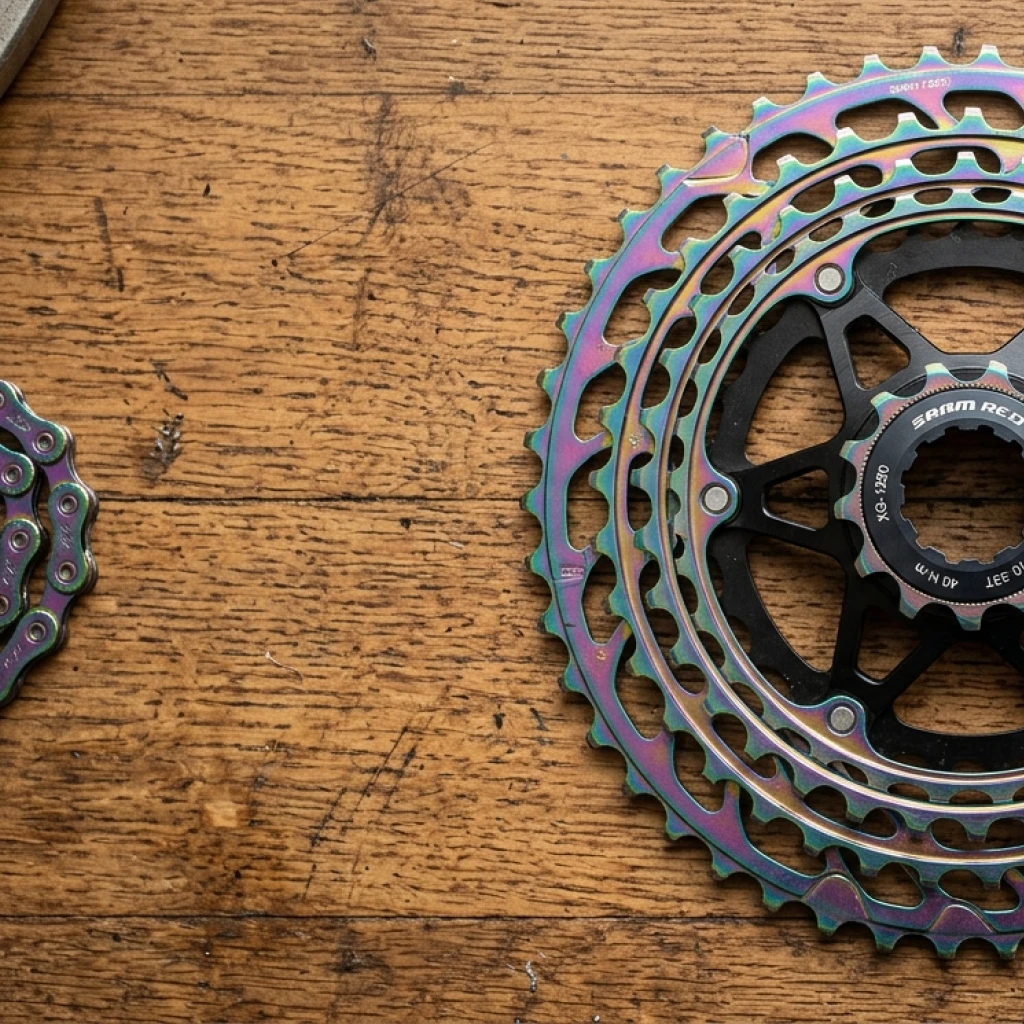
High-end cassettes (Shimano Dura-Ace, SRAM Red, Campagnolo Super Record) use hardened steel or titanium throughout the critical range. With wax lubrication and chains replaced at the 0.5% threshold consistently, 20,000 to 30,000 km is achievable. The same cassette with neglected chains will not outlast the aluminium alternative.
The 3,000–5,000 km floor applies regardless of how much you spent. Material quality cannot overcome the damage done by a worn chain.
The Speed Count Factor
The speed count of your drivetrain also sets the rules of engagement.
11-speed and 12-speed systems pack the cogs tighter. Narrower spacing means the chain has less margin for misalignment before it loads the teeth incorrectly. For 11-speed systems (Shimano and SRAM) and 12-speed Shimano, Park Tool specifies chain replacement at 0.5% wear. SRAM's 12-speed Eagle and AXS use a different chain spec and sets 0.8% as their threshold — follow the manufacturer's own guidance for your system.
9-speed steel cassettes, with their wider spacing and more material per tooth, are more forgiving. They can tolerate chains replaced at the 0.75% mark without the same degree of accelerated wear.
The practical implication: if you run a modern 11 or 12-speed drivetrain, the tolerance for late chain replacement is smaller. The cost of missing the window is higher.
When to Replace a Bike Cassette
Replace a bike cassette once its teeth develop a hooked, shark-fin profile, a new chain skips under load when dropped onto it, or the gears jump intermittently under a hard pedal stroke. Any one of those three signs, covered in detail below, means the cassette has already used up its life against your specific chain history — not against a fixed calendar interval or a mileage figure alone.
Three Signs Your Cassette Needs Replacing
1. Hook-shaped or shark fin teeth
Remove your rear wheel and hold the cassette at eye level. Look along the small sprockets — the 11t, 12t, and 13t teeth — from directly above. A healthy tooth is roughly symmetric on both faces. A worn tooth leans forward in the direction of chain travel, with the leading face rounded or scooped away. The tooth ends up pointed, like a shark fin.
This visual check requires no tools and takes 30 seconds. If the teeth are clearly hooked or asymmetric, replacement is overdue.
2. Chain skipping under load
If your cassette is worn to match an elongated chain, a new chain will skip immediately when you put power through it. This is the most common way cyclists discover cassette wear: they replace the chain, and the cassette now skips on all their favourite gears.
Skipping that appears specifically with a new chain, under load, that resolves when you fit the old chain back on, is confirmation the cassette is past its service life.
3. Jumping under power
Intermittent gear jumping — where the chain drops into the next sprocket under a hard pedal stroke, then returns — is a subtler symptom of worn teeth. It is easy to misattribute to cable tension or derailleur adjustment. If indexing changes fail to fix it, and the cassette has accumulated significant mileage, worn teeth are the more likely cause.
How to Check Cassette Wear
Unlike chains, cassettes have no single-measurement wear tool. Assessment combines three inputs:
Visual inspection is the primary method. The shark fin check described above identifies wear that is already significant. You are looking for asymmetric tooth profiles on the most-used sprockets.
The new chain test is the most reliable confirmation. Drop a new chain onto the suspected sprocket and apply load by pedalling through it. A cassette within serviceable life will engage cleanly. A worn cassette will skip. This test distinguishes a cassette that looks borderline from one that is genuinely past threshold.
Mileage history is the third input. If you know the cassette has accumulated kilometres in the range of its tier's expected lifespan, and tooth profiles are showing early asymmetry, replacement is appropriate even if the wear is not yet severe. Waiting for fully developed shark fin teeth means waiting until damage is already accelerating.
A useful heuristic: the three-chain rule. Replace the cassette after every three chains. Under consistent chain replacement at 0.5% wear, three chains at 3,000 to 5,000 km each covers roughly the expected lifespan of an entry-level cassette. For higher-tier cassettes with longer-lived chains, the arithmetic shifts, but the principle holds: cassette and chain replacement are coupled decisions.
Why Tracking Chain Changes Is the Real Answer
The question cyclists actually want answered when they search "how long does a bike cassette last" is usually one of two things: am I due for a replacement now, or how do I avoid an unexpected replacement later?
Both answers come back to chain maintenance history.
A cassette covered 12,000 km with three carefully replaced chains at 0.5% wear is in a fundamentally different state than one that covered 12,000 km with two chains allowed to run to 0.85% before replacement. The second scenario may have already destroyed the cassette by the time you check it. The first may have years of life remaining.
The problem is that most cyclists cannot reliably recall when they last replaced their chain, how many kilometres ago that was, or whether the chain at installation was at a 0.5% or 0.75% threshold. They check when they remember — which is often after symptoms have already started.
This is the structural gap that tracking your chain changes closes. Knowing the exact distance on your current chain, against the threshold for your drivetrain speed, converts cassette lifespan from an unknown into something you can actively manage. Each timely chain swap is a direct extension of cassette life. Three or four correct chain replacements at scale across a training season can add 10,000 to 15,000 km to a cassette that would otherwise be worn out in a fraction of that distance.
The chain is not a consumable you deal with when it becomes inconvenient. It is the primary maintenance lever for the most expensive components in your drivetrain.
How Componentry Tracks This Automatically
The mechanical logic is straightforward. The practical challenge is remembering to act on it.
Componentry tracks the distance on every component on every bike, updated automatically from each Strava, Garmin, or Wahoo activity. No manual logging. No trying to recall installation dates.
For each bike, you set thresholds for the chain and cassette separately — calibrated to your drivetrain speed, your typical conditions, and the material tier of your cassette. When the chain approaches its replacement threshold, you get an alert. You replace the chain before it begins concentrating load on the cassette teeth. The cassette accumulates correctly maintained kilometres instead of damaged ones.
For riders who own multiple bikes, this matters more than for single-bike households. A gravel cassette accumulating off-road kilometres in abrasive conditions follows a completely different wear curve than a road cassette in dry weather. Componentry tracks each one separately, so you know which bike needs attention next — not just which bike has covered the most total kilometres.
The sign-up takes two minutes. The component thresholds take another five. From there, the app handles the tracking, and you make the replacement decisions on schedule rather than in response to a problem.
Know your cassette's wear state before the new chain tells you. Componentry tracks chain and cassette mileage independently across every bike — syncing automatically from Strava, Garmin, and Wahoo. Set custom thresholds per component and get alerted before the problem appears. Get started free →
Further Reading
Related Componentry Articles:
Technical Reference: