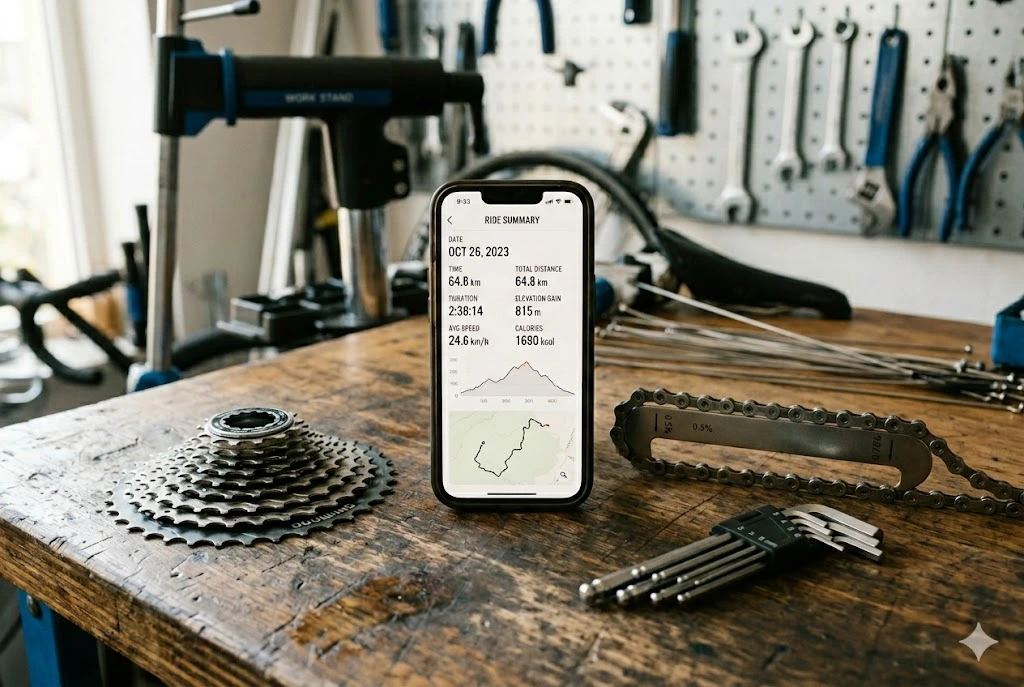
Strava bike maintenance is not something the app was built to do. Strava is exceptional at what it does: recording activities, comparing segments, tracking fitness progression, and connecting you to a community of riders. But when you finish a ride and the app marks it complete, the component wear from that effort — the chain links that elongated a fraction, the brake pad material that vaporised on that descent, the cassette teeth that absorbed thousands of pedal strokes — goes unrecorded. Strava closes the loop on performance. It does not close the loop on the machine that delivered it.
That gap is not a criticism of Strava. It is simply a different job. And it is the exact gap that Componentry was built to fill.
What Strava Tracks — and What It Doesn't
Strava does offer a gear tracking feature. You can assign a bike to activities, and the app accumulates total kilometres on that bike. For many riders, this is good enough as a rough guide to when a service might be due.
But total bike kilometres is not the same as component-level wear tracking. A bike is not one thing that wears uniformly. Your chain, cassette, chainrings, brake pads, Di2 or AXS battery, bar tape, tyres, and drivetrain lubricant all wear at different rates, have different replacement thresholds, and cost different amounts to neglect.
Strava's gear tracking cannot tell you:
- Which components are on which bike (just the bike name)
- How much wear each individual component has accumulated
- When a specific component approaches its replacement threshold
- What happens to your cassette when your chain is 400km overdue for replacement
- That the chain currently on your gravel bike has been on three different bikes and has 6,400km on it
These are not edge cases for obsessive mechanics. They are the information any cyclist needs to maintain their equipment proactively rather than reactively.
The practical evidence that Strava's maintenance layer is insufficient is everywhere in cycling communities. Riders who use Strava daily still maintain maintenance logs in spreadsheets, notebooks, or phone reminders. The workarounds people build around Strava's limitations are the demand signal that Componentry addresses directly.
How Strava Data Becomes Component Wear Data
When you connect your Strava account to Componentry, the integration reads your activity data and does something Strava does not: it allocates the distance and duration of each ride to every component currently installed on the bike you rode.
The data flow works like this. Strava records an activity — 85km on your road bike. Componentry reads that activity via the Strava API, identifies which of your Componentry bikes was used based on the bike assignment in Strava, and credits all 85km to the current component list for that bike. Your chain ticks 85km closer to its replacement threshold. Your cassette, brake pads, tyres, and bar tape do the same. Your Di2 or AXS battery adds 85km (and approximately 3–4 hours of ride time) toward its charging reminder.
This happens automatically, every time you ride, without any manual input after the initial setup. You log the ride in Strava as you always have. Componentry handles the maintenance ledger.
What Componentry Reads from Each Activity
The integration draws on more than just distance. For each activity synced from Strava, Componentry uses:
Distance — to increment mileage-based wear counters on chains, cassettes, tyres, brake pads, and drivetrain components.
Duration — to track time-based intervals such as lubricant re-application schedules and electronic shifting battery consumption. A 6-hour gravel epic in wet conditions consumes brake pad material and drivetrain lubricant at a different rate than an equivalent distance on dry tarmac.
Ride date — to enable calendar-triggered reminders for services that are better measured in time than mileage: hydraulic brake bleeds, suspension service, cable replacement.
Bike assignment — to route mileage to the correct set of components when you own multiple bikes. This is the feature that multi-bike Strava users discover changes everything: no more guessing which chain has what mileage because you rode three bikes this month.
The Components That Benefit Most
All components tracked in Componentry benefit from automatic Strava data. But three categories see the most immediate value.
Drivetrain: Chain, Cassette, Chainrings
The drivetrain is where neglect is most expensive and where precise mileage tracking matters most. Park Tool defines the chain replacement threshold at 0.5% elongation for 11-speed and 12-speed systems, and 0.75% for 9/10-speed. Typical road chain lifespan runs 2,000–3,000km on a well-lubricated drivetrain; gravel and mountain riding can reduce this to 1,500km or less.
The cost of missing this threshold is asymmetric. A chain costs £20–£50. A cassette costs £50–£400. According to SILCA's friction research, a worn chain also costs you 5–10 watts of power output before it starts skipping — a performance penalty most riders never attribute to their drivetrain.
Componentry alerts you when your chain approaches its replacement threshold so you replace it before the damage reaches your cassette. That is the single most cost-effective intervention in cycling maintenance, and it requires knowing exactly how many kilometres are on your chain — which is exactly what Strava-linked tracking provides.
For waxed-chain users rotating three or four chains per bike, the value compounds. Each chain in rotation has its own mileage counter. Componentry tracks which chain is currently installed and which are in the freezer, so every rewax and re-installation is logged without mental arithmetic.
Electronic Shifting Batteries: Di2, AXS, EPS
A dead electronic shifting battery mid-ride is inconvenient. Before a race, it is a potential DNS. Battery capacity degrades gradually over charging cycles and accelerates in cold weather. Most riders have no systematic way to track how much capacity remains until the indicator warns them.
Componentry tracks each battery's ride-time accumulation and prompts a charge reminder based on your riding patterns. Combined with Strava's activity data — which includes duration that correlates with battery consumption rate — the system builds a more accurate picture of battery health than checking the indicator light once a month.
For triathletes and endurance riders who have experienced an electronic shifting failure before a major event, a mileage-based reminder backed by automatic activity sync is the difference between knowing and guessing. As the Di2 battery life guide covers in full, the risk is real and the tracking solution is straightforward.
Brake Pads
Brake pad wear is highly variable by terrain and conditions. A rider accumulating the same annual kilometres on flat terrain versus Alpine descents can have brake pads that last three times as long. Tracking total bike kilometres does not help here — it dilutes the wear signal by treating a flat century and a 4,000-metre mountain stage as equivalent.
Componentry's duration tracking, combined with component-specific service history, gives a more accurate picture of pad consumption than raw mileage. The system does not replace a physical thickness check, but it tells you when to do that check rather than leaving it to chance.
Why Strava's Built-In Gear Tracking Isn't Enough
It is worth being direct about the specific limitations of Strava's existing feature, because "Strava already does this" is the most common objection from Strava power users.
| Feature | Strava Gear | Componentry |
|---|---|---|
| Total bike mileage | ✅ | ✅ |
| Per-component mileage | ❌ | ✅ |
| Wear threshold alerts | ❌ | ✅ |
| Multiple chains on one bike | ❌ | ✅ |
| Component swap between bikes | ❌ | ✅ |
| Cassette wear from chain history | ❌ | ✅ |
| Battery tracking (Di2/AXS) | ❌ | ✅ |
Strava tracks whether you rode. Componentry tracks what that riding costs your components, and tells you what to do before the next ride.
The comparison is not competitive — the tools are complementary. Strava remains the activity layer. Componentry is the maintenance layer that sits on top of it.
Step-by-Step: How to Connect Strava to Componentry
Setup takes under five minutes and requires no configuration after the initial connection.
Step 1: Create your Componentry account Sign up at the Componentry app. The free trial gives you full access to test the integration with your actual ride history.
Step 2: Add your bikes Create a bike profile for each bike you ride. Include the bike's name as it appears in your Strava gear list — the integration uses this to match activities to the correct bike.
Step 3: Add components to each bike Set up the components you want to track: chain (with current mileage if you know it), cassette, brake pads, Di2 or AXS batteries, tyres. If you don't know current mileage, start from zero — you'll have accurate data going forward within a few weeks.
Step 4: Connect Strava In Componentry's settings, select "Connect Strava" and authorise the integration. Componentry requests read-only access to your activities and gear data. It does not modify your Strava data.
Step 5: Sync recent history On first connection, Componentry will offer to sync your recent ride history. This populates your component wear counters immediately rather than starting from zero.
After this point, every Strava activity automatically updates your component wear state. You ride, Strava records it, Componentry tracks what it costs your components.
Multi-Bike Strava Users: Where the Integration Pays Back Most
If you ride one bike, the Strava integration saves you the friction of manual mileage logging. If you ride two or more bikes, it changes the quality of the information you have entirely.
Multi-bike Strava users frequently report the same problem: which chain is on which bike, which chainrings have the most mileage, whether the cassette that moved from the road bike to the gravel bike three months ago has life left. These are not small questions — the cost of getting them wrong is a cassette that fails because a chain continued running on it for 3,000km past its threshold with no one tracking the total.
Componentry handles cross-bike component transfers explicitly. When you move a component from one bike to another, you record the transfer in the app. The component's accumulated mileage follows it to the new bike. Strava continues recording activities on the correct bike; Componentry routes those kilometres to the correct components on that bike. The ledger stays clean regardless of how many bikes you own or how often you rotate parts between them.
Know Your Bike's State After Every Ride
The fundamental promise of Strava bike maintenance via Componentry is this: after every ride, you know the current state of every component on the bike you just rode, without doing anything differently from what you already do.
Your chain mileage is updated. Your cassette wear is current. Your brake pads have accurate ride time against them. Your Di2 battery has the latest consumption logged. If anything has crossed its threshold or is approaching it, you get an alert. If everything is fine, the app confirms it.
That is what "know your bike, down to the individual component" means in practice. It is not a passive data library. It is an active maintenance state that updates with every ride you log in Strava.
Connect your Strava account and start your free trial →
Further Reading
- Componentry vs Strava Gear Tracking: The Full Comparison
- When to Replace Your Bike Chain: The Complete Guide
- Cassette Lifespan: How Many Kilometres Before You Need to Replace It?
- The Chain-Stretch Domino Effect: How One Worn Chain Destroys a $600 Drivetrain
- Di2 Battery Life: How to Track, Extend, and Never Get Caught Dead on a Climb