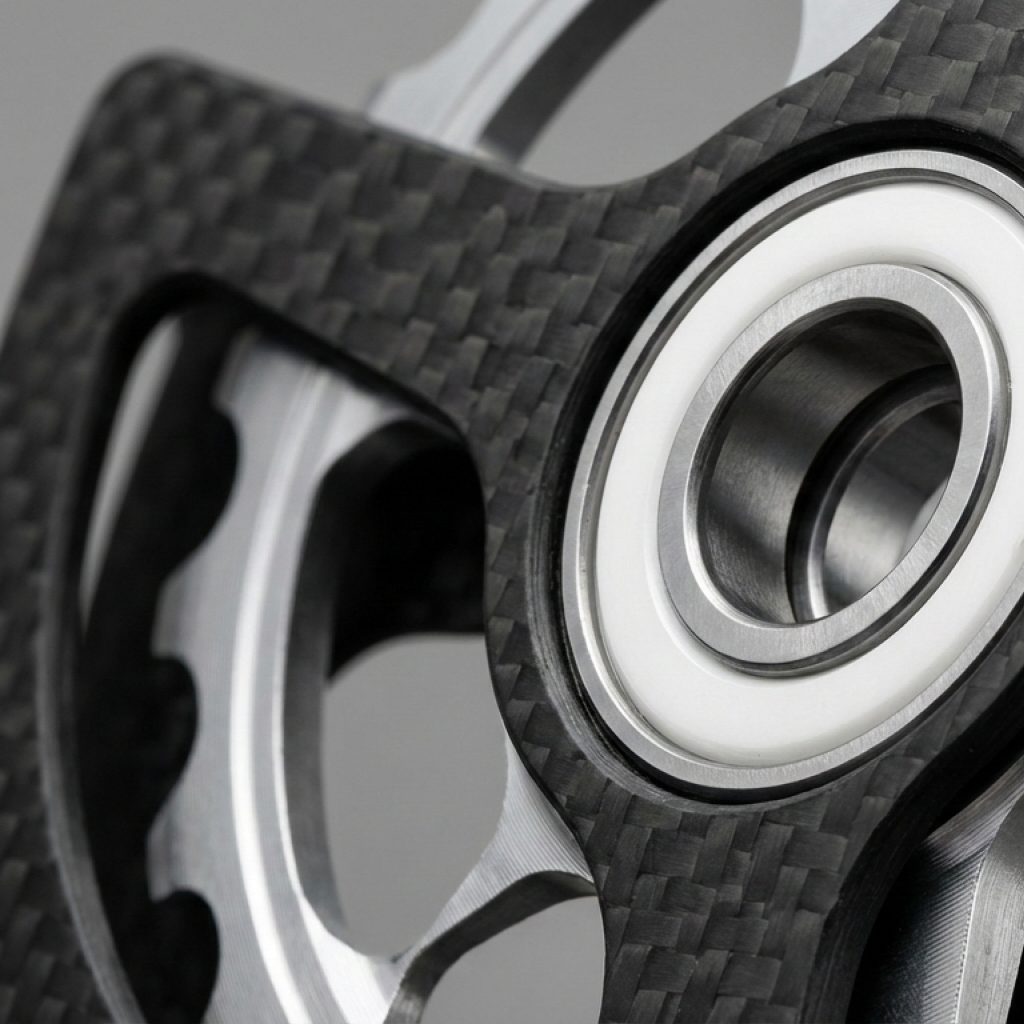


Your $600 oversized pulley wheel system is wearing out right now. You cannot see it. You cannot feel it. And by the time you do, the damage is already done. This is the hidden challenge of ceramic bearing maintenance for OSPW systems.
You invested in ceramic bearings for marginal gains, reduced friction, and that satisfying mechanical precision. But unlike a chain that elongates measurably or brake pads that visibly thin, these bearings degrade in silence. There is no wear indicator. No stretch gauge. No visual cue that tells you the ceramic bearing maintenance window is closing.
The result is predictable. Most cyclists service their OSPW systems reactively, after hearing grinding or feeling drag. At that point, a $30 bearing service becomes a $200 bearing replacement. The efficiency gains you paid for have been eroding for thousands of kilometers.
This post examines why ceramic bearing maintenance is so often neglected, what the actual service intervals should be, and how to protect your investment before problems become audible.
The Invisible Maintenance Window
Chains have a measurable wear indicator. At 0.5% elongation, you replace them. Brake pads have visual grooves that disappear with use. Tires show tread wear. These components tell you when they need attention.
Ceramic bearings do not.
The degradation happens inside the sealed housing. Grease breaks down over time. Microscopic contamination works past seals. Corrosion begins on steel races even while the silicon nitride balls remain pristine. By the time you hear a sound or feel roughness, the internal surfaces have already been compromised.
CeramicSpeed provides explicit guidance on service intervals:
"Service interval: 5,000-8,000 km (3,000-5,000 miles) or yearly for normal conditions. Extended maintenance: Every 6 months (or 3,000 km/1,800 miles) in extreme conditions." CeramicSpeed OSPW Maintenance
The challenge is that these intervals depend on conditions you cannot easily quantify. What counts as "extreme"? Wet winter rides? Gravel racing? Trainer sessions with sweat dripping onto the derailleur? The answer varies, which means most riders either service too early (wasting money) or too late (causing damage).
The pulley wheel bearing is the fastest revolving bearing on the bike. According to Zero Friction Cycling's technical analysis, this means contamination and wear accumulate faster here than anywhere else on the drivetrain. It is also the bearing most exposed to road spray, chain lube fling-off, and environmental debris.
Signs Your OSPW Bearings Need Attention
Before we discuss prevention, know the warning signs. These indicate that the maintenance window has already closed:
Audible indicators:
- Grinding or clicking when the derailleur is under load
- Uneven spinning sound when rotating the pulleys by hand
- Any noise that was not there when the system was new
Tactile indicators:
- Gritty feel when spinning pulleys manually (should be silky smooth)
- Noticeable resistance or "notchiness" in rotation
- Play or looseness in the pulley axle
Performance indicators:
- Increased drivetrain noise during quiet efforts
- Slight drag sensation that appeared gradually
- Shifting hesitation that is not explained by cable tension
Kogel Bearings, which manufactures competing OSPW systems and aftermarket ceramic bearings, explains the failure progression:
"Corrosion causes 90% of bearing failures. Contamination is an easy fix with a bearing service and a new seal kit if caught early." Kogel Bearings
The critical phrase is "if caught early." Once corrosion pits the steel races or contamination grinds into bearing surfaces, cleaning and regreasing will not restore original performance. The bearing needs replacement.
The Service Interval Reality
Here is what manufacturers actually recommend:
CeramicSpeed: 5,000-8,000 km for normal conditions, 3,000 km for extreme conditions. Their industry guide notes that CeramicSpeed bearings last 4-8x longer than standard bearings with proper maintenance.
CyclingCeramic: Service at least twice per year, and after any particularly dirty rides. They specifically warn against high-pressure water that can force debris past seals.
"Avoid high-pressure water and air that forces debris into bearings. Service at least twice a year, or after grotty conditions." CyclingCeramic
Park Tool: Their guidance confirms that ceramic bearing maintenance for cycling is accessible, not exotic:
"No special procedure or process for servicing ceramic bearings. Install bearings fully covered with grease." Park Tool
The professional mechanic approach is straightforward: service by mileage, not by symptoms. A team mechanic logs every kilometer on every component and services before problems appear. Most recreational cyclists do not have that infrastructure. They rely on memory (unreliable), calendar reminders (disconnected from actual usage), or waiting until something feels wrong (too late).
The Cost of Missed Maintenance
The economics are clear. A bearing service kit costs approximately $30. Replacement bearings for an OSPW system cost $150-$250. A complete pulley replacement runs $200-$400 depending on the system.
But the cost is not limited to the bearings themselves. CeramicSpeed's maintenance documentation explicitly warns:
"A worn chain will increase the wear on the pulley wheels significantly." CeramicSpeed OSPW Maintenance
This creates a cascade. Worn bearings increase friction. Increased friction accelerates chain wear. Worn chain damages pulley teeth. Damaged pulleys cannot be fixed with new bearings. What started as a $30 service becomes a $600 system replacement.
For a rider putting in 8,000 kilometers per year, the math works out simply:
Proactive approach (service at 5,000-6,000 km):
- One bearing service per year: $30
- Bearing replacement every 3-4 years: $200
- System replacement every 6-8 years: $600
- Annual cost: approximately $120
Reactive approach (wait for symptoms):
- No service until grinding appears
- Bearing replacement every 18-24 months: $200
- Accelerated pulley wear requiring system replacement every 3-4 years: $600
- Annual cost: approximately $280
The proactive approach costs less than half over time. And it maintains the efficiency you paid for. A well-maintained OSPW system delivers its advertised friction savings. A neglected one may actually increase drivetrain friction compared to a standard pulley setup.
Mileage-Based Triggers vs Calendar-Based
Neither approach works in isolation.
Calendar-based reminders fail high-mileage riders. If you ride 12,000 kilometers per year, a twice-yearly service means 6,000 kilometers between maintenance. That is already at the upper limit of normal service intervals and well beyond the threshold for extreme conditions.
Calendar-based also fails low-mileage riders, but differently. Grease degrades over time even without use. Seals dry out. Corrosion progresses. A rider who covers 3,000 kilometers per year but only services annually may find degraded bearings despite low accumulated mileage.
Mileage-based tracking addresses the first problem. It accounts for how much you actually ride. But it cannot account for conditions without additional data.
The ideal approach combines both: mileage tracking with condition awareness. If you logged 2,000 kilometers in wet winter conditions, that counts differently than 2,000 kilometers of dry summer riding. A proper maintenance system should account for both distance and context.
How Componentry Fits Into Your Care Routine
Componentry automates the mileage tracking that makes proactive ceramic bearing maintenance possible for OSPW systems. Connect your Strava, Garmin, or Wahoo account once, and every ride automatically updates your component usage. No manual entry. No spreadsheets. No trying to remember when you installed those CeramicSpeed pulleys.
The platform tracks each component independently. Your road bike OSPW system has its own service counter. Your gravel bike pulleys have their own. When either approaches the 5,000-kilometer threshold (or whatever interval you set based on your conditions), you receive a proactive alert.
Here is how it works in practice:
You install a new OSPW system and log it in Componentry on January 1st. You ride 200 kilometers per week. By mid-May, you have covered 4,000 kilometers. Componentry shows you are at 80% of your configured service interval. By early June, at 4,800 kilometers, you receive an alert: "OSPW bearings approaching service threshold."
You order a seal kit and schedule 30 minutes for maintenance. The bearings get fresh grease before any grinding starts. Your efficiency stays where it should be. The pulleys last their full lifespan.
The feature set includes:
- Automatic activity sync from Strava, Garmin, Wahoo
- Component-specific tracking for OSPW systems, chains, cassettes, and more
- Custom service intervals based on your conditions and manufacturer recommendations
- Proactive alerts before the maintenance window closes
- Multi-bike dashboard showing wear status across your entire stable
- Service log to track maintenance history and costs
For cyclists who already track every watt and every gram, Componentry adds the maintenance layer that protects those investments. You track your fitness. Componentry tracks your equipment.
Recommended Videos & Further Reading
Manufacturer Resources:
- CeramicSpeed OSPW Maintenance - Official service intervals, procedures, and torque specifications
- CeramicSpeed Ultimate Guide to Bearing Maintenance - Comprehensive bearing care from the industry leader
- CyclingCeramic Jockey Wheel Service - Alternative brand perspective with specific maintenance warnings
Technical Deep Dives:
- Park Tool: Ceramic Bearings - Accessible guidance proving ceramic maintenance is not exotic
- Kogel Bearings: Problems with Ceramic Bearings - Honest analysis of failure modes and prevention
- Zero Friction Cycling: Hybrid Ceramic vs Steel Bearings - Independent testing and technical analysis
Componentry Resources:
- Drivetrain Efficiency: Why Your $1,000 Cassette Requires 0.5% Precision - The chain wear thresholds that protect premium components
- The Friction Tax: How Drivetrain Efficiency Costs You Watts - The performance cost of worn components