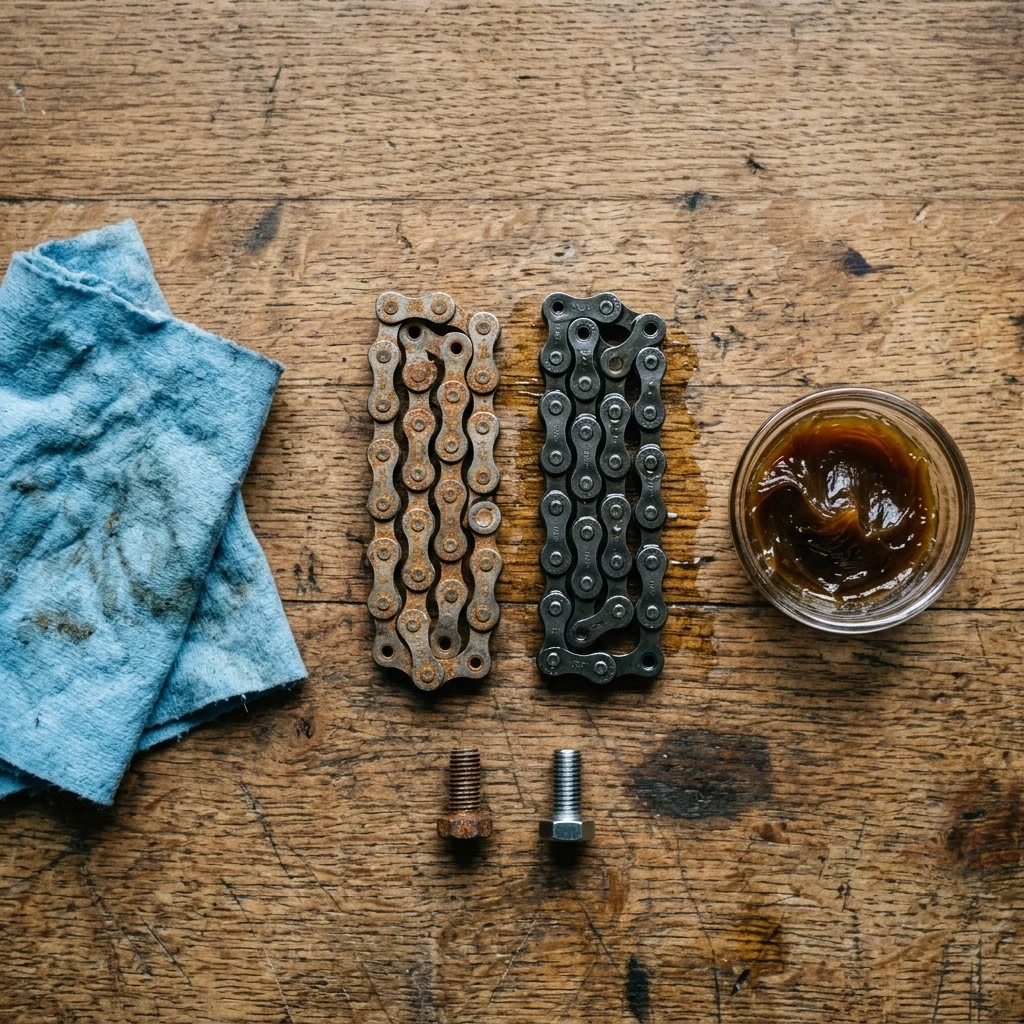
How to Prevent Bike Rust: The Routine
Most of the work is washing and drying. The Polygon Bikes rust guide, published in April 2026, and Park Tool's cleaning advice agree on the core steps.
- Rinse after wet or salty rides. Use a water bottle, or a hose on low pressure with a wide spray, and work from the top of the bike down. Park Tool gives this method in its bike washing guide. Polygon says to rinse the drivetrain, brakes and the underside of the frame after winter rides to remove salt.
- Dry the bike by hand. Park Tool recommends a towel because it also lets you look over the frame and parts. Polygon adds the hidden spots: the bottom bracket area, the seatpost and bolt heads.
- Do not blast the bearings. Park Tool warns against pointing compressed air straight at bearings. Dry around them instead.
- Dry the chain, then lubricate it. Run the chain through a clean dry rag first. Park Tool uses one drop of lubricant per link. Use a wet lube in rain and winter, then wipe off the excess so it does not hold grit.
- Treat bolts, derailleurs and cable ends. Polygon suggests a light oil or an anti-corrosion spray. Tern names Boeshield, GT85 and Fluid Film as examples. Keep spray off the brake rotors and pads.
- Touch up chipped paint. Tern's advice is to cover chips right away so rust does not creep under the paint.
Do not rely on a penetrating oil such as WD-40 as your chain lube. Park Tool says it is not ideal for regular chain lubrication.
Protect a Steel Frame From the Inside
A steel frame can rust from the inside while the paint looks perfect. Water gets in through the seat tube and the bottom bracket shell, and it has nowhere to go.
Surly suggests coating the tube interiors with a rust inhibitor such as Frame Saver, motor fogging oil or boiled linseed oil. Seven Cycles recommends reapplying an inhibitor inside the frame at least once a season, and more often if you ride in the wet. That interval is one maker's advice. Not every maker gives one, so check your frame maker's care page.
The easiest time to treat a frame is when it is stripped. On a built bike, ask a shop to do it, or follow the product's own instructions and let the frame drain before you ride.
Stop the Seatpost and Stem From Seizing
A seized seatpost is corrosion too, but it is galvanic, not rust. Park Tool's guide to seized seatposts and stems says an aluminium post in a steel frame bonds through an exchange of ions between the two metals. It names the same risk for aluminium in carbon, and for carbon in steel or aluminium.
The fix is a barrier between the two surfaces:
- Grease or anti-seize on a metal post. Park Tool says anti-seize is more resistant to water and corrosion than grease. Its lubricant guide says to apply it to the inside of the seat tube, not to the post.
- Carbon assembly compound on a carbon post. Park Tool names SAC-2 for carbon seatposts as the exception to the grease rule.
- No grease on the stem clamp. Park Tool says grease should not be used between the stem and the handlebars, or between the steerer and the stem on threadless systems. Also keep grease off disc rotor bolts, where it can creep and contaminate the brake.
Park Tool says to remove the post occasionally, clean the surfaces and apply fresh lubricant. It gives no interval. A yearly look when you service the bike is a reasonable habit, but that is our suggestion, not a maker figure.
Store the Bike Dry to Prevent Rust
Where the bike sleeps matters as much as how you wash it. Polygon's storage advice:
- Keep the bike indoors in a dry room with a stable temperature.
- Do not leave it outside overnight, even under a cover, because dew and humidity speed up corrosion.
- If you must cover it, use a light, breathable cover. A tight plastic sheet traps moisture.
- In a damp garage or shed, use silica gel packs or a small dehumidifier.
Do bike covers prevent rust? A breathable cover keeps rain and snow off, which helps. A sealed one can cause the condensation you are trying to avoid.
Can You Stop Rust Once It Starts?
Light surface rust on a chain, bolt or rotor is mostly cosmetic if you catch it early. Wipe it off, dry the part, and protect it. Rust that makes chain links stiff is different, because a stiff chain wears itself and the cassette faster. Check it with a chain wear gauge and replace it at the wear limit in our chain replacement guide.
Treat these as stop and replace signs:
- Rust that has pitted a bolt head or thread.
- A seized seatpost or stem you cannot free by hand.
- Rust bubbling through the paint on a steel frame. Have a frame builder or a shop look at it.
- A brake rotor with deep corrosion on the braking surface. Check the maker's wear limit.
Do not scrub a steel frame hard to remove rust. One forum thread on rust removal warns that removing rust also removes steel, which thins the tube. That is a forum opinion, so ask a frame builder before you try it.
How Componentry Helps You Track Rust-Prevention Jobs
Componentry cannot see rust. It tracks what you can measure: the distance and ride time from every Strava, Garmin or Wahoo ride, and the calendar time since you last did a job. That covers the chain, which is the part rust hurts most through wear, and it covers the jobs that run on a calendar.
Set reminders for the jobs in this guide:
- A chain lube or re-wax reminder by distance, with a shorter interval for wet winters.
- A yearly reminder to pull the seatpost, clean it and regrease the seat tube.
- A seasonal reminder to treat the inside of a steel frame.
- A reminder to check bolts and cable ends before the wet season starts.
Log each job when you do it and the counter resets. If you ride in salt or live near the coast, set the intervals shorter than a dry-climate rider would. Your service history then shows when each protective job was done, which also helps when you sell the bike.
Related Componentry guides:
Sources: