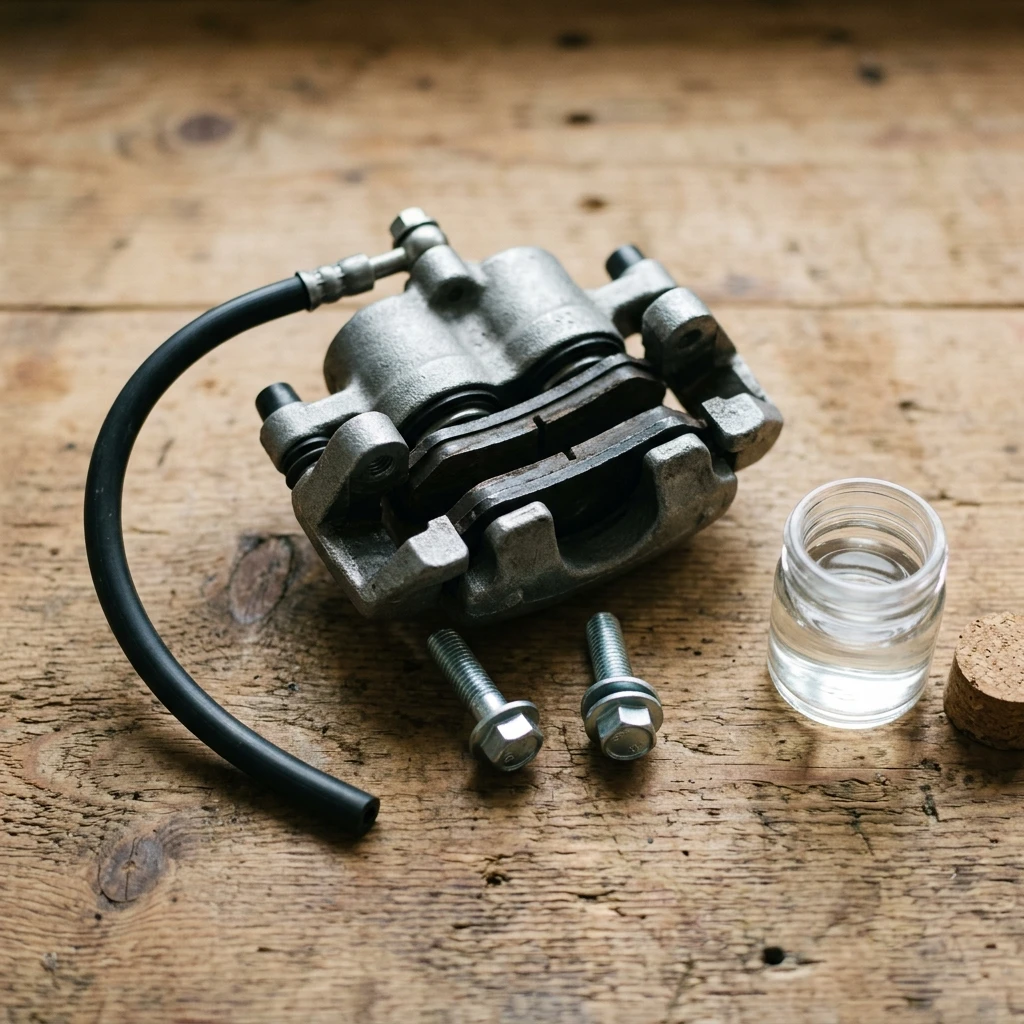
Two Fluids, and They Are Not Interchangeable
Before anything else: check which fluid your brakes actually use, because this is a safety issue, not a preference.
Shimano hydraulic disc brakes use mineral oil exclusively, as do Magura, Tektro and TRP. SRAM, Hope and Hayes use DOT fluid (DOT 4 or DOT 5.1). These two fluids are chemically incompatible. Putting DOT fluid into a mineral-oil system, or mineral oil into a DOT system, damages the internal seals and can cause a complete loss of braking power. SRAM says a brake must be replaced if it is contaminated with mineral oil or DOT 5 fluid, so in the worst case you are replacing the lever and caliper, not just re-bleeding the system. Never assume, and never substitute one for the other because it's what you have on the shelf.
The difference matters beyond compatibility, too. Mineral oil doesn't absorb water from the air, which is why Shimano systems tend to go longer between bleeds. DOT fluid is hygroscopic: it starts absorbing moisture the moment its container is opened. That is why BikeRadar recommends buying small quantities, such as 100ml, which it says should be good for two to three bleeds.
Which Brake Brands Use Which Fluid
| Brand | Fluid | Maker source |
|---|
| Shimano | Mineral oil | Shimano says to use only its own mineral oil (per BikeRadar) |
| SRAM | DOT 5.1, or DOT 4 | Guide and Level service manuals: "Do not use mineral oil or DOT 5 fluid" |
| Magura | Mineral oil (Royal Blood) | MT manual: never use DOT brake fluid |
| Hope | DOT 5.1, or DOT 4 | Tech 4 bleed instructions |
| Hayes | DOT 5.1 | Dominion A4 product page |
| Tektro and TRP | Mineral oil | TRP's page lists its mineral oil for all TRP and Tektro systems |
| Campagnolo | Its own supplied oil, a mineral oil | Retailer listings say to use Campagnolo's own oil. We could not open a Campagnolo manual, so confirm in the manual for your brake |
| Trickstuff | Bionol, a vegetable-oil based fluid | Trickstuff technical page, which compares Bionol's boiling range with DOT fluids; check it for your brake |
SRAM also lists a separate mineral oil bleed manual for some of its older SRAM and Avid brakes without naming the models, so a brand name is not enough. We could not confirm the fluid for Formula from a document we could open. Check your own brake's manual before you buy fluid. Sources: SRAM Guide RS and R service manual, SRAM bleed manuals, Magura MT manual, Hope Tech 4 bleed instructions, Hayes Dominion A4, TRP mineral oil, Trickstuff: heat resistance, BikeRadar: brake fluid.
Why DOT Fluid Ages: Water and Boiling Point
DOT fluid is hygroscopic, so it draws moisture from the air, and water lowers its boiling point. The US standard for brake fluid, FMVSS 116, sets minimum boiling points when the fluid is dry and after it has absorbed water.
| DOT grade | Minimum dry boiling point | Minimum wet boiling point |
|---|
| DOT 4 | 230 °C | 155 °C |
| DOT 5 (the row also covers non-silicone DOT 5.1) | 260 °C | 180 °C |
Source: 49 CFR 571.116. The standard sets no separate figure for DOT 5.1; it labels the non-silicone version of the DOT 5 row as DOT 5.1. BIKE magazin puts mineral oil at about 190 °C. These are minimums for the fluid, not measurements of your brake. DOT 5 itself is silicone based and is not used in bicycle brakes, and SRAM says never to use it in its brakes.
How to Tell It's Time (Without a Calendar)
There's no odometer for brake fluid, which is why the intervals above are only a baseline. The most reliable guidance points to condition and feel over any fixed schedule. Shorter intervals suit aggressive riding, demanding terrain, or heavy braking, and it is worth checking the interval your own brake maker publishes.
Between scheduled bleeds, the lever itself is a better signal than the calendar. A lever that feels spongy or soft when you squeeze it, rather than firm, is the clearest sign. So is a lever that travels noticeably further before the brake actually bites, or one that pulls closer to the handlebar than it used to even after the pads have been adjusted. Each of these points to air in the system, degraded fluid, or both. None of them wait politely for your annual service date to show up.
Fluid itself also degrades in a way you can see, if you happen to see it during a bleed. It picks up dirt and moisture over time and turns visibly darker than fresh fluid straight from the bottle. If you're already mid-bleed and the old fluid coming out looks noticeably discolored, take that as confirmation the interval was overdue rather than a reason to stop early.
Doing the Bleed: What Actually Differs Between Systems
The mechanics of a Shimano bleed and a SRAM bleed follow the same broad shape, connect a reservoir at the lever, open the caliper, push fluid through until the old fluid and air bubbles are gone, but a few details are specific to each system and worth getting right.
On Shimano systems, check the service instructions for your model about fluid handling. Shimano's PDF blocked our automated check, so we could not confirm its wording on reusing oil. As general practice, use oil from a freshly opened container: oil that has already been drained from the bleed nipple may have absorbed water, and reintroducing it works against the purpose of a bleed. Park Tool's Shimano procedure says to squeeze the lever gently and not to let the funnel run out of fluid, because air gets in if it does. We found no Shimano or Park Tool statement about pumping the lever, so follow your model's instructions.
On SRAM systems, using DOT 4 or DOT 5.1 fluid (check your specific model's spec) is the whole ballgame; any other fluid risks the same seal damage described above. SRAM publishes bleed manuals for hose shortening and full bleeds through its official service documentation, with procedure details specific to each brake model.
If any of this sounds like more than you want to take on yourself, a shop bleed is a reasonable job to hand off even if you do most of your other maintenance at home.
What a Home Bleed Actually Requires
If you decide to do it yourself, hydraulic brake maintenance doesn't need a full workshop. The core kit is small: a bleed kit matched to your specific brake model and fluid type (Park Tool says never to share bleed kits between DOT fluid and mineral oil systems), the correct fluid for your system in a sealed, unopened container, a way to keep the bike stable while you work, and something to catch drips, since DOT fluid can damage paint on contact (see the paint note below).
What you don't need is guesswork about which fluid goes where. That single check, mineral oil for Shimano, DOT for nearly everyone else, is worth confirming against your specific brake model before you buy anything, since the wrong purchase is money spent on fluid you can't safely use.
How Much Brake Fluid Do You Need to Bleed Bike Brakes?
Less than most people expect. Epic Bleed Solutions, a bleed-kit retailer, says "50ml of brake fluid is enough to perform a bleed on one set of cycle brakes (front and rear)," and that a 100ml bottle is enough to bleed a complete set of brakes two to three times. BikeRadar gives the same 100ml, two to three bleeds figure. Both are rough rules of thumb, and your kit's instructions come first.
The exception is a neglected system. If the old fluid is dirty or dark, Epic recommends flushing it out completely, which can take more than the standard amount, so buy the full 100ml if the brakes have not been bled in a long time.
The Bleed Procedure: What the Steps Look Like
Shimano's own service instructions are the reference for a Shimano bleed, and SRAM's manuals for a SRAM bleed. We could not open Shimano's current PDFs when writing this update, so the outline below follows Park Tool's published procedures. It shows the shape of the job and does not replace your brake's manual.
Park Tool's Shimano mineral oil procedure is split into four sections: preliminary information, bleed kit preparation, the bleeding procedure and bicycle preparation. In outline it covers setup, removing the wheel, prepare the caliper with the pads out and a bleed block in, expose the bleed nipple, fit the funnel, prepare the syringe, push fluid through, close and refill (discarding dirty fluid), drain downward, close and pressurize, finalize the caliper, burp the lever, close the lever port, then clean and reassemble. Source: Park Tool: How to Bleed Shimano Flat Bar Hydraulic Brakes.
Park Tool's SRAM procedure has six parts: preliminary information, bicycle prep, bleed kit prep, bleeding, resetting the bicycle, and cleaning the kit. Source: Park Tool: Brake Bleeding for SRAM Bleeding Edge Hydraulic Brakes.
Mistakes That Ruin a Bleed
- The wrong fluid: Park Tool says never to put DOT in a mineral oil brake or the reverse, and not to share kits between the two. SRAM says a brake contaminated with mineral oil or DOT 5 must be replaced.
- Fluid on the pads: SRAM says any brake fluid on the pads contaminates them and they must be replaced. Magura says never to use contaminated pads, even after cleaning. Park Tool takes the pads out for the whole bleed.
- Bleeding without the pads or a bleed block: Hope warns that pistons can come out. Magura warns that pulling the lever with the wheel and pads removed causes oil loss and damage.
- Letting the funnel run dry: Park Tool notes that air gets in.
- Pulling the syringe too hard: Park Tool's SRAM procedure says this draws air.
- Fluid on paint: SRAM, Hope and Park Tool all say DOT is corrosive and damages painted surfaces. Wipe spills at once.
- The wrong cleaner: makers disagree. SRAM and Park Tool use isopropyl alcohol on parts, while Trickstuff warns that brake cleaner and isopropyl can contaminate pads. Follow your maker.
Brake Fluid Questions
How often should I bleed my bike brakes? SRAM's figure is once a year for DOT and every two years for mineral oil. Hope says no more than once a year should be needed. Bleed sooner if the lever feels spongy.
Which fluid does my brake use? Shimano, Magura, Tektro and TRP use mineral oil. SRAM, Hope and Hayes use DOT 4 or DOT 5.1. Check your brake's manual, because some brakes are exceptions.
Can I mix mineral oil and DOT fluid? No. SRAM says a brake contaminated with mineral oil or DOT 5 must be replaced, and Park Tool says never to put one in the other's brake.
What happens if brake fluid gets on the pads? SRAM says the pads are contaminated and must be replaced.
Does brake fluid expire? DOT fluid draws water from the air over time, which lowers its boiling point, so open bottles age. Magura says its mineral oil does not age, and BIKE magazin says an opened bottle of Shimano mineral oil lasts for years.
Why This Is Worth Tracking, Even Without a Sensor
Brake fluid condition doesn't generate a distance signal the way chain wear or tire tread does. There's no activity count or mileage figure that tells an app the fluid inside a sealed hose has picked up moisture. That's a real limitation worth being upfront about rather than overstating what any tracking tool, including Componentry, can measure directly here.
What brake fluid does share with every sealed, invisible component on your bike is that "sometime last year" is about as precise as most riders can get without a record somewhere. The same is true of cables, housing, and bar tape: nothing about them shows up in ride data, and all of them still benefit from being on an actual schedule instead of left to memory.
That's the gap Componentry is built to close for the components it can measure automatically, and to at least track a date for everywhere it can't. Chain wear, cassette wear, brake pad life, and Di2 or AXS battery levels update from your Strava, Garmin, or Wahoo rides with no manual logging. For a sealed system like brake fluid, the same app gives you a place to log the last bleed date and set a reminder for the next one, so the interval your brakes actually need doesn't depend on remembering.
Further Reading
Related Componentry Articles:
Technical Reference: