A maintenance reminder fires and two kinds of riders respond. The first glances at it, thinks "yeah, the chain is probably fine," and dismisses it. The second treats the reminder as a trigger: inspect the component, do the work if it needs doing, and write down what they found. The difference between those two riders is not mechanical skill or free time. It is whether they keep a bike maintenance log. Over a season, that habit decides who catches a worn chain at the cheap end of the wear curve and who buys a new cassette they never needed to buy. Over a few years, it decides whose bike sells quickly at a fair price and whose bike gets picked apart by a buyer with a chain checker.
Recording service work matters more than most riders think, and the reminders you already receive are the cheapest way to build a service history you can actually use.
Ticking the Box Is Not a Bike Maintenance Log
Reminders are good at one thing: interrupting you. Whether it comes from a phone app, a calendar entry, or a sticky note on the toolbox, a reminder tells you that a threshold has passed. It says nothing about the state of the component, and dismissing it records nothing.
That is the failure mode. Ticking a box takes one second and feels like progress, so the reminder resets and the next one fires on schedule, calculated from a service that may never have happened. Repeat that a few times and your maintenance system is tracking fiction. The reminder says the chain was waxed three weeks ago. Reality says it was waxed in autumn.
A real bike maintenance log entry is small but specific:
- What was inspected or serviced, per component
- What condition it was in, with a measurement where one exists
- What action was taken: cleaned, adjusted, replaced, or left alone
- The date and the distance on the component at the time
That last line matters most. Wear on a drivetrain is a function of distance ridden and conditions, not weeks elapsed. A log entry pins every service to a point on the component's actual wear curve, which is what makes the next interval meaningful.
Wear Compounds Quietly Between Reminders
The strongest argument for recording inspections is that drivetrain wear compounds, and the expensive damage happens silently between the moments you happen to look.
A chain elongates as its pins and inner plates wear. Up to a known threshold, the chain is the only component wearing at a meaningful rate, and replacing it is a routine, low-cost job. Past that threshold, the elongated chain no longer meshes correctly with the cassette and chainrings, and it starts reshaping their teeth on every pedal stroke. We covered the thresholds in detail in when to replace your bike chain; Park Tool puts them at 0.5% elongation for 11-speed and 12-speed drivetrains and 0.75% for 10-speed, and is blunt about what happens if you sail past them:
"Using a chain beyond its intended wear limit will prematurely wear out your cogs and chainrings, so staying on top of this routine maintenance task can save you a lot of cost and hassle in the long run." — Park Tool: When to Replace a Worn Chain
Zero Friction Cycling's independent chain testing program shows how quickly that window can close. Fast-wearing chains can blow past 0.5% elongation between casual checks, and once a chain is well past the limit the cassette, and sometimes the chainrings, go in the bin with it. Catching the threshold costs you a chain. Missing it costs you a drivetrain.
Here is the connection to record keeping: a wear threshold is only useful if you measure against it, and you only measure consistently when measuring is part of a routine. A reminder that ends with a dismissal produces no measurement. A reminder that ends with a log entry produces a data point, and a series of data points shows you the wear rate, not just the wear. When your log shows the chain moved from 0.25% to 0.4% in six weeks of winter riding, you know the next check needs to come sooner. No single inspection tells you that.
A Bike Maintenance Log Keeps Your Intervals Honest
Most service intervals worth following are stated in distance, not time, because distance is what wears parts. SILCA's guidance for waxed chains is a good example of how precise these intervals have become:
"Secret Chain Blend typically needs a new application after about 300 miles of clean road riding, while adding an Endurance Chip to the pot will extend the life up to about 600 miles." — SILCA: How To Maintain A Waxed Bike Chain
An interval like that is impossible to follow from memory. To act on "re-wax every 300 miles" you need to know the distance ridden since the last wax, which means you need to know when the last wax actually happened. Riders without records substitute feel for data, and feel is generous. The chain sounds fine, the ride is about to start, and "about 300 miles" quietly becomes 500.
Time-based intervals decay the same way. Ask yourself when you last bled your brakes or re-greased your freehub. If the answer starts with "I think," you are scheduling maintenance by vibe. A written bike maintenance log replaces three unreliable habits:
- Guessing the date of the last service, which drifts optimistic
- Restarting intervals from when the reminder fired rather than when the work was done
- Treating a dismissed reminder as a completed service
There is a compounding benefit too. Once services are recorded against real dates and distances, your intervals become personal. Manufacturer intervals assume average conditions. Your log reflects your winters, your gravel, and your training load, and it will tell you whether the stated interval is conservative or dangerous for the way you ride.
Your Bike Service History Is Money at Resale
Buyers of second-hand bikes are coached to assume neglect and inspect for it. Every used-bike guide tells them to check the drivetrain first, because drivetrain wear is easy to measure and expensive to fix. road.cc's second-hand buying guide is explicit about the maths:
"A chain checker measures the percentage stretch. Assuming the stretch is 0.75%, you'll need at least a new chain, and if it's 1% or above the cassette (and maybe the chainrings) will need to be replaced too." — road.cc: Your complete guide to buying a second-hand bike
The same guide tells buyers to factor replacement costs into their offer and to question the seller about the bike's background. Sellers without answers eat the discount, and the discount is priced at retail parts plus labour, which is always more than the maintenance would have cost.
A bike maintenance log flips that conversation. A per-bike service history shows the chain replacements at sensible intervals, the brake bleeds, the bearing services, and the crash that was inspected and cleared by a mechanic. It answers the buyer's questions before they are asked, and it signals something the buyer cannot verify any other way: this owner paid attention. Riders keep receipts for a bike computer worth a fraction of their bike. The service history of the bike itself is worth keeping for the same reason, and we have made the full resale case for a digital bike log before.
How to Turn Every Reminder Into a Service Record
The habit change is small. You are not adding a new maintenance routine; you are changing what happens in the 90 seconds after a reminder fires.
- Treat the reminder as an inspection trigger, not a chore notification. The reminder's job is to get your eyes on the component.
- Inspect before you decide. Drop a chain checker on the chain, look at the pad material, and spin the wheel. Most inspections end with "all good," and that is a result worth recording.
- Do the work while you are there. Batch it. If the chain reminder got you to the workbench, knock over the open brake and tyre checks in the same session.
- Record what you found and what you did in your bike maintenance log, per component, with the date and distance.
- Reschedule from reality. The next interval should start from the day the work was done and the wear the component actually carries, not from when the reminder first fired.
Do this consistently and the bike maintenance log builds itself one entry at a time, which beats reconstructing last season from Strava data and guesswork.
How Componentry Fits Into Your Care Routine
Componentry was already built around the first half of this loop. Reminders can be time-based, distance-based, or ride-count-based, and the distance-based ones run on real ride data synced from Strava, Wahoo, or Garmin, so a "re-wax every 500 km" reminder fires on kilometres actually ridden rather than a calendar guess.
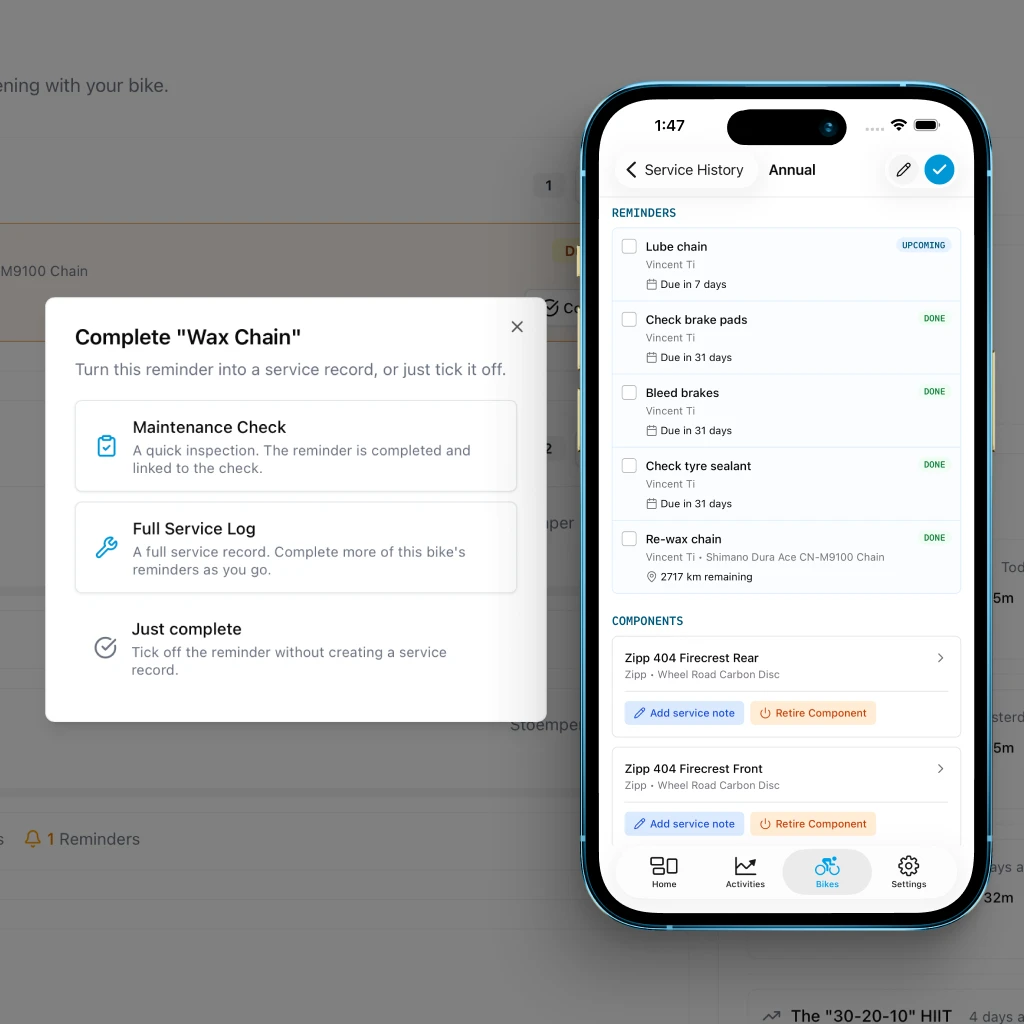
The new completion flow closes the second half. When you complete a reminder on a bike, Componentry now asks how you want to close it. You can record it as a maintenance check, which is a quick inspection with per-component notes. You can open a full service log for bigger sessions. Or you can simply tick it off when a record genuinely adds nothing.
Maintenance checks and service logs list all of the bike's open reminders as a checklist, which matches how work actually happens: one session on the stand clears the chain check, the brake pad check, and the tyre inspection together. Each reminder completed through the service reschedules from today's date and today's actual wear, so your intervals stay honest automatically. And every reminder completed this way stays on that service's record permanently, building the per-bike service history that pays off at inspection time and at resale.
Full service logs carry the detail a future buyer, or a future you, will want: a status workflow from New to Booked to Completed, a crash flag, the mechanic's name, and notes per component. Service logs now work in the mobile app too, so a workshop visit can be recorded from the shop floor. On the web app you can also replace components within a log and email a service report when the work is done.
The result is a bike maintenance log that assembles itself from the maintenance you were already being reminded to do. Stop ticking boxes and start building a record.
Recommended Videos & Further Reading
- Park Tool: When to Replace a Worn Chain — The industry standard on chain wear thresholds and why running past them destroys cassettes and chainrings.
- Zero Friction Cycling: Chain Testing — Independent chain wear testing that quantifies how fast chains reach replacement thresholds in real conditions.
- SILCA: How To Maintain A Waxed Bike Chain — Distance-based re-waxing intervals and the maintenance routine that makes waxed drivetrains last.
- road.cc: Your complete guide to buying a second-hand bike — What buyers are told to inspect and discount for, and exactly what a good service history protects you from as a seller.
- GCN Tech: Maintenance Videos playlist — Practical video walkthroughs for the inspections and services your reminders will trigger.