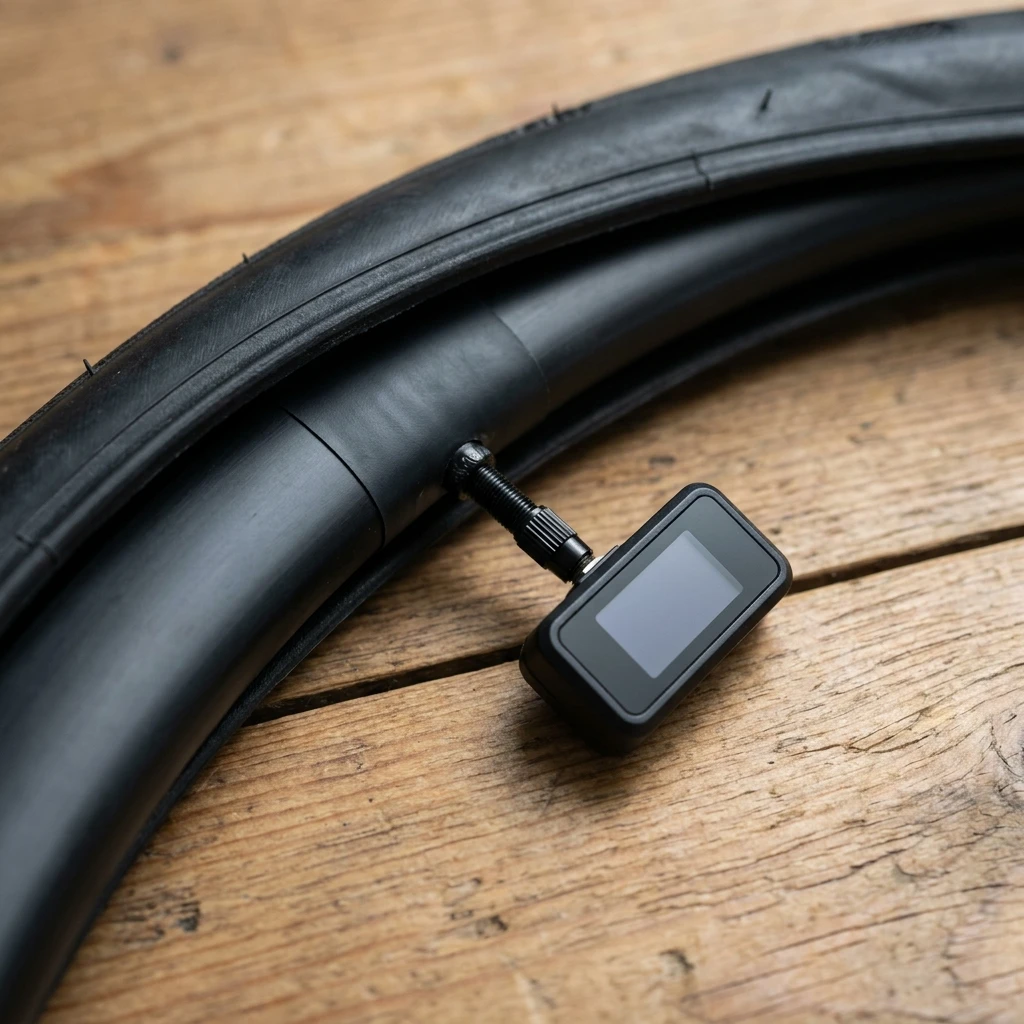


Tyre pressure sensor wheels just went mainstream. Zipp's newest wheels ship with a pressure sensor built into the rim itself. Open the SRAM AXS app, or a compatible head unit, and your tyre pressure appears as a live number next to your speed and power. The cycling press has covered it as a breakthrough, but the sensor itself has existed since 2018. What changed is where it lives.
What Zipp Actually Announced
The 353 NSW and 303 SW, Zipp's flagship road and all-road wheelsets, now carry an integrated pressure sensor mounted in a pocket inside the rim rather than bolted to the valve stem. A small port drilled through to the tyre chamber lets the sensor read pressure directly, and a CR2032 coin cell claimed to last more than 400 days keeps it running. Pressure data transmits over Bluetooth to the SRAM AXS app, with reported compatibility extending to Garmin and Wahoo head units and native integration on Hammerhead's Karoo.
The wheels themselves are not cheap. The 353 NSW pair lists at roughly £3,500 (around $3,350 USD), weighing a claimed 1,310 grams. The 303 SW pair runs about £1,700 to £1,900 depending on market, at a claimed 1,440 grams. Both come with a new ZR1 SL hub, full ceramic bearings, and 66 points of engagement, 30 grams lighter than the hub it replaces. Sensor-compatible tubeless valves are included, along with a TPU inner tube for riders not running tubeless.
The Sensor Isn't New. The Packaging Is.
Bikerumor's coverage of the launch is direct about where this technology comes from: the new sensor is, in the outlet's words, a development from the original Quarq TyreWiz. That matters, because TyreWiz has been doing exactly this since 2018, as a small pod that clips onto your valve stem. The current TyreWiz 2.0 already reads pressure to plus or minus two percent accuracy, at 0.1 PSI resolution, over both ANT+ and Bluetooth, on a device that weighs 10 grams and works with most existing head units.
So the live-pressure capability itself is eight years old. TyreWiz already covered live pressure over ANT+ and Bluetooth, head unit and app compatibility, and low and high pressure alerts, at the same 0.1 PSI resolution. What Zipp actually changed is integration: the sensor now lives inside the rim instead of on the valve stem, the claimed battery life jumped to 400 days from a much smaller watch-style cell, and it ships with a dedicated ceramic-bearing hub.
That is a real convenience improvement. It is not a new capability, and the marketing language around "first-ever" integrated sensors describes the packaging, not the underlying sensing.
Why Tyre Pressure Actually Matters
None of this means tyre pressure is a trivial thing to get right. SILCA's pressure calculator methodology, built from testing across surface types, tyre widths, and rider weights, lays out the actual trade-off: pressure set too high increases vibration and reduces grip without further reducing rolling resistance, while pressure set too low increases both rolling resistance and the risk of a pinch flat.
"Too high pressure increases vibration and reduces grip, while too low pressure increases rolling resistance and risk of pinch flats." (SILCA Tire Pressure Calculator methodology)
That narrow band between too hard and too soft shifts with temperature, tyre wear, and how long a bike has sat since it was last aired up. A live in-ride reading is a genuine answer to a real question. The question is whether you need a $2,000 to $4,700 wheelset to get it, when a 10-gram valve accessory has answered the same question since 2018.
Tyre pressure sensor wheels are not the only way to get this data, either. If you are not in the market for a new wheelset, the practical version of this story does not change. Check pressure before you ride, not after, using a decent floor pump gauge or a standalone sensor like TyreWiz on the wheels you already own. Riders chasing the last few percent of rolling resistance at a fixed event or time trial get real value from a live in-ride reading. Everyone else gets most of the benefit from getting pressure right before setting off.
The Trade-offs Nobody's Advertising
A few limitations sit underneath the launch coverage:
- A closed parts list. The sensor requires Zipp's own cross-drilled valve or the included TPU smart tube. A standard tubeless valve will not work with it, so the convenience of an integrated sensor comes with a dependency you did not have before.
- Reliability questions with no track record yet. Specialist-site commenters, not Zipp's marketing, raised the reliability history of Zipp's hub electronics, and asked how a rim-mounted sensor and its wiring hold up against water ingress over years of wet riding, a concern current TyreWiz owners have not had to think about, since their sensor sits outside the rim entirely.
- A genuinely mixed reception. One Bikerumor commenter dismissed the feature outright as a gimmick. BikeRadar's own coverage opened by asking whether this represents a step too far in data-driven riding, before landing on a measured, not glowing, verdict.
- Ambiguous openness. BikeRadar reports generic Garmin and Wahoo compatibility alongside native Hammerhead support. Bikerumor's framing leans more heavily on the SRAM AXS app as the primary interface. Both are probably right in part: the data transmits over standard Bluetooth, but the fullest experience sits inside SRAM's own ecosystem, the same pattern electronic groupsets have followed for years.
Pressure Is a Live Number. Wear Is a Lifecycle Number.
Here is the distinction that gets lost in most of the coverage. Tyre pressure resets every time you use a pump. It tells you something true about right now, and nothing about next month. Tyre wear works the opposite way: it accumulates ride after ride, and it is the number that actually determines when you need to spend money on a replacement.
A pressure sensor cannot tell you that your tyre's casing has taken enough cuts and abrasion to be approaching the end of its life. It cannot tell you that a cassette is three thousand kilometres into a lifespan rated for five thousand, or that a chain has crossed the elongation threshold where it starts accelerating wear on everything downstream of it. Those are lifecycle questions, built from data accumulated across every ride you have logged, not a single live reading.
That is also, not coincidentally, where bike telemetry is heading in every direction at once. A pressure reading lives in the AXS app. Battery status lives in a Di2 or AXS app of its own. Ride data lives in Strava, or Garmin Connect, or Wahoo's app. Each new sensor category launches inside its own silo, because that is how the manufacturer sells the ecosystem around it. None of them talk to each other, and none of them answer the question that actually costs you money: what needs replacing, and when.
How Componentry Tracks What a Pressure Sensor Can't
Componentry does not compete with a tyre pressure sensor, and it is not trying to. It answers a different question: how far into its life every component on your bike actually is, independent of what your pressure happens to read right now. Sync your rides from Strava, Garmin, Wahoo, or Hammerhead, and Componentry tracks distance, duration, and conditions against every chain, cassette, tyre, and battery on your bike, so you know when something needs attention before it fails on you.
That includes the tyre itself. Componentry logs distance against each tyre you add as a component, and prompts the casing and tread inspection that actually determines replacement once you approach your set interval, the lifecycle question a pressure sensor was never built to answer. As more of your bike gains its own siloed sensor and its own app, the case for one place that pulls the lifecycle picture together across all of it only gets stronger. A smart wheel can tell you your pressure is right for this ride. Componentry tells you what is going to need replacing before your next one.
Sources on Tyre Pressure, Sensors, and Wheel Data
- BikeRadar: Zipp 303 SW and 353 NSW: full specs, pricing, and hub details for the new wheels, plus early skepticism about the value of built-in sensors.
- Bikerumor: Zipp 353 NSW and 303 SW Wheels Get AXS Pressure Sensor: confirms the sensor's lineage from the original Quarq TyreWiz, with reader reaction on reliability and value.
- SRAM Quarq: TyreWiz: the valve-stem sensor this technology descends from, in production since 2018.
- SILCA: Tire Pressure Calculator Explained: the physics behind why correct tyre pressure matters, independent of any single product.
Related Componentry posts: