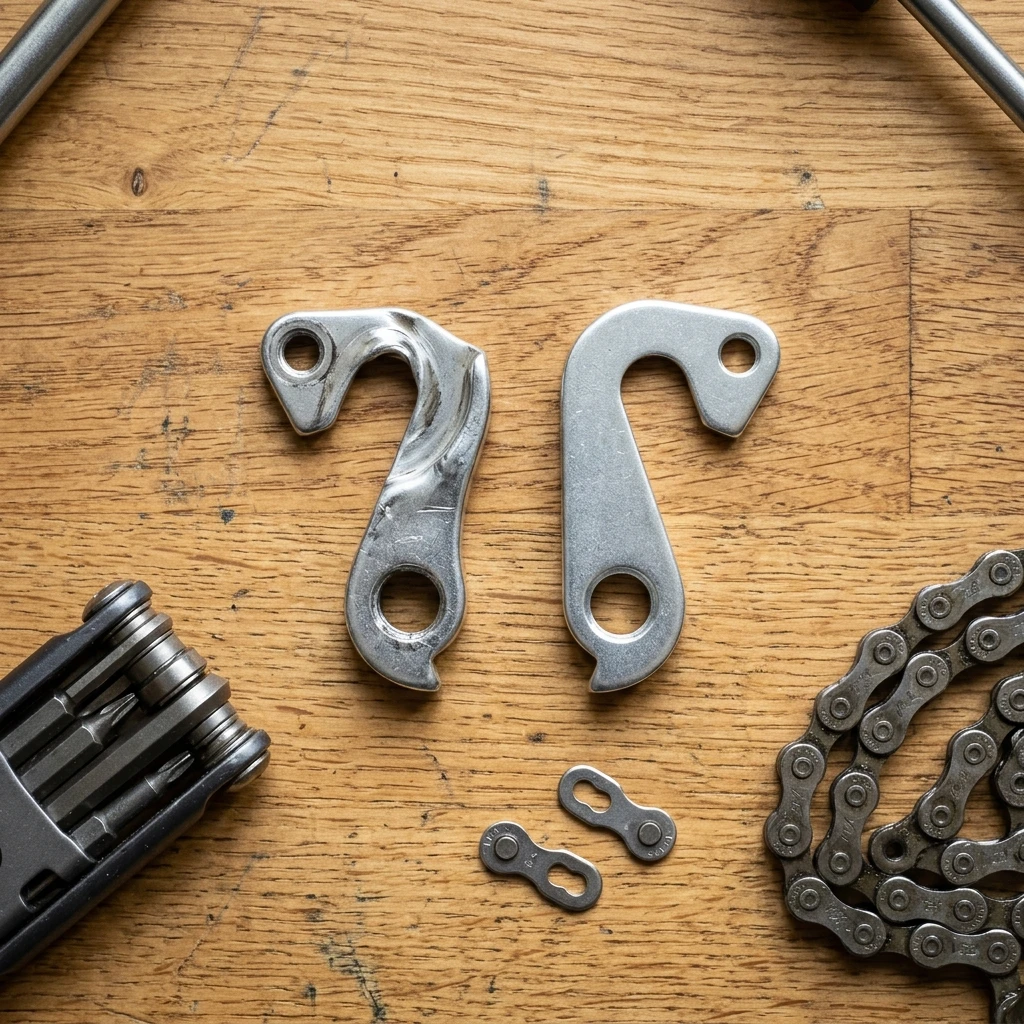


On day 11 of his unsupported 2024 Tour Divide record attempt, Lachlan Morton's rear derailleur failed on the trail, hundreds of kilometres from the nearest bike shop. The first fix didn't hold. He ended up wedging a spare spoke through the derailleur cage against the rear triangle, rigging roughly three usable gears to finish the remaining distance. By the time he crossed the line, he was also riding on brake pads worn down to bare metal. He still finished faster than anyone before him, though the run was never ratified as an official record, since course deviations and a media crew's presence broke the event's self-supported rules.
That story works as folklore because the ending is heroic. It reads very differently once you swap Morton, with his mechanical instincts and a route full of dot-watchers tracking his progress, for a rider on a solo bikepacking trip who has never had to jam a spoke into a derailleur cage. Most gravel bike maintenance advice is written for the driveway: clean your chain, check your tyre pressure, lube what squeaks. None of it prepares you for the one failure that behaves completely differently once you're hours from a road. On a supported road ride, a bent derailleur hanger is a phone call and a short wait. Deep in the backcountry, it's the difference between a good story and a long walk.
Why the Hanger Is Built to Fail
A derailleur hanger is a small, replaceable metal plate that bolts to the frame and holds the rear derailleur. It exists for one reason: to break before something more expensive does.
"When there is an impact to the derailleur — for example, a crash, a fall, or rough handling around a rack or other obstacle — the hanger sustains the damage, protecting the more-expensive derailleur and frame." — Park Tool: Rear Derailleur Hanger Alignment
The design logic is straightforward once you see it: a carbon frame or a $150 derailleur cracking in a crash is a genuinely expensive problem. A $15 to $40 metal plate bending instead is a cheap one.
"On almost every modern bike it is designed to be the sacrificial part — it is deliberately softer than the frame and softer than the derailleur, so that when the bike goes down, the hanger bends instead of something expensive cracking." — PaceLineBikes: How to Tell If Your Derailleur Hanger Is Bent
That trade-off was made correctly for the failure. It just wasn't made with the environment in mind. Near home, a bent hanger converts a frame-replacement problem into a cheap parts problem and a short wait for a shop. In the backcountry, the same "safety valve" event removes your ability to shift, and sometimes to pedal at all, with no shop reachable at any price.
What Actually Bends a Hanger on Gravel and Bikepacking Trips
Hangers don't usually fail from ordinary pedalling. They fail from specific, identifiable events, and several of those events happen more often on a multi-day trip than on a road ride from your driveway.
- Tip-overs and drops. BikeRadar and PaceLineBikes both point to the same short list of causes: a bike tipping over onto its drive side in a parking lot or at camp, leaning it against a tree or rock, rough handling loading it onto a rack, or a knock during flights or shuttle transport. A loaded bikepacking bike is set down, leaned, and loaded and unloaded far more often than a road bike ridden straight from the garage, usually on uneven ground rather than a flat driveway.
- Chain suck and misalignment feeding on itself. A bent hanger pulls the derailleur's lower pulley out of line until the derailleur's cage can contact the spokes in the lowest gear, which is exactly the situation that drags a derailleur into the wheel and can snap it outright. Park Tool's own alignment guidance backs up why this doesn't self-correct: a bent hanger causes shifting problems that "can generally not be accounted for by making adjustments to the indexing or limit screws." You can't tune your way out of it. It has to be straightened or replaced.
- A chain already past its wear threshold. A worn chain is more prone to skipping and chain suck under load, which can put a sudden, abnormal force through the rear derailleur and hanger. Componentry's own chain wear guidance uses the same industry-standard thresholds worth repeating here: 0.5% elongation for 11- and 12-speed chains, 0.75% for 10-speed and below. A chain that's already past that line isn't just a drivetrain-cost problem. It's one more way to load a hanger that's already doing a difficult job.
The Preparedness That Actually Helps
You can't redesign the sacrificial part. You can make sure you're not relying on luck when it does its job.
Carrying "a spare hanger" sounds like enough, but it usually isn't, because hangers are almost always model-specific.
"It's a good idea to carry a spare with you when you're out riding or on a bikepacking trip." — BikeRadar: What Is a Derailleur Hanger?
The same source is specific about why the generic version of that advice falls short: hangers vary by mounting orientation and fastener type, and manufacturers can change a hanger's design mid-model-cycle, meaning two bikes of the same model year can need different parts. The advice that actually helps is narrower: look up your exact frame's hanger part number before the trip, buy that one, and carry it. A universal hanger, like the one Adventure Cycling Association stocks, is a legitimate get-home fallback if you didn't manage that, not a substitute for having the right part in the first place.
Beyond the spare part itself, a few habits reduce the odds you need it:
- Check the derailleur mounting bolt for tightness before a trip. It carries constant tension and can work loose over time.
- Inspect the hanger visually and with a straight-edge if you've dropped or transported the bike recently, rather than waiting for shifting to tell you something's wrong.
- If a hanger does fail mid-route with no correct spare on hand, the field fix isn't improvisation with a spoke. BikeRadar's emergency singlespeed conversion (pull the derailleur, pick a straight-chainline gear, and ride conservatively to the nearest shop or vehicle) is the deliberate version of what Morton did on instinct. Treat his spoke-jam as the story of what happens without the right spare, not as a technique to copy.
Other Backcountry Risks a Road Ride Never Tests
A hanger is the sharpest example, but the same asymmetry runs through the rest of a proper gravel bike maintenance checklist. None of these parts fail more often on gravel than on the road. They're just far harder to recover from when the nearest shop is a full day away instead of a few kilometres.
- Brake pads. A pad that's "fine for now" on a commute can cross the wear line mid-trip with no way to swap it. Componentry's own brake pad thresholds put the hard limit at 0.5mm of remaining friction material, with a 1.0mm working threshold for margin. That margin matters more the further you are from a shop, not less.
- Broken spokes. A snapped spoke on tour usually can't wait for the exact gauge and length. This is why experienced bikepackers carry a few spare spokes stored inside the seatpost, along with matching nipples and a spoke wrench built into a multi-tool, or a Kevlar emergency spoke marketed specifically for adventure and touring riders who need to get home without the exact replacement.
- Tubeless sealant that's already drying out. Sealant typically lasts two to six months depending on heat, humidity, and how many punctures it's already sealed. A multi-day or multi-week trip can outlast sealant that wasn't refreshed shortly before departure, meaning the flat protection you're counting on may already be marginal on day one if nobody checked.
How Componentry Fits Into a Pre-Trip Check
None of this changes the fundamental trade-off in a derailleur hanger's design, and Componentry doesn't track hangers, spoke tension, or sealant condition specifically. A hanger isn't a distance-wear item; it fails on impact, not mileage, so there's no wear percentage to calculate for it. That's a real gap, not something worth glossing over.
What Componentry does track, automatically from every synced Strava, Garmin, or Wahoo ride, is the condition of the parts that do wear on a predictable schedule: chain elongation, cassette wear, and brake pad thickness, each with a predicted replacement date based on your actual riding rather than a generic mileage guess. That matters here specifically because a chain or brake pads that are already marginal are one more variable stacked on top of remoteness risk you can't remove. A gravel or bikepacking bike that's been sitting since your last trip is also worth a second look before the next one: components don't stop wearing between rides, and Componentry's multi-bike tracking flags a dormant bike's aging components rather than assuming everything's still where you left it.
The night before a big trip is not when you want to be guessing whether your chain is at 0.4% or 0.6% wear. Check what's already marginal before you add distance-from-help on top of it.
Know what's marginal before you're hours from help. Componentry tracks chain, cassette, and brake pad wear automatically from every ride, with a predicted replacement date so you know what to check before a trip, not after something fails on it. Get started free →
Further Reading on Backcountry and Drivetrain Reliability
Related Componentry Articles:
- The Chain-Stretch Domino Effect: How One Worn Chain Destroys a $600 Drivetrain: the wear thresholds and cascade risk referenced above
- When to Replace Brake Pads: The Data-Driven Guide for Cyclists: the 0.5mm/1.0mm thresholds that matter more with no shop nearby
- How to Track Bike Maintenance When You Own Two or More Bikes: why a bike that's been sitting since its last trip needs a second look
Technical Reference: