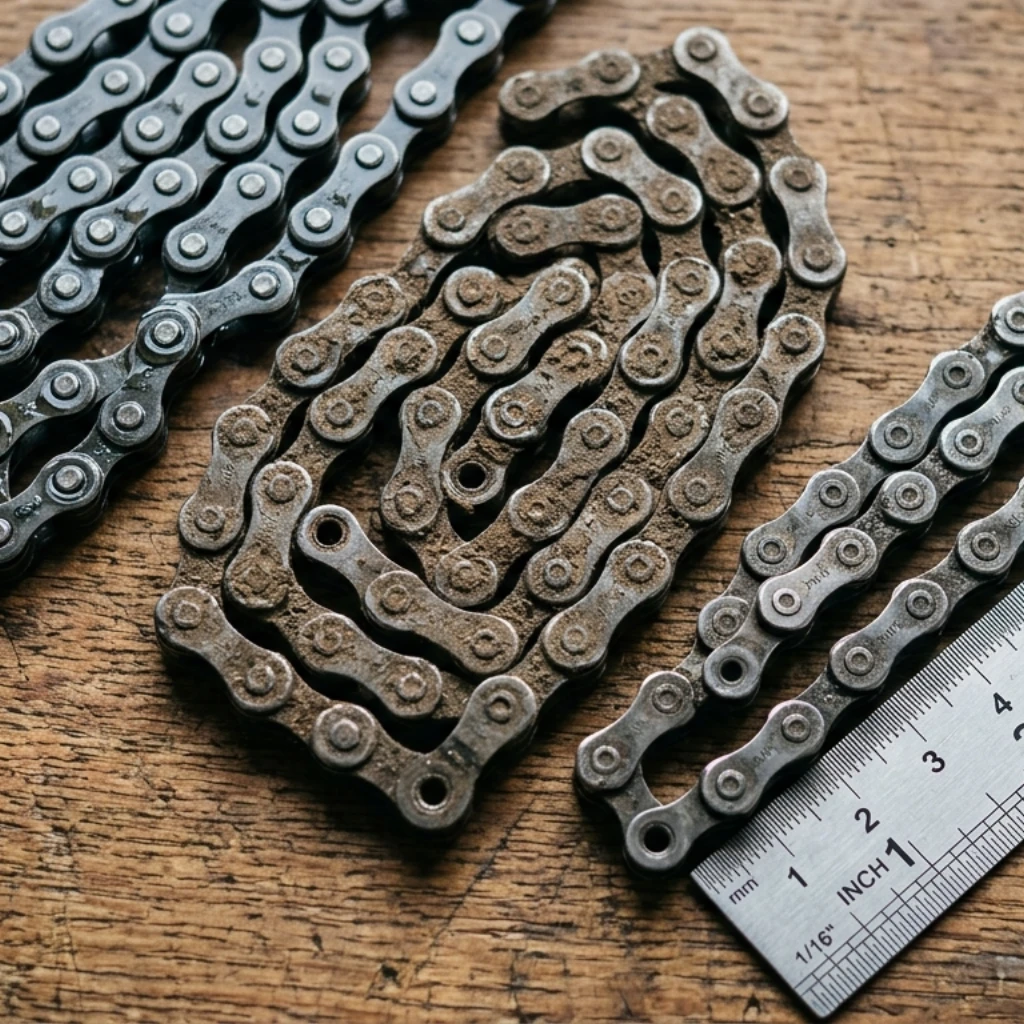
Two riders can have chains at the exact same wear percentage and be losing very different amounts of power. One rode a wet commute this morning and hasn't wiped the chain down. The other cleaned and re-lubed last night. Both chains might measure 0.4% elongation on a checker tool. Their drivetrain power loss right now is not the same number.
That's because "friction tax" was always shorthand for three separate physical problems bundled into one figure. Contamination, lubrication state, and chain stretch each cost their own watts, move independently of each other, and respond to completely different fixes. A chain can be freshly wiped down and still losing several watts to stretch. A brand-new chain can be losing watts to a bad lube choice before it's ridden a single kilometer. Treating the three as one number hides which one is actually costing you.
This post breaks the number apart, source by source, then covers how Componentry's new Drivetrain Power Loss feature now resolves it for your own bike instead of leaving you with a population average.
Three Different Watts, Three Different Causes
Chain friction happens where metal parts move against each other under load. SILCA's breakdown of the mechanism is precise on this point:
"The primary sources of friction in a bicycle chain are the articulation between the inner plates and the pins, and the rolling contact between the rollers and pins." SILCA: Chain Friction Explained
That's the physical location. What changes the amount of friction happening there is three separate variables: how much grit has worked its way into those contact points, whether there's still functional lubricant separating the metal surfaces, and whether the pins and bushings have worn enough to change the chain's geometry. Any one of those three can be good or bad independently of the other two, on the same chain, on the same day.
The Dirt Cost: Contamination
Contamination is the fastest-moving of the three variables. It can go from negligible to significant within a single ride.
CyclingAbout's testing on a Friction Facts precision rig, accurate to ±0.02W, measured a clean and properly lubricated chain running at 97.6% mechanical efficiency. A muddy, dry chain dropped to 92.8% efficiency, a 4.8-point loss. At 250 watts of output, that translated to a real-world speed difference: 31.38 km/h clean versus 30.71 km/h dry-muddy, a 2.1% slowdown from grit alone. Riding with no lubrication at all cost 2.7% of speed at the same power output.
Zero Friction Cycling's contaminated-condition block testing puts a number on how much worse this gets when grit and a struggling lubricant combine: wet lubricants under real-world contaminated conditions can lose 5 to 8 watts, well beyond what either factor would cost on its own.
"Even with a perfectly cleaned chain, there will be a 3W difference between the best and worst lubricants." Zero Friction Cycling: Lubricant Testing
This is the part of the number that changes hour to hour, not just week to week. A dry gravel ride and a wet commute can leave the same chain in wildly different contamination states by the same evening, independent of how worn it is or which lubricant is on it.
The Lubricant Cost: What's Actually on the Chain Right Now
Lubrication state is a different question from contamination: not "is there grit in there," but "is there still enough functional lubricant separating the moving surfaces."
Zero Friction Cycling's testing found a 3-watt spread between the best and worst lubricants even on a chain that's completely clean, and founder Adam Kerin puts the cost of a poor lubricant choice at upwards of 5 watts at race power. Independent testing from CeramicSpeed backs up the range: their UFO Drip Chain Coating measured under 4 watts of friction loss at 250W and 95rpm, against 4.5 to 9 watts for the other lubricants tested under the same protocol.
Chains coated with a coating that resists picking up road grit "were faster if anything" after being ridden outside, while conventional wet and dry lubes "typically generated more friction after being ridden outside." BikeRadar: CeramicSpeed's "World's Fastest" Chain Lube
That distinction matters more than which lubricant you picked. What counts is how much of it is still doing its job. A wax-lubed chain three weeks past its re-lube interval isn't being penalized for wax as a lubricant, it's being penalized for depletion. Wax film wears off predictably with distance and needs reapplying on a schedule; wet lube migrates and attracts grit over time in a different way. Either way, "lubrication state" is asking how long it's been since the chain last had a fresh, intact layer, not what brand is in the bottle.
The Wear Cost: Chain Stretch
Chain stretch is the only one of the three variables that's cumulative and effectively irreversible without replacement. Contamination washes off. Lubricant gets reapplied. Elongated pin-bushing gaps don't shrink back down.
CeramicSpeed's "Old vs. New" drivetrain efficiency test isolated this specifically, and the numbers are unusually clean: friction losses increased at an average rate of roughly 2.02 watts per 1% of chain elongation. A new chain paired with a new cassette measured 6.26 watts of friction loss at 250W and 95rpm. The most-elongated chain tested, at 1.56% elongation, measured 10.27 watts under identical conditions.
Swapping an old cassette and chainrings for new ones under the same chain shifted friction by only 0.10 to 0.33 watts. Elongation, not cog or ring wear, was "predominantly responsible" for the efficiency loss. CeramicSpeed: Drivetrain Efficiency Test, Old vs. New
That's a useful number to hold onto: elongation alone, isolated from every other factor, costs roughly 2 watts for every 1% of stretch. For the mechanics of measuring your own chain against the 0.5% and 0.75% replacement thresholds, The Friction Tax and our chain stretch measurement guide cover that in full. What matters here is that stretch behaves nothing like the other two variables. It only moves in one direction, and no amount of cleaning or re-lubing gets those watts back.
How Componentry Quantifies This for Your Bike
Componentry's new Drivetrain Power Loss feature (mobile v2.7.0, web v0.32.0) replaces the "somewhere between 5 and 10 watts" guess with a live number specific to your own chain, broken into the same three factors covered above: contamination, lubrication state, and chain stretch.
Instead of a lab-average figure applied to your bike after the fact, the estimate is built from your own ride history: how you've actually been riding, in what conditions, and how long it's been since your last clean and re-lube. Tag a reminder as a lubrication reminder and the model sharpens further, working from your real lube-timing data instead of an assumed habit.
On the bike, drivetrain power loss shows up where you're already looking. On mobile, a Drivetrain Power Loss card sits on the chain's entry in the component list, with a nudge on the home bike card and the bike's Components tile when there's something worth recovering. On web, it appears as a "Recover X.X watts" figure on the dashboard, bikes list, and component rows. Tap or open it and the breakdown expands into the three factors individually, each with its own figure, so you can see exactly which one is costing you: is it grit, is it a lubricant that's run dry, or is it stretch that only a new chain will fix.
A clean, freshly lubricated chain with minimal elongation shows nothing. The feature is built to flag recoverable watts, not to manufacture a number where none exists.
That's the practical difference this makes. "Your chain is probably costing you 5 to 10 watts" was never wrong, but it was never useful either, because it couldn't tell you which of three unrelated problems to fix first. A number broken into contamination, lubrication, and stretch, calculated from your actual rides, tells you exactly that.
Further Reading
- The Friction Tax: How Drivetrain Efficiency Costs You 5-10 Watts Before You Notice: the wear-threshold primer this post builds on
- Chain Stretch Measurement Guide: how to measure the 0.5%, 0.75%, and 1% elongation thresholds referenced above
- Waxed Chain Intervals: re-lube interval data specific to wax lubrication