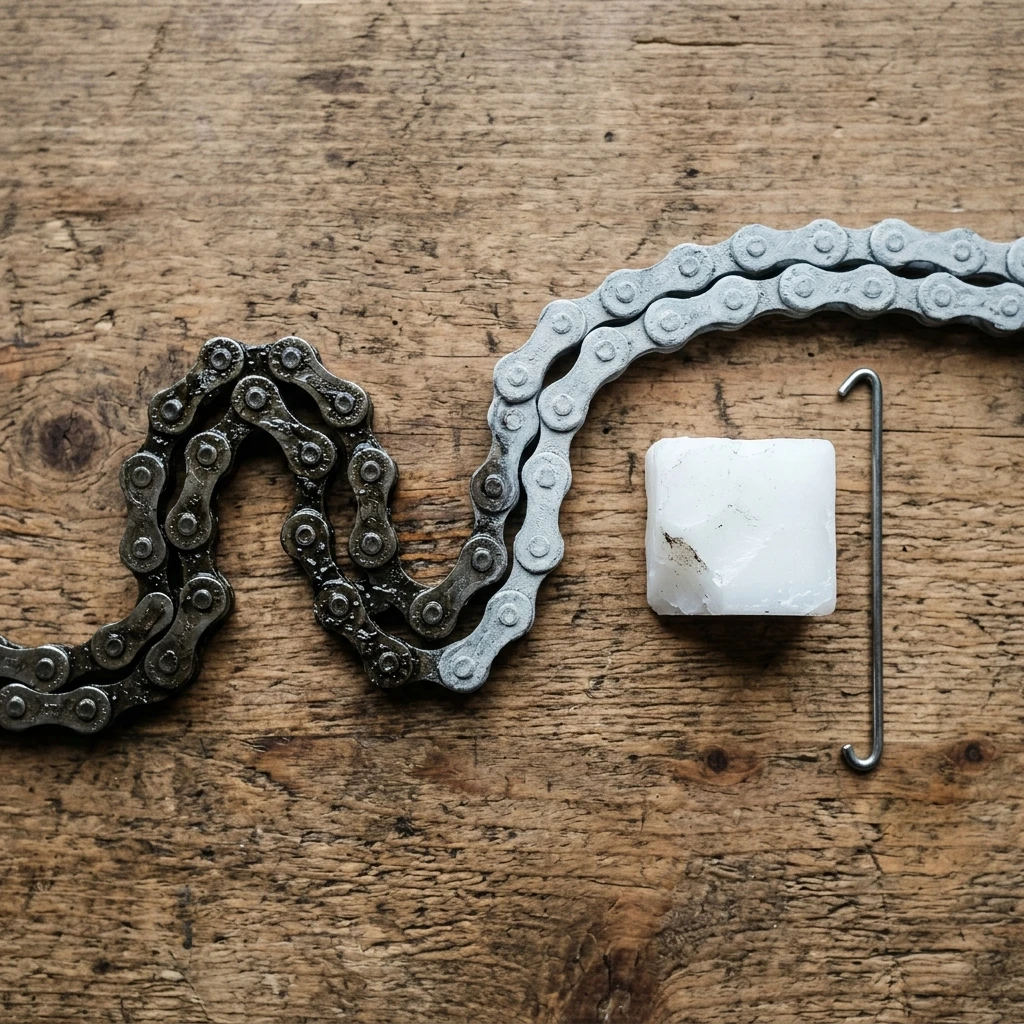
How a Waxed Chain Works
An oil-lubed chain stays wet. That is how oil protects the metal, and it is also why grit sticks: sand, dust, and fine metal particles from wear suspend in the oil and travel with it through the rollers.
A waxed chain stays dry. The film inside the chain does the lubricating, and nothing tacky on the outside collects dirt. The bigger advantage, according to Zero Friction Cycling, is what happens at each re-wax. Because the chain is stripped and rewaxed from clean, the routine wipes out whatever contamination built up:
"every re-wax does a brilliant near perfect re-set of any contamination in chain" Zero Friction Cycling: Lubricant choice matrix
ZFC's 2021 write-up goes further and calls immersive waxing with top waxes "unchallenged by drip lubricants." ZFC is an independent tester, but that was a five-year-old statement about the best waxes available then, so read it as a direction rather than a current ranking.
Hot-Melt Wax vs Drip Wax
The two systems are not interchangeable, and most of the "does waxing work" arguments come from people comparing one against the other.
| Hot-melt immersion | Drip wax |
|---|
| How it goes on | Chain is submerged in melted wax | Applied link by link, then left to dry |
| Setup | Slow cooker or wax pot, thermometer, solvents, wire hook | A bottle, plus a one-off degrease of the chain |
| Effort per application | About 20 minutes of hands-on work, plus melting and drying time | Low; no melting, no bath after the first prep |
| Where it is strong | The most thorough contamination reset | Convenience, and no need to remove the chain |
| Where it is weak | Setup, time, and the chain has to come off the bike | The film is thinner and more easily displaced |
The hot-melt details come from published guides. BikeRadar puts wax melting at 30 to 45 minutes and drying at about 20 minutes. SILCA, which sells wax, gives 75°C and a 10 minute immersion for its blend. Roadman Cycling puts a later re-wax at about 20 minutes.
Never mix the two families of lubricant. KMC's instruction is blunt: "Never mix wax and oil-based lubricants."
What a Waxed Chain Costs
Hot-melt waxing has a start-up cost and then a small running cost. Roadman Cycling's 2026 guide lists the following, in its own dollar prices:
- Slow cooker: $15 to $25
- Wax (Silca Secret or Molten Speed): $20 to $30
- Mineral spirits: $5 to $8
- Isopropyl alcohol: $4 to $6
- Quick link pliers: $10 to $15
- Spare quick links: $5 to $10
- Second chain: $25 to $40
Adding those lines gives about $84 to $134 to start. SILCA lists its Secret Chain Blend at $40 for a 500g pouch, which is a useful yardstick for the wax line, though the price varies by seller and region.
The second chain means you are not off the bike while the first one dries.
Time is the other cost, and the first prep is the longest: Roadman's guide has three mineral spirits baths of two to three minutes each, a one minute isopropyl rinse, and at least 30 minutes of drying before the chain goes into the wax. After that, a re-wax is about 20 minutes. Drip wax skips most of this, which is why it is the usual middle ground.
Waxed Chain vs Oil: Is It Faster?
This is where the claims are loudest and the comparable data is thinnest.
SILCA says its wax "saves up to 8w" against standard lubricants. The page states no test conditions, and SILCA sells the wax, so treat it as an upper-end claim rather than a typical result. For scale, 8 watts is about 3 percent of a 250 watt effort.
Independent lab numbers exist, but they do not answer the wax-versus-oil question. Cyclingabout's 2026 summary of lab testing reports total drivetrain loss at 370 watts of 7.8 to 8.2 W for three drip waxes and 11.5 to 11.8 W for two hot waxes, then 10.4 to 11.1 W for drip waxes and 12.2 to 14.3 W for hot waxes at 680 watts. It then adds a caution that matters more than any figure:
"The results from the different wax tests are not comparable, as they were tested under slightly different lab conditions." Cyclingabout: The 10 Fastest Wax Chain Lubes
So no drip-versus-hot-melt winner can be read from those tables, and the numbers verified for this guide do not put wax and oil in one test. The honest summary is that testers and vendors generally report that a well-prepared wax system loses fewer watts than a typical oil lube, the size of the gain depends on the lube, the chain, and how clean it is, and the biggest number you will see quoted is not the number to plan around. Our post on recoverable chain power loss covers how lubricant choice and contamination each change the figure.
Does a Waxed Chain Last Longer?
Efficiency and wear are separate questions, and the data shows they do not always move together.
In the same Cyclingabout roundup, the drip wax with the lowest loss at 370 watts in its list (Smoove at 7.8 W) showed 87 percent chain wear after 5,000 km in dry conditions. Effetto Mariposa Flowerpower, at 8.0 W, showed 12 percent. That does not make one brand good and another bad. It shows that "waxed" covers many different products, and the lube with the lowest loss in a lab is not automatically the one that protects the chain best.
Guides also repeat that waxed chains "have been known to last 15,000 to 20,000 km." No test is cited for that line, and SILCA's own "up to 25,000 km" is a vendor claim. Treat both as best cases from careful riders, not as what to expect.
ZFC makes a cost argument too, saying the gap between top and average lubricants is "well over 1k per year for ROAD cycling." That figure comes from ZFC's own model over 10,000 km, so it shows how the maths can work for a high-mileage rider rather than a payback period for everyone.
The Downsides of a Waxed Chain
The first prep is the hard part. Wax needs a clean, degreased chain, and our intervals guide explains why oil left inside the rollers defeats it. That is why Roadman's first session runs long.
Wet weather shortens the life of the wax. BikeRadar: "If it's often very wet, this will shorten the lifespan of the wax on your chain, leading to a greater need to re-wax frequently."
Manufacturers disagree about quick links. SILCA says, "We do not recommend that you wax your quick link." KMC says, "The rivets of the missing link must be waxed before closing." Follow the instructions for the chain and the wax you actually use.
Finally, it is a routine you have to keep up. BikeRadar's author notes he is the only person on the staff who wax-immerses, and that most of his colleagues prefer lubricants that need minimal preparation.
Is Chain Waxing Worth It? Who Should Wax and Who Should Not
Waxing suits riders who ride in mostly dry conditions, care about a clean drivetrain, and are willing to keep a small workbench routine. The more distance you ride, the more riding the setup effort is spread across.
It is a poor match for the rider Roadman describes as one who "trains through a British winter in persistent rain and road spray." That guide's suggestions are to alternate chains or use drip wax year-round. If you want to ride and forget the chain, a good oil lube is a legitimate answer, not a failure.
If you are undecided, drip wax is the low-commitment way to try it. You keep the chain on the bike, skip the wax pot, and find out whether you enjoy the cleaner drivetrain before buying anything else.
How Componentry Helps You Track a Waxed Chain
Waxing works best when it happens on schedule. Log a wax as a maintenance event, set the distance you want between waxes, and Componentry counts the distance from your synced Strava, Garmin, or Wahoo rides and alerts you before the chain is due. When you tell Componentry a chain is waxed, its power loss estimate treats it that way, because wax and oil age differently.
Interval figures for each type of wax are in our re-waxing guide. Componentry tells you when you have reached them.
Recommended Resources & Further Reading
Technical Data:
Componentry Reading: