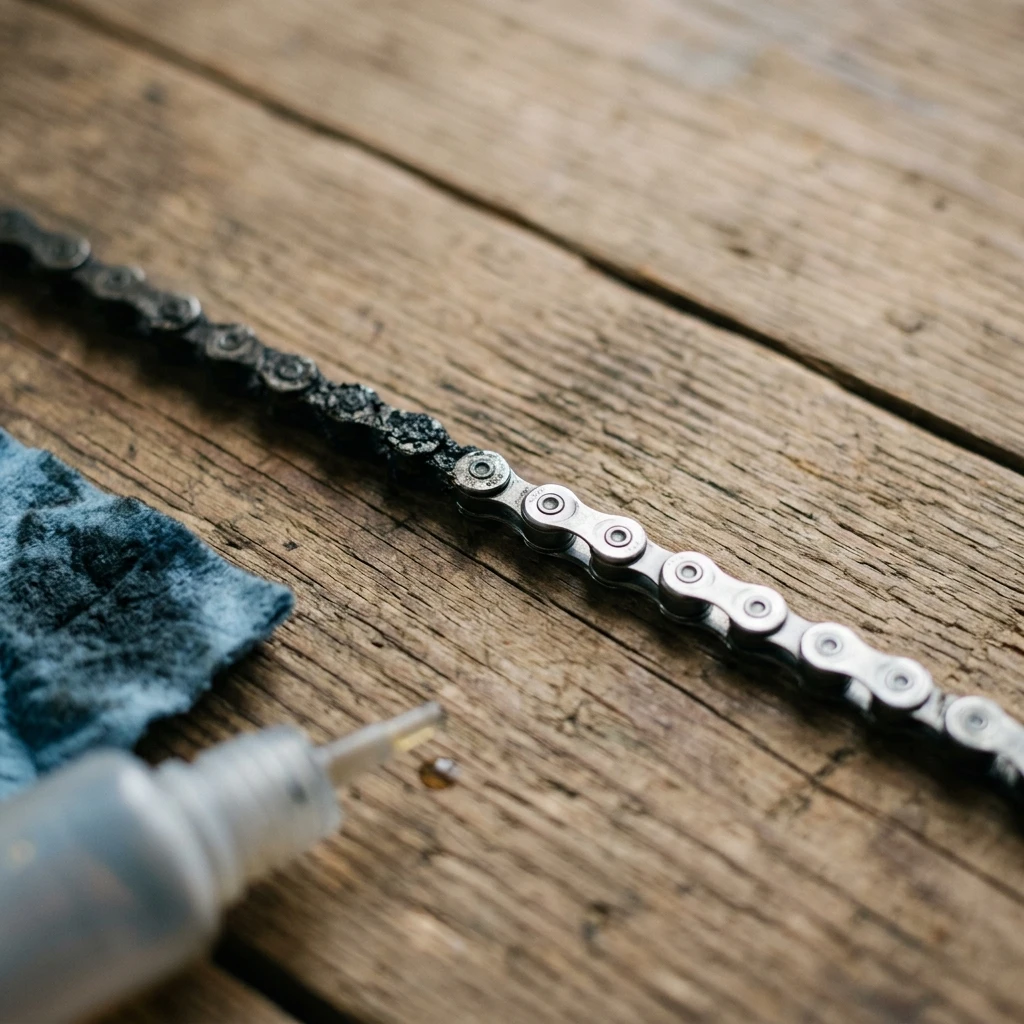


Before a big effort, a performance cyclist checks the obvious things: tyre pressure, weather, how the legs feel on the warm-up. The chain doesn't make the list, because it isn't skipping and it isn't stretched past a replacement threshold. It just looks like a chain.
That's the problem. The watts a chain is costing you have almost nothing to do with whether it looks fine, and the same ride data you already sync to chase a personal best can now put a number on it. Componentry calls this number chain power loss, and most of what it measures isn't wear at all.
What Chain Power Loss Actually Measures
Chain power loss is an estimate of the drivetrain drag your chain's current condition is costing you, split into three parts:
- Contamination: dirt, grit, and water sitting in the chain. This is usually the largest and most variable part, and the one a clean removes.
- Lubrication state: how fresh your wax or oil is. It fades gradually with distance and time since you last applied it.
- Chain stretch: mechanical wear from elongation. Unlike the other two, this part isn't recovered by cleaning. It only goes away when you fit a new chain.
The headline number Componentry shows is contamination plus lubrication state: the drag you can undo this afternoon with a rag, a brush, and fresh lube, not the drag that requires a trip to the bike shop.
Why Wear Isn't the Big Number
Ask most cyclists what a worn chain costs in watts and the answer usually points at wear itself, the stretch you'd catch with a chain checker. The lab data tells a more specific story.
CeramicSpeed's Friction Facts testing measured drivetrain friction across a range of chain conditions using a standardized tension-test method at roughly 250 watts of simulated rider output:
Frictional losses ranged from 6.26 watts with a new chain and new rings and cogs, to 10.27 watts with the highest-elongation chain and worn rings and cogs. CeramicSpeed: Drivetrain Efficiency Test, Old vs. New
That's about a 4-watt spread, and it's tempting to attribute all of it to chain wear. Look closer and the test is comparing a new chain and new rings and cogs against a worn chain and worn rings and cogs together. The chain isn't aging in isolation. It's dragging the rest of the drivetrain's wear along with it, and about 0.75 watts of that new-chain advantage is just a break-in effect: the microscopic roughness on new pins and plates polishing smooth in the first few rides.
Isolate the chain's own elongation from everything around it, and the mechanical penalty is small: on the order of a watt or two once a chain reaches a typical replacement threshold. Real, worth tracking for when to replace a chain, but not where the large, variable numbers people associate with "a worn chain" actually come from.
A separate data point makes the same case from another angle. Friction Facts recorded a chain at 0.78 percent wear, treated with Squirt lube, at a 9.39-watt loss, 4.59 watts higher than the figure published for that same lube on a new chain. A worn chain running a degraded lube is a very different number from a worn chain alone, and it's the combination, not the elongation by itself, doing most of the damage. Componentry keeps the two apart for exactly this reason: a wear figure that's honest about being small is more useful than a combined figure that overstates what a new chain, on its own, would fix.
The Watts Hiding in a Dirty Chain
Those large numbers come from contamination, and they move fast. Velo's lab testing put figures on exactly how fast, measuring a rider producing 250 watts before and after a ride with no chain cleaning in between:
A chain left dirty after a muddy ride cost the rider about 12 watts, roughly 5 percent of output. After a rainy ride, the loss was 6 watts. Less than an hour of dirty riding cost 2 to 6 watts, depending on the lubricant used. Velo: Dirty Chain Lab Testing
Twelve watts is a number a Performance Cyclist would notice immediately on a power meter. It's also a number that a ten-minute clean fully erases without buying anything new. That's the case for treating contamination as its own line item rather than folding it into a vague sense that the chain is "getting old": it appears and disappears far faster than wear ever does, and it's the part most worth watching after a wet or gritty ride.
Wax vs. Lubricant Changes the Number
Lubrication state is the second recoverable lever, and the type of lube changes the baseline before contamination even enters the picture. Zero Friction Cycling's lubricant test matrix, built from real-world 6,000 km test blocks across clean, wet, and contaminated conditions, is the most detailed independent dataset on this:
Hot wax measures 2.0 to 2.5 watts of loss at the low end of all lubricants tested. Fresh wet and dry lubes both run 5 to 7 watts. Even on a perfectly clean chain, the spread between the best and worst lubricant choice alone is about 3 watts. Zero Friction Cycling: Lubricant Testing
Contamination compounds whichever baseline you start from. ZFC's real-world blocks show wet lubricants degrading to 5 to 8 watt losses as grime accumulates, and drip lubes in particular can pick up as much as 4 watts in a single hour of contaminated riding. A well-maintained wax chain starts lower and resists that pickup better than a drip-lubed one, which is why Componentry asks whether a chain is waxed or running a lubricant before it estimates anything: the two age at different rates, and the estimate is only useful if it reflects your actual setup.
How Componentry Predicts Your Recoverable Watts
None of this requires a chain checker or a trip to the workshop. Componentry builds the estimate from the same ride data a Performance Cyclist already syncs from Strava, Garmin, Wahoo, or Hammerhead:
- Full accuracy comes from a connected bike computer, where Componentry can read terrain, conditions, and power directly from enough ride history.
- Reduced accuracy applies to Strava-only syncing or early ride history. The estimate still runs, scaled against typical values and clearly labelled, and sharpens as more data comes in.
- A completed lubrication reminder resets the baseline. Mark a "lube or wax chain" reminder done and Componentry records exactly how far and how long ago that was, then re-evaluates from a fresh starting point instead of assuming typical habits.
This is a different prediction from the lifespan estimate Componentry already gives each component. That one asks how many kilometres a part has left. Chain power loss asks something narrower and more immediate: what a clean and relube would hand back right now.
Turning Your Next Sync Into a Power-Loss Check
The appeal of chain power loss for a rider who already tracks every watt is that it costs nothing extra to maintain. There's no manual logging to keep up and nothing to remember about when the chain last saw a rag. The recoverable watts figure shows up on the bike card, the component list, and the chain's own detail view, updating as new rides sync in.
Set the lubrication reminder once and the number stops being a rough average and starts being specific to that chain's actual history: what it's running, how far it's gone since the last clean, and how the conditions on recent rides have likely treated it. Before the next big effort, that's one more genuine variable accounted for, sitting in data that was already being collected.
Go back to the rider checking tyre pressure and weather before a big effort. The chain was never really off that list, it just wasn't measurable in the same way the others were. It is now, and the fix, when the number says there's one to make, is a rag and ten minutes, not a purchase.
More on Drivetrain Efficiency and Chain Care
- The Watts You Can Actually Recover: Componentry's Drivetrain Breakdown Comes to Mobile. This same estimate, now live in the mobile app.
- The Friction Tax: How Drivetrain Efficiency Costs You 5-10 Watts Before You Notice. The wear and replacement side of this story.
- Waxed Chain Intervals. A data-driven guide to re-waxing before performance drops.
- Chain Power Loss help article. How the estimate works and how to get full accuracy.
- CeramicSpeed: Drivetrain Efficiency Test, Old vs. New
- Velo: Dirty Chain Lab Testing
- Zero Friction Cycling: Lubricant Testing