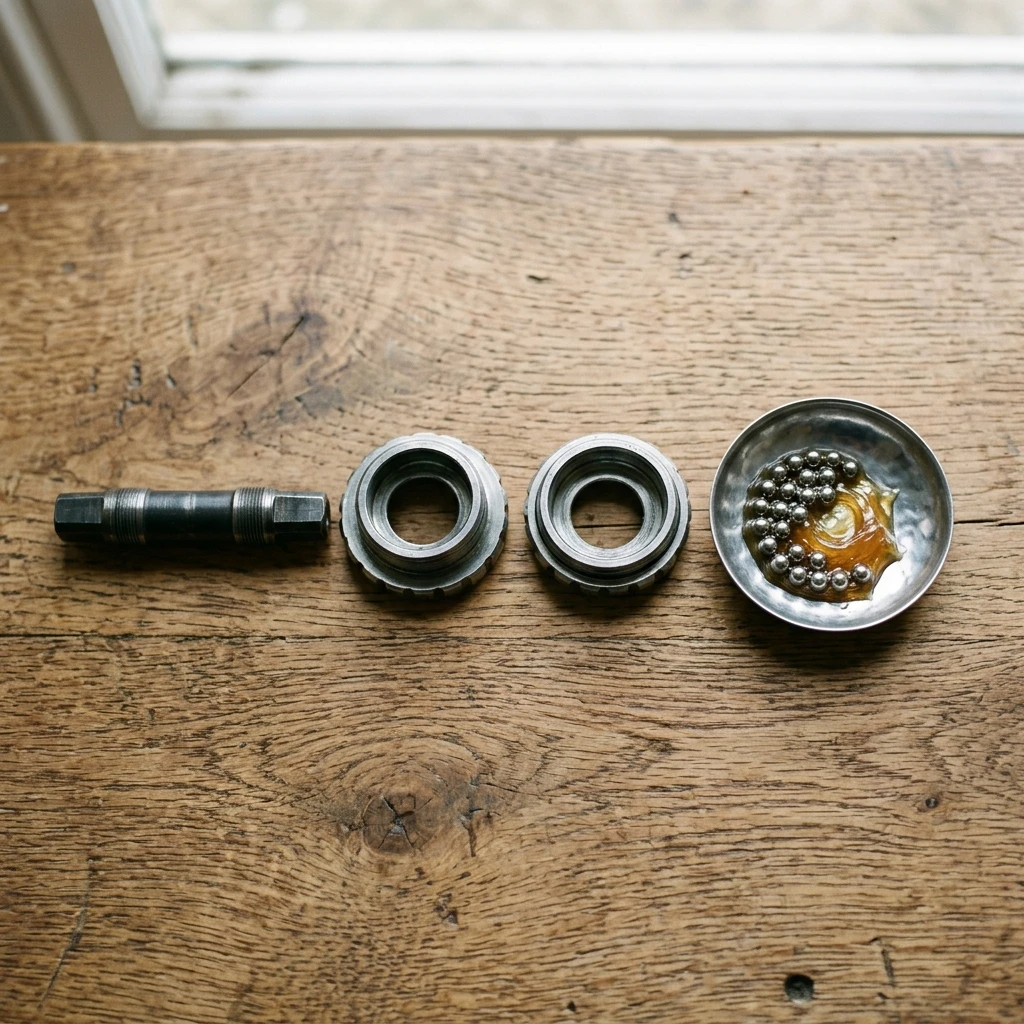
Servicing a Bottom Bracket: What It Means for Each Type
"Service" means different work depending on what is in your frame.
Adjustable cup-and-cone
This is the one type built to be taken apart. Park Tool notes that "adjustable style bottom brackets allow for full disassembly, reassembly, and adjustment," and its service procedure covers disassembly, cleaning, inspection, reassembly and adjustment of the bearings. Found mostly on older and some budget bikes, it is the type where an annual service means opening it up.
Sealed cartridge
A sealed cartridge is a single pressed unit with no parts inside you can adjust or repack. For this type, service means inspecting it, keeping water out, and replacing it when the bearings are worn. Our replacement guide covers the hand-spin test that tells a worn bearing from a loose press-fit shell.
Serviceable and ceramic bearings
Some bottom brackets use bearings you can clean and regrease. CeramicSpeed describes the routine in three steps: apply cleaner to each bearing and flush out the old grease and contamination with compressed air, let it dry completely, then refit the seal and apply fresh grease. Deep cleaning, when that is not enough, means removing the bearing and submerging it in cleaner.
"Clean and apply grease to bearings immediately following any significant exposure to water." SRAM: Road Cranksets and Bottom Brackets User Manual
Bottom Bracket Standards: Which One Do You Have?
Your frame's shell standard decides what service involves and what a replacement has to fit. Park Tool's standards guide lists them by the inside diameter of the shell, and the first split is threaded or press-fit.
| Standard | Type | Shell inside diameter |
|---|
| English (BSA) | Threaded | Approximately 33.7 mm |
| Italian | Threaded | 35 mm |
| T47 | Threaded | Approximately 46 mm |
| BB86, BB92 (Park's PF41 group) | Press-fit | 41 mm nominal |
| BB30 (Park's PF42 group) | Press-fit | 42 mm nominal |
| PF30, BB386EVO (Park's PF46 group) | Press-fit | Approximately 46 mm |
Park Tool: Bottom Bracket Standards and Terminology. The numbers in BB86 and BB92 are nominal shell widths, not the bore. Most frames use a threaded shell.
SRAM's DUB is not a shell standard. It is a spindle and bearing system that SRAM lists for several shells, including BSA, BB30, PF30, BB386 and BBright, so the DUB name alone does not tell you which one your frame has. Measure the shell, or check the frame maker's specification, before you buy a replacement.
Signs a Bottom Bracket Needs Service Before the Calendar Says So
A fixed interval is a baseline. Conditions and symptoms should pull the job forward.
- After significant water exposure. SRAM's instruction is to clean and grease the bearings immediately after it. A bike left wet, ridden through a storm or caught in a deep ford counts.
- After a pressure wash. SRAM's manual is blunt: "Do not clean the bottom bracket or crankset with a power washer." Water forced past the seals is how a bearing loses its grease. Clean the outside with water and mild soap instead.
- Play in the cranks. SRAM's check is to rock the crank arms. If there is play, its manual says to "remove the crank arms and apply additional grease to the spindle," and to repeat the installation until the play is gone.
- Riding that matches CeramicSpeed's list. Hot, humid, sandy or consistently wet riding all call for shorter intervals than the dry-road figure.
- Roughness or a creak. A gritty feel when you spin the cranks by hand, or a creak under load, means looking at the bearing now. The cause is not always the cartridge, which is why the replacement guide walks through the difference.
Bearings or Interface? A Two-Minute Check
Not every creak is a worn bearing. To separate the likely causes before you spend money, take the chain off, rock the crank arms, then spin them by hand.
| What you find | What it suggests | What to do |
|---|
| Play when you rock the crank arms | Play in the crank fit | SRAM: remove the crank arms, add grease to the spindle, and repeat the installation until the play is gone |
| Grinding or roughness when spun, on an adjustable type | Worn cups or cones | Park Tool: replace the worn parts |
| Smooth spin, creak under load, threaded shell | Cups or lock ring not tight | Park Tool: check the cups or lock ring and tighten to at least 35 Nm |
| Smooth spin, creak under load, press-fit shell | An adapter or bearing moving in the bore | Park Tool: re-install the adapter with retaining compound |
| Gritty after a wet ride or a pressure wash | Water past the seals | SRAM: clean and grease the bearings at once, and do not use a power washer |
The Park Tool advice comes from its noisy drivetrain guide and its bottom bracket service pages. The 35 Nm figure applies to threaded cartridge and thru-spindle types only; the guide gives no torque for press-fit systems. When a sealed cartridge spins roughly, our replacement guide explains why the cartridge usually needs replacing, and why a new one can still creak if the shell is the cause.
A Simple Yearly Bottom Bracket Service Routine
A yearly check does not need a workshop. Clean the outside of the bottom bracket and cranks with water and mild soap, never a power washer. Rock the crank arms side to side to feel for play, then spin them by hand with the chain off and listen for roughness. If the bearings are serviceable, clean, dry and regrease them as above. If the bottom bracket is a sealed cartridge and the spin is rough or the play will not go away, that is the point to replace it rather than service it.
Write the date down when you finish. A service you cannot date is a service you will do twice or not at all, and the log is what turns the intervals above into a schedule you can keep.
What Bottom Bracket Service Costs
Published prices are patchy, so read these as examples rather than a range.
| Item | Price | Source |
|---|
| Shimano BB-UN300 sealed bottom bracket | £12.95 on sale (RRP £27.99) | Biketart, UK retailer, seen 2026-10-17 |
| Shimano SM-BB52 Hollowtech II, 83 mm threaded | £10.95 on sale (RRP £24.99) | Biketart, seen 2026-10-17 |
| Adjust a bottom bracket (labour) | $25.00 | Propel Bikes service menu, updated 2022-12-21 |
| Replace a bottom bracket (labour) | $50.00 | Propel Bikes service menu, updated 2022-12-21 |
The Propel prices exclude parts, and its menu does not name a currency. We found no published price for repairing a damaged frame shell, so there is no figure for that job here. In these examples the part costs less than the labour, so a failing sealed cartridge is not worth nursing along.
Bottom Bracket Service Questions
How often should I service a bottom bracket? At least once a year, and sooner after wet, hot, humid or sandy riding. CeramicSpeed's distance figures are 5,000–10,000 km (3,000–5,000 miles) for standard types.
Can I service a sealed cartridge bottom bracket? Not in the way you service an adjustable one. A sealed cartridge has no parts you can adjust or repack, so service means inspecting it and keeping water out, then replacing it when the bearings are worn.
Why does my bottom bracket still creak after a service? The bearings may not be the cause. A loose threaded cup or lock ring, or a press-fit adapter moving in the bore, can creak with smooth bearings. Use the check above, then see the replacement guide.
Can I pressure wash a bottom bracket? SRAM's manual says not to clean the bottom bracket or crankset with a power washer.
Which bottom bracket fits my bike? It depends on your frame's shell. Identify the standard first, using the table above and the frame maker's specification.
How Componentry Helps You Keep Track of Bottom Bracket Service
Nothing in your ride data shows what is happening inside a sealed bearing. A sensor cannot read it, and neither can a tracking app. What an app can do is count the distance and time since the bottom bracket was last serviced, which is the number every interval above depends on.
Componentry adds the distance from every Strava, Garmin or Wahoo ride to the bottom bracket on the bike you rode, and you log the date and details of each service when you do it. Set the interval to suit how you ride, shorter for wet or gritty conditions and longer for dry road, and the reminder arrives before the bearing has had a chance to complain. It also keeps a service history per bike, so the answer to "when did I last do this?" is a date rather than a guess.
Related Componentry articles:
Technical reference: