A worn chain tells you it's worn. It skips, it rattles, it wears down a cassette you can see. A worn wheel bearing tells you nothing until the wheel starts to rock on its axle, and by then the cheap fix window has usually already closed.
That's the frustrating part about hub bearings on a premium wheelset. You paid for a Chris King, DT Swiss, or Industry Nine hub specifically because it's supposed to spin better and last longer than a stock hub. But "premium" doesn't mean "ignore it forever." Every major hub manufacturer publishes an actual wheel bearing service interval, and the three biggest names in the category land on the same rough number by two completely different routes.
What the Premium Hub Brands Say
Chris King states it plainly in its own service manual: hubs should be maintained "every 6-12 months in normal and dry conditions" and "every 3 months in wet or muddy conditions." A full RingDrive service, which goes deeper than a basic clean and regrease, is recommended "at least once every 12 to 24 months." Chris King also flags something worth knowing before you assume a fresh hub is failing: the first 60 hours of use can show "above average amounts of drag" as normal break-in, not wear.
DT Swiss recommends "annual hub maintenance under normal riding conditions, with more frequent service every three months in harsh environments like regular driving in dust, rain, snow or frequent transport in the rain." That's functionally the same split Chris King publishes, despite DT Swiss's star-ratchet engagement system working nothing like Chris King's RingDrive mechanically.
Industry Nine's Torch hubs land in the same neighborhood again: a recommended service "every 1 to 2 years depending on how often you ride."
Three manufacturers, three different mechanical designs, and all three converge on roughly the same pattern: about a year between services in dry conditions, cut to around a quarter of that in wet, muddy, or otherwise harsh riding. None of the three states that convergence outright since each is only writing about its own hub. Put side by side, though, it stops looking like a brand-specific recommendation and starts looking like a genuine fact about how quickly a sealed hub bearing picks up contamination, regardless of who made it.
Two Bearing Designs, Two Very Different Service Stories
Not every "high-end hub" ages the same way, because not every high-end hub uses the same kind of bearing.
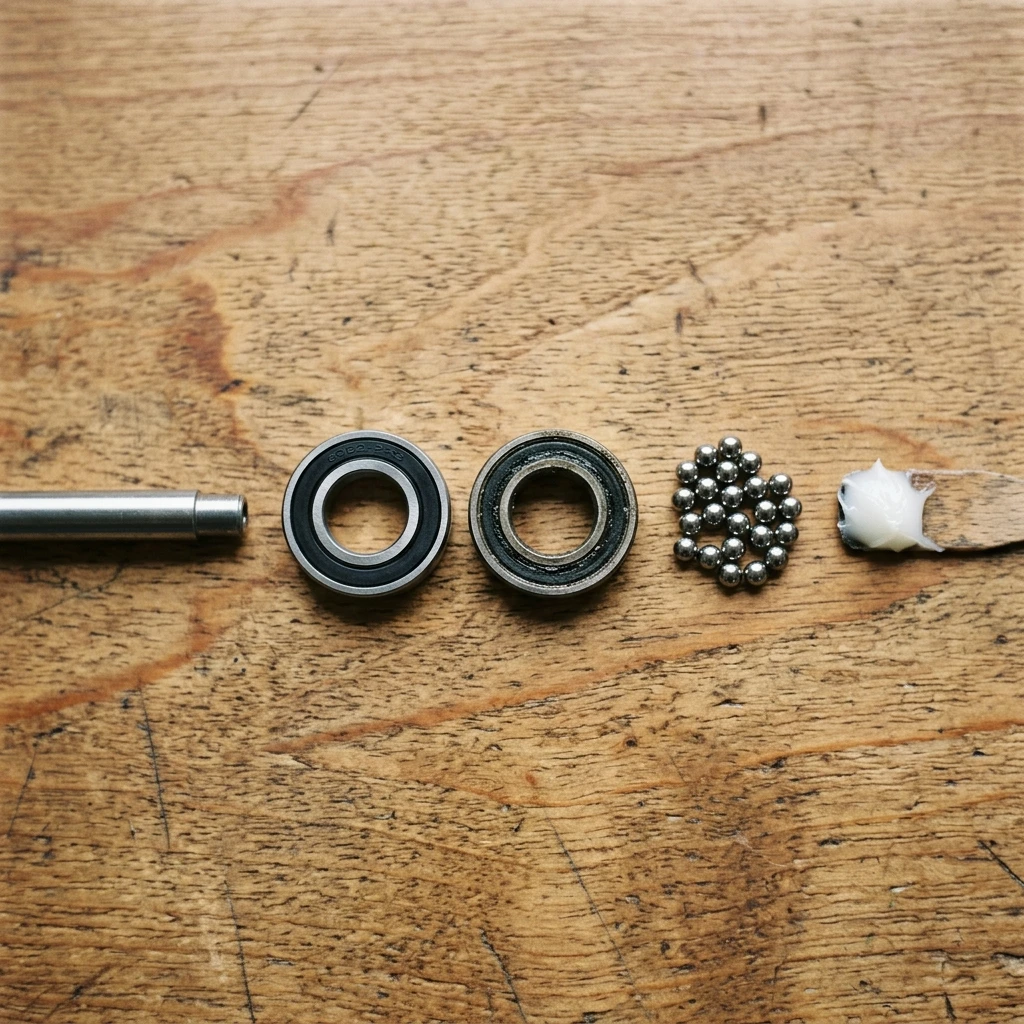
Older and some current premium hubs use loose ball, cup-and-cone bearings: individual steel balls running directly between a cup pressed into the hub shell and a cone threaded onto the axle. Park Tool describes these as "relatively easy to maintain," because they can be stripped down, cleaned, regreased, and readjusted indefinitely, provided the cup and cone surfaces themselves haven't worn out. There's no unit to replace, just an adjustment to redo.
Most current premium hubs, including the sealed cartridge bearings used in Industry Nine's Torch hubs, work differently. BikeRadar is direct about the tradeoff: cartridge bearings "cannot be adjusted or fully disassembled." When one wears out, it gets pressed out of the hub shell and a new sealed unit goes in. There's no in-between step, no regrease-and-reuse option. Industry Nine's own service process backs this up: the tool required is a proprietary bearing press, and the replacement is a kit of six cartridge bearings by part number, not a tube of grease.
That's a useful thing to know before you assume "premium" means "user-serviceable forever." It often doesn't. It means the manufacturer is confident the bearing will run cleanly for the interval they've published, not that you'll be regreasing it yourself on a Sunday afternoon.
How to Tell Your Hub Needs Attention Now
You don't need to wait for a calendar reminder to run a wheel bearing service check. A few minutes of hands-on testing tells you more than a guess at elapsed months.
- The side-to-side play test. With the wheel still in the frame or fork, grab it at the rim and rock it side to side while watching and feeling for movement at the hub. Park Tool's guidance is to feel specifically for "a knocking sensation" as you rock and rotate. Any detectable play means the bearing adjustment (or the bearing itself) has already failed.
- The off-the-ground spin test. Lift the wheel clear of the ground and spin it. BikeRadar puts it simply: "if your wheels feel rough when you spin them, it's time to service the hubs on your bike." Smooth and quiet is healthy. Anything gritty, notchy, or inconsistent through the rotation is wear.
- The listen-and-feel test. RoadBikeRider notes a symptom that's easy to miss: "a ticking sound if you spin the wheel, which is the dry ball bearings falling," a sign the grease has broken down well before you'd feel outright play. In more advanced cases, the axle itself becomes "dry and binding so bad that you can barely turn the axle by hand."
- Freehub drag is a separate question. Slow or inconsistent freehub engagement points to the pawls or ratchet mechanism, not the wheel bearings. Worth checking, but it's a different service item and doesn't confirm or rule out bearing wear either way.
If you're already unsure whether an adjustment on a cup-and-cone hub can be tightened back to zero play, Park Tool has a second-order test worth knowing: trace the bearing race with the ball end of a pen. Roughness felt as the pen passes over the surface means the race itself is pitted, and no adjustment will make a pitted race run smooth again. That's the line between "needs a regrease" and "needs new cones."
What Happens If You Wait
A hub bearing that's allowed to run past the point of detectable play doesn't stay a small problem. On a cup-and-cone hub, a cone and cup surface that's been ridden with play present will pit and gall, moving the repair from "strip, clean, and readjust" to "replace the cones and races," which is a more involved job with a narrower range of compatible parts. On a sealed cartridge hub, the bearing itself is the wear part, and once it's contaminated or pitted there's no adjustment to fall back on; it gets pressed out and replaced.
The broader risk sits one level up from the bearing. BikeRadar notes that unchecked bearing wear "will introduce play to the hub, allowing the wheel to rock from side-to-side on its axle." That rocking motion doesn't stay contained to the bearing. It transmits load into the axle and, on the drive side, into the freehub body, in ways those parts were never designed to absorb. The honest, conservative version of this warning is simple: a bearing that's cheap and routine to service on schedule becomes progressively more expensive to ignore, and the exact dollar figure depends on how long it runs past the point where the play test would have caught it.
Riding Conditions Change the Math
Every one of the manufacturer intervals above splits roughly the same way: a long interval for dry conditions, a much shorter one for wet, muddy, or otherwise harsh riding. That's not a marketing hedge. It's the same logic Componentry already applies to chain wax intervals and suspension service: water and grit are what actually break down a sealed bearing, not the number of pedal strokes it's absorbed.
A hub ridden mostly on dry roads can genuinely reach the upper end of its manufacturer's stated interval. A hub ridden through a wet winter, on muddy gravel, or washed down with a pressure washer aimed too close to the axle needs the shorter end of that same range, sometimes the quarterly figure both Chris King and DT Swiss publish for harsh conditions. The bearing doesn't know how many months have passed. It only knows what's gotten past the seal.
How Componentry Helps You Track Wheel Bearing Service
Componentry already tracks wheels as individual components on your bike profile, front and rear, the same way it tracks your chain and cassette. It pulls distance and time automatically from every Strava, Garmin, or Wahoo activity, so you never have to log a ride by hand.
That's the exact input the manufacturer intervals above are built around. Chris King's "6 to 12 months dry, 3 months wet" and DT Swiss's near-identical split are calendar-based guidance standing in for something Componentry can measure directly: how much you've ridden that wheel, and over what stretch of time. Set a service reminder on your wheel component calibrated to how you actually ride it, rather than trying to remember the last time you serviced a part you can't see turning.
The app handles the tracking. The play test and the spin test are still yours to run.
Know when your hub bearings are actually due for service. Componentry tracks distance and time on every component across every bike, synced automatically from Strava, Garmin, and Wahoo. Set a service interval that matches your conditions and get alerted before a rough spin turns into a worn axle. Get started free →
Further Reading
Related Componentry Articles:
- Bottom Bracket Service: How Long It Lasts and Why the Creak Sometimes Comes Back: the same sealed-bearing service logic applied to a component you can't see at all
- Ceramic Bearing Longevity: Tracking the "hidden wear" of OSPW systems: a different bearing, the fastest-spinning one on the bike, with its own wear story
- How to Track Bike Maintenance When You Own Two or More Bikes: keeping wheelsets and their service history straight across a fleet
Technical Reference:
- Chris King: Boost CL Service Manual: official service intervals, break-in period, and RingDrive care
- DT Swiss: Ratchet EXP Maintenance Notice: official annual and harsh-conditions service guidance
- Park Tool: Hub Overhaul and Adjustment: cup-and-cone service, play test, and the pen-trace pitting check
- BikeRadar: Bicycle Bearings, Everything You Need to Know: cup-and-cone vs. sealed cartridge design differences
- RoadBikeRider: Checking the Condition of Bicycle Wheel Bearings: field tests for dry and worn bearings