Why Bottom Brackets Wear Out
Every rotating bearing wears eventually. What determines whether that takes three years or three months is almost entirely about what gets past the seal.
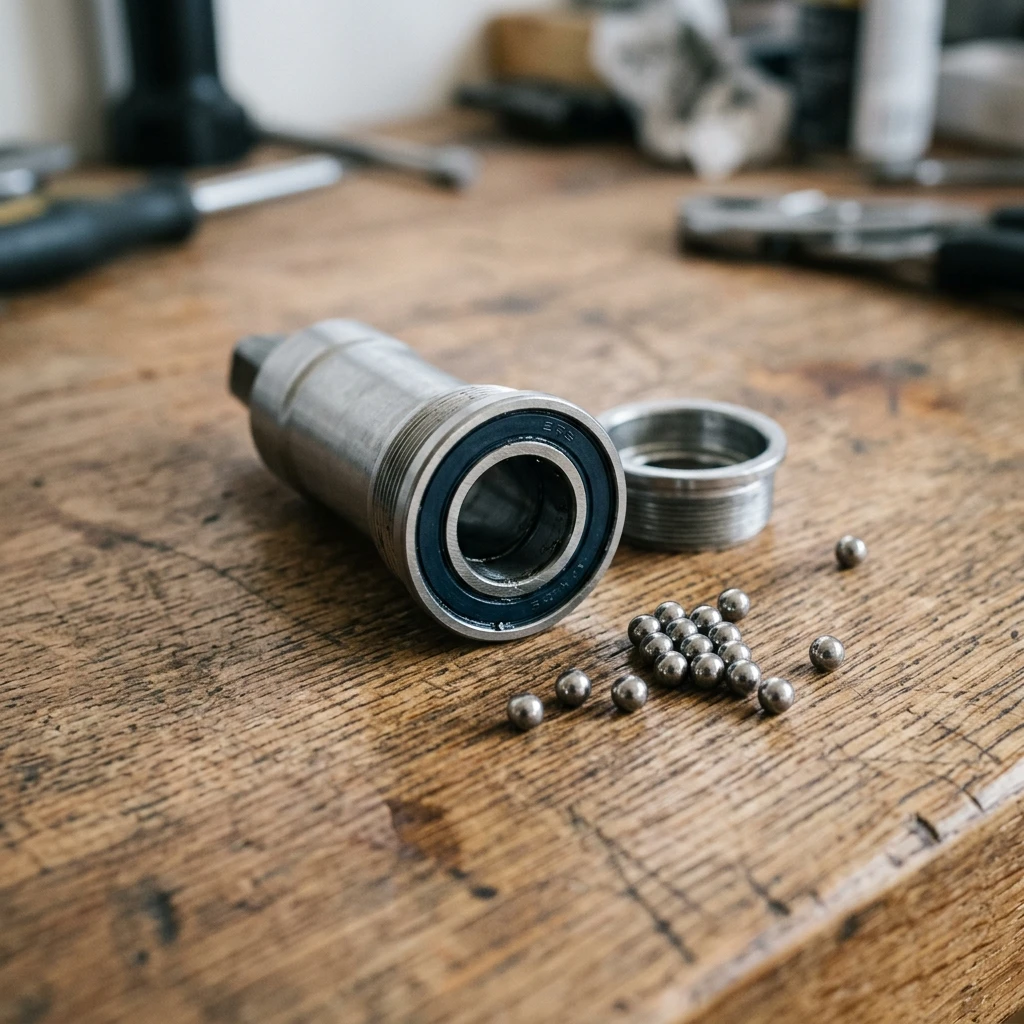
Sealed cartridge bottom brackets use small ball bearings running in a race, protected by a rubber or labyrinth seal designed to keep grease in and everything else out. Under normal, dry, well-maintained conditions, that seal does its job for a long time. Two things defeat it faster than ordinary pedalling fatigue ever would.
Water is the first. Pressure washing directly at the BB shell, riding in heavy rain, or storing a bike wet all push water past a seal that was only ever rated to shed light spray. Once water reaches the grease, it emulsifies, loses its protective properties, and the bearing surfaces start to corrode. Grit is the second, and it's worse, because unlike water it never evaporates. Fine grit from gravel or trail riding works its way in through the same path and sits in the grease acting as an abrasive on every rotation.
Once either has happened, the bearing's remaining life is set by how much material has already been abraded away, not by how many kilometres are left on some theoretical service schedule.
Threaded vs. Press-Fit: Not the Same Reliability Story
The bottom bracket standard your frame uses changes more than just which tool fits it.
Threaded standards (English/BSA at 1.37 inches × 24 TPI, T47 at 47mm × 1.0mm pitch, and the less common Italian standard at 36mm × 24 TPI) hold the bearing cups in the frame with actual threads. The connection is mechanical and doesn't depend on a precise fit between two round surfaces.
Press-fit standards (PF41, covering BB86/BB92; PF42, BB30; and PF46, PF30/BB386EVO) hold the bearing cups purely through an interference fit: the cup's outer diameter is machined very slightly larger than the frame shell's bore, and friction alone keeps it in place once pressed together. That works perfectly when both the shell and the cup are manufactured to the tight tolerances the standard specifies. It creaks when they aren't.
Servicing vs. Replacing a Sealed Bottom Bracket
For the sealed cartridge bottom brackets on almost every modern bike, "service" and "replace" are effectively the same action. Unlike an older cup-and-cone bottom bracket, which a mechanic can strip down, regrease, and reassemble, a sealed cartridge is a single pressed unit with no user-serviceable parts inside. There is nothing to adjust and no way to repack the bearings. Once the hand-spin test described below shows genuine bearing wear rather than a shell-tolerance problem, the correct response is to replace the cartridge outright, not to open it up.
That makes the inspection interval the whole job. There is no midpoint maintenance step that extends a cartridge's life the way a cable adjustment or a chain relube does. You check it, and either it's fine or it needs a new one.
Why Replacing the Cartridge Doesn't Always Stop the Creak
This is the part most maintenance guides skip, and it's the reason a straightforward-sounding repair sometimes fails twice in a row.
Press-fit creak is often not a bearing problem. BikeRadar's press-fit feature traces it to an inconsistent fit between the frame shell and the bearing cup: if the bore is too big, the cup does not fit tightly, which can lead to creaking, and plastic cups can change dimensions over time under load. The same article lists other possible sources, such as the spindle moving in the bearings or pedals rocking in the crank arms. A brand-new cartridge pressed into the same loose shell will creak just as readily as the old one did, because the cartridge was never the part that was wrong.
The practical test that separates the two problems: pull the cranks, remove the bottom bracket, and spin the bearings by hand with your fingers. Smooth and quiet with no play means the bearing itself is fine, and a creak is coming from the interface, not the cartridge. Gritty, notchy, or with detectable side-to-side play in the races means the bearing has genuinely worn out and needs replacing.
If a fresh cartridge creaks again within days on a press-fit frame, the fix is not a third cartridge. It's addressing the shell itself: cleaning and lightly refacing the bore, using a cartridge with a slightly larger outer diameter designed for a looser press, or in persistent cases converting to a threaded solution like T47 if the frame supports it. None of that is obvious from the symptom alone, which is exactly why guessing at "replace it again" wastes money without fixing anything.
When to Replace a Bottom Bracket: Three Signs
Creaking or clicking from the bottom of the frame, especially when it changes with pedalling load but not with braking or steering, points toward the bottom bracket area, though on a press-fit frame it doesn't yet tell you whether the cause is the bearing or the shell.
Lateral play in the crank arms. With the chain off, grab a crank arm and push it side to side. Any detectable movement (a knock you can both feel and sometimes hear) means the bearings or their retention have failed and the bottom bracket needs immediate attention rather than a watch-and-wait.
Rough or gritty rotation. Spin the cranks by hand with the chain off. Smooth and silent is healthy. Anything crunchy, notchy, or inconsistent through the rotation is bearing wear that a regrease will not fix.
How Componentry Tracks a Component You Can't See
A bottom bracket is one of the hardest components to stay on top of, precisely because it gives you almost nothing to look at. There's no wear indicator, no tooth profile to inspect, no thickness to measure with calipers. The bearings are sealed inside the frame, and the only feedback you get is a creak that, as this guide covers, doesn't even reliably tell you what's wrong.
Componentry tracks distance and time on your bottom bracket the same way it tracks every other component: automatically, from every Strava, Garmin, or Wahoo activity, with no manual logging. Set a bottom bracket service interval calibrated to your riding conditions (shorter for wet-weather or off-road riding, longer for dry road use) and get a reminder before the bearings are likely to be contaminated, rather than after they start making noise.
That matters more here than almost anywhere else on the bike. A worn chain gives you weeks of gradually degrading shifting as warning. A worn bottom bracket gives you nothing, until it doesn't. Knowing exactly how long it's been since your last service turns a guess into a scheduled task, and gives you a real answer the next time a creak shows up: is this overdue for a regrease, or is it something else?
The app handles the tracking. You make the call on whether to open it up.
Know when your bottom bracket is actually due for service. Componentry tracks distance and time on every component across every bike, synced automatically from Strava, Garmin, and Wahoo. Set a service interval that matches your conditions and get alerted before the bearings fail. Get started free →
Further Reading
Related Componentry Articles:
Technical Reference: