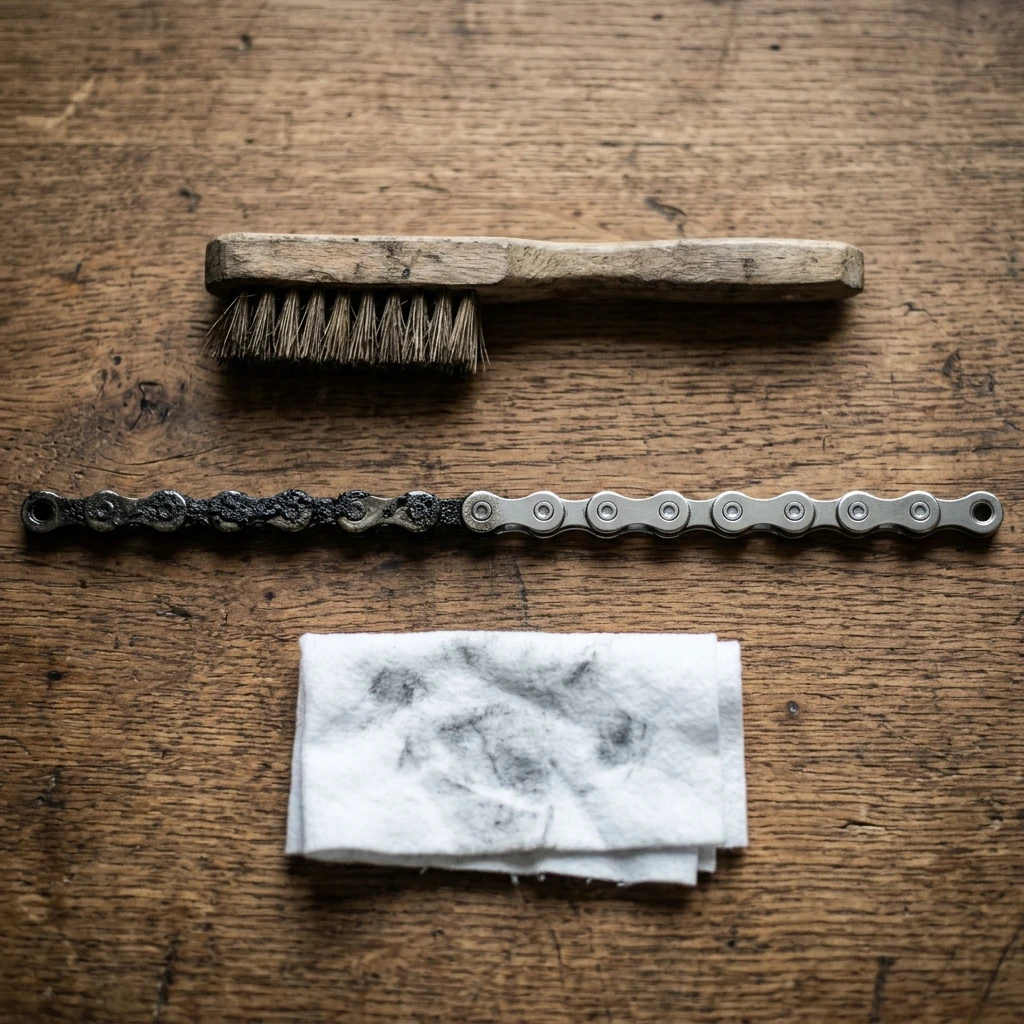
Wipe and Re-Lube
A wipe-down is the lowest-effort option. Run a clean rag along the chain while backpedalling, then add lube where it is needed.
The trade-off is what happens if you skip cleaning altogether. BikeRadar is blunt about it:
"If you lube a dirty chain, it will only continue to attract more contaminants and not be of particular benefit." BikeRadar: How to clean a bike chain
The same article also says "it's better to re-lube over a dirty chain than do nothing at all." Read the two together. A wipe and fresh lube is a stopgap that beats no maintenance, but it is not a substitute for a proper clean.
Cleaning a Bike Chain Without Removing It
Learn this on-bike method first. It needs a degreaser, a brush or a bike chain cleaner tool, and rags. Park Tool uses a chain scrubber and notes that a stiff-bristled brush is an acceptable substitute. The steps below combine Park Tool's and BikeRadar's published procedures.
- Check wear first. Park Tool says that if the chain is worn past its service life, replace it instead of cleaning it. See the wear section below.
- Protect the brakes. BikeRadar says to cover or remove the disc rotor, or use a chain cleaning device, and keep degreaser away from the rotor.
- Set up where a mess is fine. Park Tool warns that degreaser can stain or corrode finished floors, and BikeRadar says to clean outside, not on carpet or indoor floors.
- Shift to the smallest rear cog and the front chainring, as Park Tool does.
- Apply degreaser. With a chain cleaner, seat the chain in the brushes and fill to the fill line, then turn the cranks backward for at least thirty revolutions. Without one, spray or dip a brush in degreaser and scrub while backpedalling.
- Wait about five minutes, or the time the degreaser maker recommends, per BikeRadar.
- Rinse. Park Tool uses soapy water after the degreaser, and BikeRadar rinses with water.
- Wipe until the rag stops coming away black. BikeRadar suggests repeating the process if the chain is very dirty.
- Dry the chain with a clean rag, then let it air-dry or blow it off with compressed air.
- Lube. Park Tool says to add a small drop to each rivet and wipe off the excess.
BikeRadar gives two further tips. Use a brush or rag reserved for the drivetrain so black marks do not spread to the rest of the bike. And do not leave the chain to sit overnight after cleaning, because that invites rust.
Cleaning a Chain Off the Bike
Removing the chain gets degreaser into the rollers in a way a brush on the bike cannot. You need a quick link or chain tool to take it off. BikeRadar notes that Shimano, SRAM and Campagnolo recommend a new quick link each time the chain is installed, and that many riders reuse them anyway.
SILCA describes a jar method for this: shake the chain in degreaser for 5 minutes, rinse, and repeat if the degreaser comes out cloudy. SILCA's examples of degreasers include Simple Green Aircraft diluted 13:1 and its own Bio Degreaser at full strength, but any bike-specific or aircraft-approved degreaser fits the same routine. Hang the chain to dry fully before it goes back on the bike, then lube it.
If you are preparing a chain for waxing, the final solvent steps are different. Our guide to re-waxing a chain covers cleaning before re-waxing, so this guide does not repeat it.
Ultrasonic Cleaning
An ultrasonic cleaner is a tank that shakes dirt loose with sound waves. TOUR magazin describes the effect this way:
"The so-called cavitation bubbles dislodge dirt particles even from the tiniest cavities." TOUR magazin: Dynamic ultrasonic cleaner
For a used chain, SILCA's guide runs like this:
- Wipe the chain with rags and degreaser first.
- Cover the chain with degreaser in the tank and heat it to 100 to 120 degrees Fahrenheit.
- Run 15 to 30 minute cycles, replacing and reheating the degreaser each time. SILCA says this typically takes 2 to 5 cycles, until the degreaser comes out fairly clear.
- Finish with a 15 minute unheated acetone bath, per SILCA's wax-prep process.
The same review is honest about the cost. TOUR magazin says the cleaner it reviewed is "not worth the effort for every cyclist" and hardly worth the investment for a single bike. If you only ride one bike, the off-bike soak gets most of the way there. Ultrasonic suits cyclists who clean chains often, or who wax.
What Not to Use on a Bike Chain
Most chain cleaning mistakes come down to the product, the soak time, or the water pressure.
- Standard Simple Green. SILCA says "We strongly suggest you don't use the standard Simple Green formula," and names hydrogen embrittlement as the reason.
- Mineral spirits on a used chain. SILCA limits mineral spirits to new chains, because on a used chain the solvent "will trap any moisture on the metal," and metal plus water leads to rust.
- Pressure washers. Stihl, a maker of pressure washers, says "Do not use the pressure washer on the bicycle chain" and not to aim the jet at bearings or seals, because it could force water and dirt inside and accelerate wear. BikeRadar warns that pressure washers can strip bearing grease.
- Diesel, benzene, gasoline. A BikeRadar article quotes Park Tool's Calvin Jones listing these as solvents to avoid, along with acetone, which is where the sources disagree: SILCA uses acetone as the final bath when stripping a chain for wax. For an ordinary on-bike clean, follow BikeRadar and leave acetone out. If you are prepping for wax, follow the wax maker's process.
- Long soaks. BikeRadar warns about "horror stories out there about degreaser corroding metal and causing surface cracks," and advises against long soaks.
- Degreaser or lube near the brakes. Keep both off the disc rotor and caliper.
Whatever you use, finish the way Park Tool does: lubricate the chain after cleaning, since a dry chain is not ready to ride.
When Cleaning Is Not Enough
Cleaning removes dirt. It does not take stretch out of a worn chain. Park Tool's own procedure starts by checking wear with a chain wear indicator, and says to replace a chain that is past its service life instead of cleaning it.
If the chain is noisy or shifts poorly after a full clean and fresh lube, suspect wear before cleaning it again. Measure it with a gauge, using the steps in our chain stretch measurement guide, and compare the result with the limits in when to replace your bike chain. SILCA adds that for an extremely dirty chain, "it might be better to start with a new chain."
A chain with rust on it is a separate problem. Our guide on how to prevent bike rust covers storage and drying habits that keep a clean chain from rusting again.
Clean First, Then Lube
Cleaning and lubing are one job done in two steps. A freshly degreased chain has no lube left inside it, so the lube goes on right after the chain is dry.
BikeRadar says a drip lube takes "one minute or less" to fully penetrate a rotating chain, so there is no need to wait long before wiping off the excess. It also says the minimum re-lube interval is before every ride. After the lube goes on, wipe the outer plates so the chain does not collect fresh grit.
Choosing the lube is its own question. Our guide to the best bike chain lube covers it. For the rest of a home service, see the bike tune-up checklist and our guide to basic bike maintenance at home.
Frequently Asked Questions
How do you clean a bike chain without removing it? Use the on-bike method. Protect the brakes, apply a bike-specific degreaser, backpedal the chain through a brush or chain cleaner, rinse, dry, and lube. Park Tool turns the cranks backward at least thirty revolutions with the cleaner filled with degreaser.
How do you degrease a bike chain? Use a bike-specific degreaser, and either a chain cleaner on the bike or a shake in a jar off the bike. Zero Friction Cycling says traditional solvents typically need multiple baths and often cannot absorb enough grease for an effective on-bike clean, which is why it recommends the off-bike soak.
How often should you clean a bike chain? No source used here states a fixed interval. Clean when black residue builds up, after wet or gritty rides, and when shifting gets noisy.
Can you clean a chain with soap and water only? Park Tool uses soapy water as the rinse stage after degreaser, not as the cleaner. Its procedure relies on degreaser to cut the grime.
Should you lube a dirty chain? BikeRadar says a lubed dirty chain keeps attracting contaminants, though re-lubing a dirty chain is better than doing nothing. Clean it first when you can.
How Componentry Helps You Time Chain Cleaning
A clean date is easy to forget and hard to guess. Componentry lets you log a service on the chain each time you clean it, then counts the distance you ride from your synced Strava, Garmin, or Wahoo rides. Set a reminder for the distance that suits your conditions, and you are told when it is due instead of relying on memory.
The same chain record tracks wear, so when a clean no longer fixes noise or shifting you can see how much of the chain's life is used. If you ride several bikes, each chain keeps its own history.
Recommended Resources & Further Reading
Technical Data:
Componentry Reading: