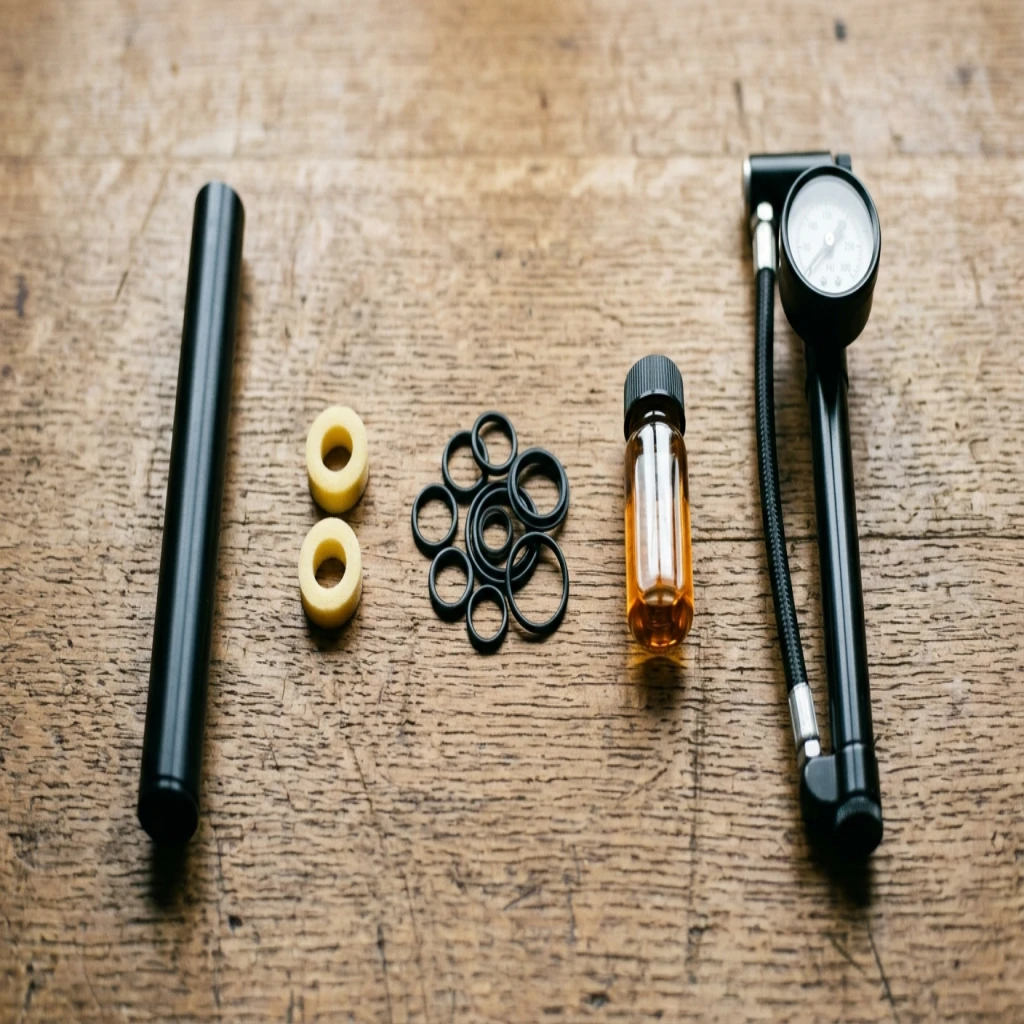
Every other component on your bike wears by distance. A chain stretches over kilometres. A cassette's teeth round off over kilometres. Brake pads wear down over kilometres. Then you get to suspension, and the manufacturer's own mountain bike suspension service schedule is written in hours.
That's not an arbitrary choice, and it's not a minor detail either. A fork or shock doesn't wear from covering ground. It wears from being compressed, over and over, under load. Two rides of identical distance can put wildly different amounts of work through a fork's seals and damper, which is exactly why "I've ridden 2,000 km on this fork" tells you almost nothing useful about whether it needs service.
Why Suspension Service Is Measured in Hours
A chain wears roughly in proportion to how far you've pedalled it. A fork or shock wears in proportion to how many times, and how hard, it gets compressed. Those are different things, and the gap between them can be large.
A three-hour ride on a smooth fire road barely loads a fork at all: some sag under body weight, occasional small bumps, nothing that stresses the seals or the damper. A three-hour ride on a rocky, technical descent puts the same fork through hundreds of hard compressions in a fraction of the distance. Both rides log the same time and maybe similar distance in a ride-tracking app. Only one of them meaningfully wore out the suspension.
This is also why the mountain bike industry doesn't have a built-in equivalent to a car's odometer for suspension: hour meters are standard on motocross bikes, where engine hours are the accepted proxy for wear, but a normal mountain bike has no equivalent sensor. Manufacturers still publish their intervals in hours, because hours of actual riding time correlates with compression cycles far better than distance does. It just means nobody's front wheel is tracking it for you.
Mountain Bike Suspension Service Intervals by Brand
Both major suspension manufacturers split service into two tiers: a basic lower-leg or air-can service, and a full service that includes the damper.
Fox organizes its published intervals by spring type rather than by individual fork model (there's no separate number for a 34 versus a 36 versus a 38 in Fox's own tech documentation):
- Air-spring forks and shocks: lower-leg oil and air-chamber service every 100 hours or annually
- Coil-sprung forks and DH-style air shocks: lower-leg service every 30 hours
- Full damper service (all types): 100 to 125 hours, or annually, whichever comes first
Fox's own guidance is explicit that this is a floor, not a ceiling: "If you ride in extreme conditions frequently (wet and muddy, downhill racing, winter riding, etc.), correspondingly the service intervals should be more frequent." Fox Factory: Service Intervals
RockShox uses a cleaner two-tier split across its current Pike, Lyrik, Zeb, Yari, and Domain forks, and its Super Deluxe and Monarch-family shocks:
- Lower-leg or air-can service: every 50 hours
- Full service (seals, air spring, damper): every 200 hours
Worth noting: RockShox's full-service interval used to be 100 hours on older fork generations before the current DebonAir/Charger damper platforms extended it to 200. If you're riding an older fork, don't assume the newer number applies.
| Brand | Basic service | Full service |
|---|---|---|
| Fox (air-spring fork/shock) | 100 hrs / annually | 100–125 hrs or annually |
| Fox (coil fork/DH shock) | 30 hrs | 100 hrs / annually |
| RockShox (current-gen fork) | 50 hrs | 200 hrs (100 hrs, older models) |
| RockShox (Super Deluxe / Monarch shock) | 50 hrs | 200 hrs |
Neither manufacturer publishes a specific numeric multiplier for wet or muddy conditions. Both say, in effect, "more often." Shop mechanics commonly cut the interval roughly in half after a genuinely muddy race weekend or a stretch of consistent wet riding, but that's trade knowledge, not a manufacturer spec.
Signs Your Suspension Needs Service Before the Interval Hits
Hour counts are a schedule, not a guarantee. A fork can need service earlier than its interval, and the symptoms are worth knowing regardless of your hour count.
- Stiction. The fork feels sticky or resistant right at the start of its stroke instead of moving smoothly. Suspension technician Lionel Saez frames the healthy baseline simply: the stanchion should always feel a little greasy. Dry is the tell.
- Loss of small-bump sensitivity. The fork starts feeling harsh over chatter it used to absorb cleanly, because internal friction is masking normal travel.
- Oil visible around the seals. A film or residue around the lower legs or shock body means contamination is getting past a seal that's supposed to keep it out.
- Sag creeping or air pressure not holding. This can mean a seal is slowly bleeding air, or, further down the neglect path, that the internal floating piston inside the damper has drifted out of position.
- Clunking, knocking, or inconsistent rebound. Clickers that used to make a felt difference stop doing anything, or the fork's rebound feels different run to run.
None of these are catastrophic on their own. The realistic consequence of ignoring them isn't a sudden failure, it's a fork that gradually loses its edge: worse small-bump compliance, less consistent damping, and more of the ride's impact reaching your hands and feet than it should.
What Skipping Service Actually Costs
The escalation from a skipped basic service to a full rebuild follows a fairly predictable path, and the cost roughly triples at each stage.
A neglected lower-leg service lets grit past the wiper seals and contaminates the oil bath that's supposed to keep the stanchion-bushing interface lubricated. That raises friction and accelerates wear on parts that were otherwise fine. Left long enough, the damper's internal floating piston can drift out of its intended position, which shows up as inconsistent damping and, in the more extreme cases mechanics describe, a full loss of air-spring support.
Real-world shop pricing gives a sense of the escalation:
- Basic lower-leg service: roughly $50 to $90 per fork or shock
- Full service including the damper: roughly $145 to $225
- Damaged stanchions from accumulated grit (a scratch tears the dust wiper's sealing edge, letting contamination in even on a fork that looks clean from outside) push toward a full stanchion or crown-steerer-unit replacement, which runs meaningfully higher again once parts and labor are combined
Cyclinic: MTB Fork Stanchion Damage covers how a scratch on the stanchion compounds: it isn't just a cosmetic mark, it's an entry point for the exact contamination the seals exist to stop.
The basic service is cheap specifically because it's preventive. The full rebuild costs more because contamination has already done some of its damage by the time you get there.
Why Distance-Based Tracking Misses Suspension
This is where suspension breaks the pattern that the rest of your bike follows. A chain, a cassette, brake pads: all of these wear in a way that scales reasonably well with distance, so an app that logs kilometres from Strava, Garmin, or Wahoo gives you a genuinely useful proxy for wear.
Suspension doesn't fit that model. A fork's wear tracks with compression cycles and the terrain that produced them, not with the distance covered while it happened. Two riders who both log 500 km a month on their Strava can have completely different suspension service needs if one of them rides smooth gravel and the other rides technical singletrack. Tracking hours ridden gets closer, but even ride duration is an imperfect proxy: a three-hour flowy ride and a three-hour rock garden crawl aren't equivalent, even though they'd log the same number of hours.
How Componentry Helps You Track Suspension Alongside Everything Else
Componentry tracks every component from the same synced ride data, whether that component wears by distance or by time. For your chain, cassette, and brake pads, that means automatic distance-based wear counters pulled from every Strava, Garmin, or Wahoo activity. For your fork and shock, it means setting a service interval in ride hours instead, matched to whatever your manufacturer publishes for your specific model and spring type, and getting an alert as you approach it.
You still make the call on terrain. A rider who knows their riding skews technical can set a shorter interval than the baseline; a rider who mostly climbs fire roads on the way to a descent can reasonably extend it. What Componentry removes is the part that's genuinely hard to do in your head: remembering how many hours have actually accumulated since your last fork service, across however many rides that took, without a dedicated hour meter doing it for you.
Set your suspension service interval the same place you track everything else on the bike, so the hours don't just disappear into your ride history unnoticed.
Further Reading
Manufacturer Service Documentation:
- Fox Factory: Service Intervals — official interval tables by spring type
- RockShox / SRAM Service Manuals — Pike, Lyrik, Zeb, and Super Deluxe service documentation
Technical Guides:
- Cyclinic: MTB Fork Stanchion Damage — how a scratched stanchion compounds into seal failure
- Singletracks: How Often Should MTB Suspension Components Be Serviced? — cross-brand interval comparison and technician-sourced wear symptoms
Componentry Resources:
- When to Replace Your Bike Chain: The Complete Guide — the same wear-tracking logic applied to a distance-based component
- Bottom Bracket Service: How Long It Lasts and Why the Creak Sometimes Comes Back — another sealed, hard-to-inspect component that needs a scheduled check rather than a symptom-triggered one