How Often Should You Add Tubeless Sealant?
Check at three months, then top up when the level is low. That is the interval Stan's gives for most riders:
"check/refresh your sealant quarterly (every three months)" Stan's NoTubes: Sealant Support
BikeRadar gives the same window as a top-up or replacement interval: every three to six months. Stan's adds that its Race Sealant should be inspected approximately every 2 to 3 weeks, which tells you the shorter-life formulas need a shorter loop.
Use these rules of thumb:
- Check at three months as a default.
- Check every couple of months in hot weather, as Muc-Off advises for +35°C riding.
- Check before a race, a big event or a long tour. Schwalbe recommends checking and replacing the sealant before a competition or a larger tour.
- Check any time a tyre loses pressure faster than usual.
- Do a full inspection with the tyre off every 12 to 18 months, which is BikeRadar's guidance.
Most maker figures are in months, because the sealant evaporates whether you ride or not. Muc-Off does give 750 miles as an alternative trigger, so check at whichever comes first.
How to Check Your Sealant Level
You do not need to take the tyre off. Two checks cover most cases.
The first check is a cable tie dipstick. BikeRadar's method works through the valve:
- Rotate the wheel so the valve sits at six o'clock and the sealant pools at the bottom.
- Let the air out and remove the valve core.
- Push a cable tie through the valve stem until it touches the bottom of the tyre, then pull it out.
- Read the sealant on the tie.
"if there's more than a centimetre of sealant on the cable tie, you're good to go." BikeRadar: How often should you change your sealant
BikeRadar's alternative is to lift one bead with a tyre lever and look inside. That shows more but is messier, and sealant is likely to spill onto the floor.
The second check is a needle test. Schwalbe's check is a puncture test:
"Just pierce the tread and let the tire rotate. If the hole does not seal automatically, you will need to refill sealant." Schwalbe: Tubeless FAQ
Use this test with care. It makes a real hole, so do it only when you intend to top up anyway.
Stan's also notes that a tyre weeping sealant through the casing is the sealant evaporating naturally. Porous tyres may need a refresh soon after setup, so check a new tyre earlier than three months.
How Much Sealant to Add per Tyre
Top-up volumes depend on tyre width. The makers give these starting amounts, in their own units. Muc-Off's are minimums, and it suggests up to 20 ml extra for added protection on road and gravel tyres.
| Tyre | Amount | Source |
|---|
| Road and cyclocross | 2 ounces (60 ml) | Stan's |
| XC 29er, 2.0 to 2.2 inch | 3 to 4 ounces (89 to 118 ml) | Stan's |
| 23 to 60 mm wide | 60 to 90 ml | Schwalbe |
| 62 to 100 mm wide | 90 to 120 ml | Schwalbe |
| 23c and 25c road | 40 to 50 ml | Muc-Off |
| 28c road | 50 to 60 ml | Muc-Off |
| 30c to 45c gravel | 70 to 80 ml | Muc-Off |
| 29 inch MTB | 105 to 140 ml | Muc-Off |
These amounts are for a fresh fill. A top-up is usually smaller, because some sealant is still in the tyre. Follow the amount printed on your bottle, which depends on wheel size and tyre width, then check the level again with the cable tie. Schwalbe adds that you can fill in extra sealant "if you don't mind the extra weight."
Park Tool's TSI-1 injector adds sealant through the valve stem of a mounted tyre without unseating the bead. You still need to remove the valve core first.
Top Up or Clear Out and Replace?
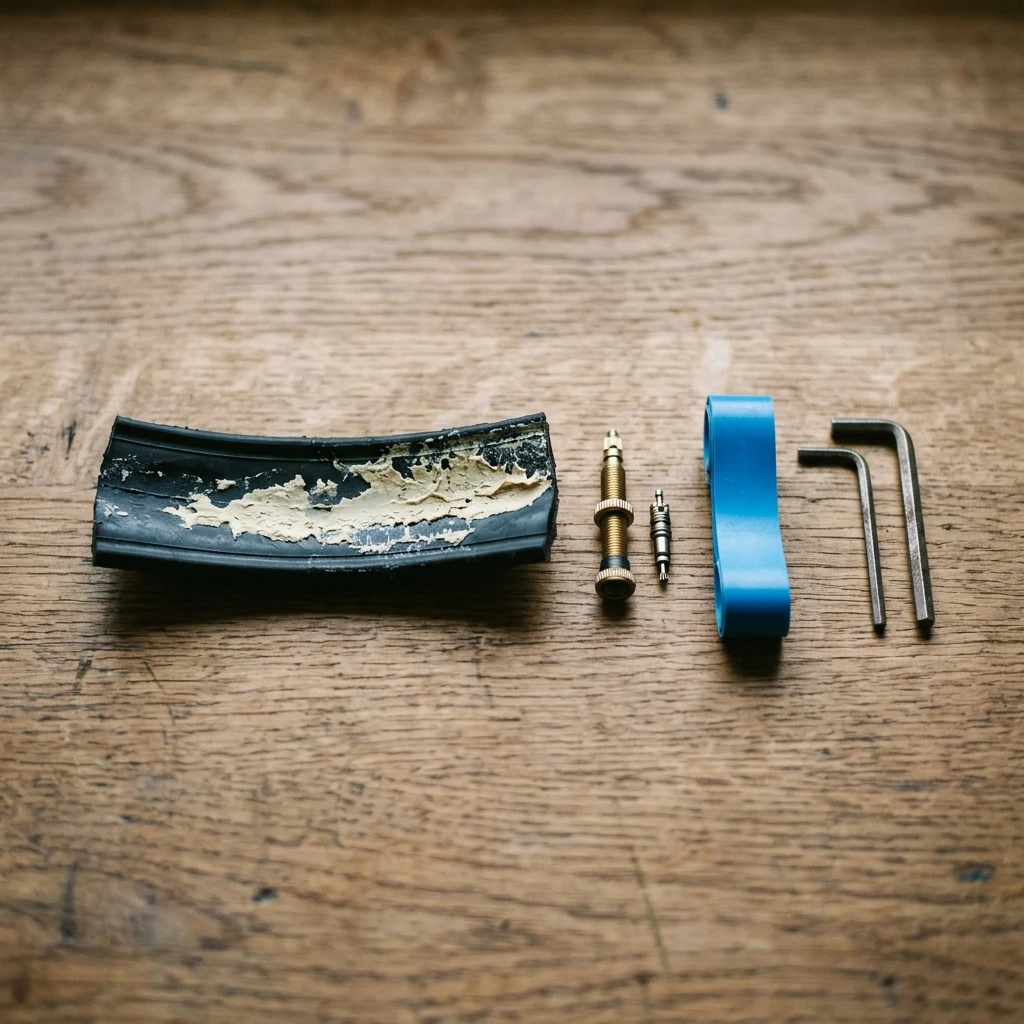
Topping up is fine for a while. At some point the old sealant has dried into flakes and chunks that do nothing. Muc-Off warns that topping up without clearing out the old sealant can dilute the new.
Do a full clear-out when:
- You find dried chunks or flakes on the cable tie or inside the tyre.
- The tyre keeps losing air after a top-up.
- You are replacing the tyre, or the 12 to 18 month inspection is due.
- You want to switch to a different sealant.
For a clear-out, Muc-Off's method is to take the tyre off, drain what remains, and wipe out the residue and dried chunks with a cloth, sponge or brush before adding new sealant. Muc-Off's own blog recommends swapping the sealant every 4 to 6 months for the best protection against flats.
Silca's two-part system takes a different route. Its replenisher page says "Up to 3 months of sealant life before adding replenisher to extend the life for up to a year." A road.cc report on the launch says that with the two-part system you only need to "clean out your tyres and reset the wheels once a year." That is one maker's system and does not apply to other sealants.
What Sealant Cannot Do
Sealant fixes small punctures, not every failure. Schwalbe states that Doc Blue is not suitable for large defects such as cuts or bursts, and that larger cuts or snake bites are cases where the fluid does not help. Carry a tube or a plug kit, and replace a tyre with a damaged casing. Our guide on when to replace bike tyres covers the signs.
Pressure matters for sealant tyres too. Our tyre pressure calculator guide helps you set pressure for your weight and tyre width.
Tubeless Sealant FAQ
How long does tubeless sealant last? About 2 to 6 months for most makers. Stan's says 2 to 6 months on average, Schwalbe says about 2,000 km or 2 to 7 months, and Muc-Off says 3 to 6 months for its road and gravel sealant.
How often to add tubeless sealant? Check at three months and top up if the level is low. Check sooner in hot weather, before a race, or when a tyre loses pressure faster than usual.
What is the best way to check sealant for tubeless tires? Use a cable tie through the valve with the valve at six o'clock. More than a centimetre of sealant on the tie is a good level, according to BikeRadar.
Can you add tubeless tire sealant through the valve? Yes. Remove the valve core and inject the sealant, with a syringe or an injector such as Park Tool's TSI-1.
How Componentry Helps You Track Sealant
Sealant runs on a calendar, and many riders own more than one set of wheels. It is easy to lose track of which set of tyres was last topped up, and a tyre that goes soft mid-ride is a late reminder.
In Componentry you can add a reminder to the tyre or wheel component and set it to a time interval you choose, such as three months. Log the date each time you check or top up, and the next reminder moves forward. If you ride a road bike and a gravel bike, each bike's tyres get their own reminder. Componentry does not measure the sealant level in the tyre. The cable tie check is still yours to do, but you will not forget when it is due.
Distance still matters for other parts. Componentry adds the distance from each synced ride to the chain, cassette and tyres on the bike you rode, so those reminders arrive on time too. Our bike maintenance schedule shows how the calendar items and the distance items fit together.
Where Sealant Fits in Your Maintenance Schedule
Sealant is on every tubeless bike's list, but the interval changes with the terrain. These guides show where it sits for each type of riding:
Further Reading on Tubeless Sealant
Maker guidance:
Independent guidance:
Componentry reading: