Chain Power Loss
How Componentry estimates the watts a chain's condition is costing you, and how cleaning and re-waxing win them back.
Componentry estimates how many watts your chain's condition is costing you and, more usefully, how many of them a clean and fresh wax or lube would win back. It works for every rider, including Strava-only accounts, with accuracy that improves as you ride with a bike computer.
Where you'll see it
- Component list: the chain's row carries a purple chip, for example Loss 3.6 watts · Recoverable 3.2 watts.
- Bike cards: on the dashboard and Bikes page, each bike shows the chip for its chain. If a bike has more than one chain, for example one per profile, it shows the chain with the most to recover.
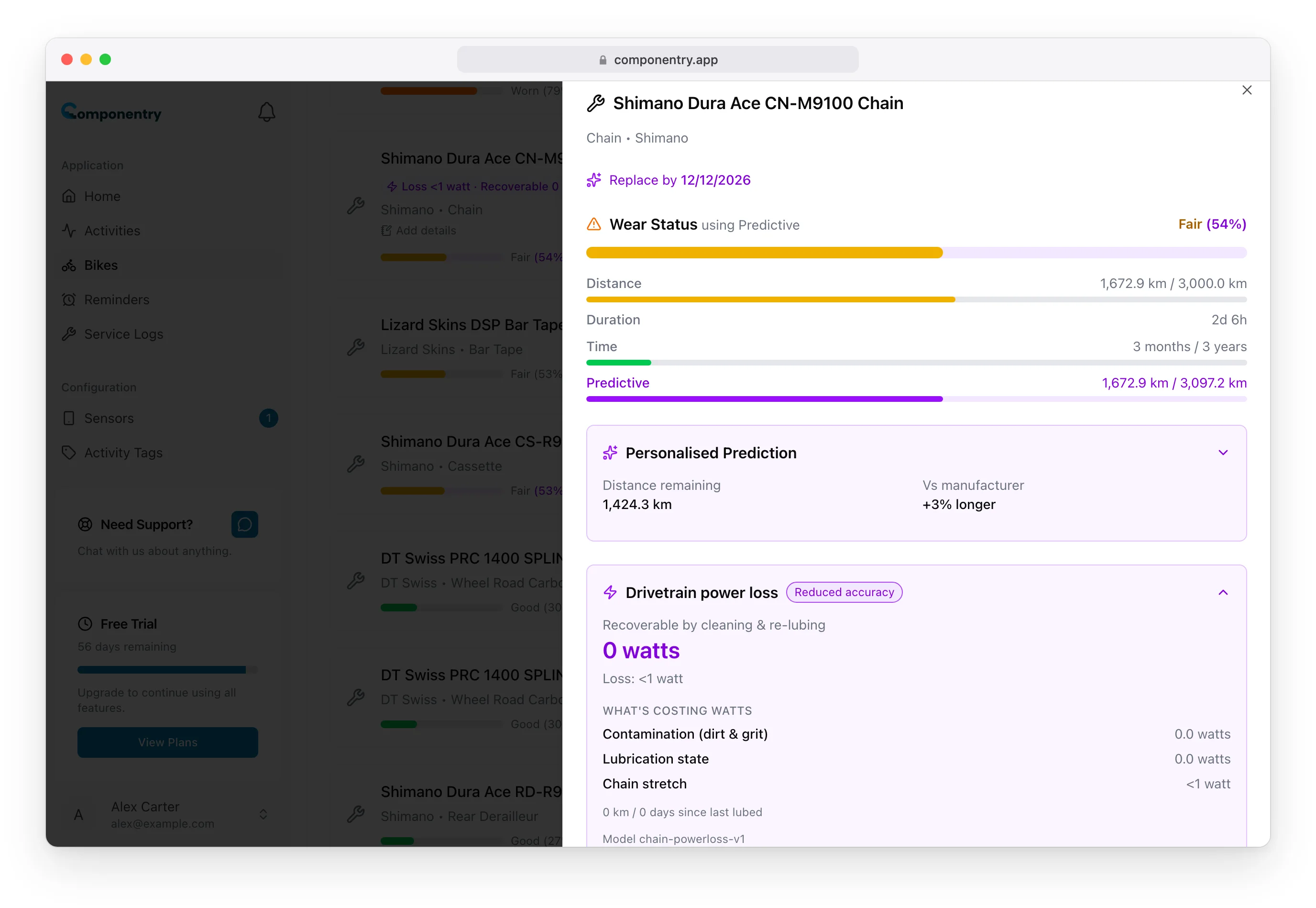
- Chain details: open the chain with the eye button to see the Drivetrain power loss card.
Losses under a watt read as <1 watt. est. after the chip means the figure leans on assumptions (see How to sharpen the estimate, below).
What the numbers mean
- Loss is the whole penalty against a clean new chain.
- Recoverable is the part you get back with maintenance alone: a clean and a fresh wax or lube.
The gap between them is chain stretch, which only a new chain fixes.
The Drivetrain power loss card leads with the recoverable watts, labelled Recoverable by cleaning & re-waxing or re-lubing to match your chain, with the total Loss underneath. Click the card to expand What's costing watts:
- Contamination (dirt & grit): usually the biggest and most variable part, and the one cleaning recovers.
- Lubrication state: how fresh your wax or lube is. It worsens with distance and days since you last lubed.
- Chain stretch: mechanical wear. Small, and only recovered by a new chain.
Below the breakdown you'll see how far and how long it has been since the chain was last lubed, or "Estimated from typical lubrication habits" if Componentry doesn't know yet.
How to sharpen the estimate
Tell it wax or lube. A good wax stays cleaner for much longer than most drip lubes, so the model treats them differently. Set the Waxed switch on the chain. See Chains.
Keep the lube reminder going. The estimate is at its best when Componentry knows when you last cleaned and lubed. That's what the chain's Lube/Wax chain reminder records. Mark it complete after you do the job and the estimate restarts from a fresh baseline: it drops straight away, then climbs again as distance and wet rides build up. If the chain has no lubrication reminder, the card suggests adding one. See Completing reminders.
Record chain stretch. A chain checker reading logged in a completed service or maintenance check replaces the estimated stretch with your measurement.
Ride with a bike computer. With fewer than 10 rides from a bike computer, the card shows a Reduced accuracy badge and scales the estimate against typical values. Once you pass 10, it reads your own power and conditions directly.
When you replace a chain in a service log, its lube reminder moves to the new chain, so the estimate carries on from the right baseline.
How we built this, and what we don't show
The model is grounded in independent laboratory testing of drivetrain efficiency, not marketing figures. That research shaped how we present the number:
- The mechanical penalty from a stretched chain is real but small, a watt or two at replacement thresholds. The large figures people associate with "a worn chain" come from a chain that is worn, dirty and poorly lubed all at once. We keep those effects separate.
- Contamination and lube state are the big, recoverable levers, which is why we lead with recoverable watts and with cleaning, not replacement.
- A worn chain's most expensive consequence is usually the cassette it wears out, not the watts it costs. That's a durability question, handled by the chain's wear tracking and predictions rather than this estimate.
The exact formula and coefficients are Componentry's own, and we don't publish them.
Sources
- CeramicSpeed / Friction Facts: Drivetrain Efficiency Test, Old vs. New.
- Velo (Dave Rome): lab testing on dirty vs. clean chains.
- SILCA: the science of chain efficiency.
- Zero Friction Cycling: chain longevity and real-world friction testing.
- Park Tool: when to replace a chain, and cassette-life effects.
- Spicer et al. (2001), Journal of Mechanical Design: bicycle chain-drive efficiency.
The mobile app shows the same chip and Drivetrain power loss card.