Choose the Right Chain
The first decision is the speed count, which is the number of cogs on your rear cassette. BikeRadar says chains are manufacturer- and groupset-specific, and come in various sizes.
BikeRadar's compatibility guidance, published on 2 October 2024, breaks down like this:
| Speed count | What BikeRadar says |
|---|
| 9-speed and under | Generally cross-compatible, with the exception of Campagnolo |
| 11-speed | Some wiggle room between Shimano and SRAM road chains, but it is generally advisable to stick with the manufacturer and the respective road, gravel or mountain bike line |
| 12-speed and 13-speed | Almost no cross-compatibility between brands, so stick with the manufacturer and groupset |
When you are unsure, buy from the same maker and family as your shifters and cassette.
Two details are easy to miss. SRAM's latest AXS groupsets use a Flattop chain, which BikeRadar says must have its flat edge on the outside of the drivetrain. And many chains are directional, so check for writing or an arrow on the outer plates that shows the direction of travel.
You need a new chain, and one of two ways to join it.
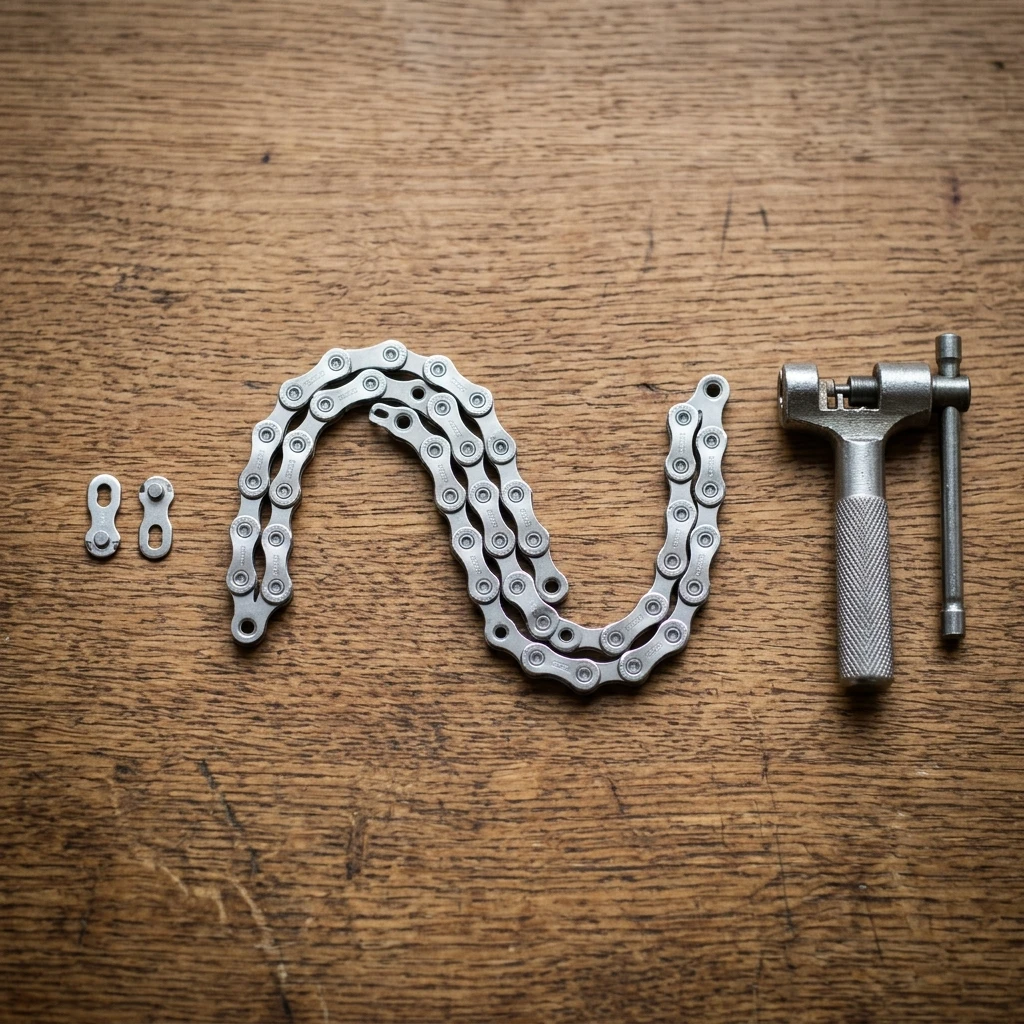
- A quick link, which BikeRadar says has a set of unique interlocking side plates and is sometimes a different colour. Quick link pliers open and close it. Park Tool lists its master link pliers as compatible with 5-to-13-speed derailleur chains that use a master link.
- A connecting rivet and a chain tool. Park Tool says each connecting rivet is specific to the make and model of chain, so use the one made for your chain.
You need a chain tool to cut the new chain to length even if you join it with a quick link. BikeRadar says the majority of chain tools work with chains up to and including 11-speed, so check the tool if you run 12 or 13 speed. Park Tool lists its CT-3.3 as compatible with 5-speed to 12-speed chains. Campagnolo chains need a chain breaker with a peening function, with the exception of Ekar and its C-Link quick link.
Have a rag and chain lube ready too. Our guide to the best bike chain lube helps you pick one.
How to Replace a Bike Chain: Remove the Old One
Shift the rear derailleur onto the smallest cog. If your bike has a front derailleur, shift to the big chainring. BikeRadar also says to release the clutch on the rear derailleur if it has one. Taking the rear wheel off is optional, and it takes tension off the chain.
Then use the method that suits your chain.
With a quick link:
- Find the quick link. Park Tool says to position it in the lower section of chain.
- Put the quick link pliers on either side of the link and squeeze. BikeRadar says this can need force, particularly on non-reusable quick links.
- Lift the chain off, either by pedalling it off the chainring or by feeding it out of the rear derailleur.
With a chain tool:
- Find the connecting rivet, which looks different from the others.
- Choose a different rivet. Park Tool says to pick one several rivets away from any connecting rivet already in the chain.
- Bring the pin of the chain tool up to the rivet and drive it out in a straight line.
If the old chain is worn out and you have no quick link pliers, BikeRadar says you can drive out a rivet with the chain tool instead of unlocking the quick link. Park Tool says the same for a worn chain.
Size the New Chain
New chains typically ship longer than required, per BikeRadar, so you cut them to size. BikeRadar says a chain that is too long sags in the smallest gears and could cause damage. A chain that is too short puts strain on the rear derailleur and hanger, potentially ripping both off the frame.
There are three common ways to size it, plus the maker's own rule for Campagnolo.
Match the old chain. Park Tool says this works if the old chain was the correct length. Line the chains up side by side and match them rivet by rivet, outer plate to outer plate or inner to inner. Remember the old chain has stretched. BikeRadar says wear can add up to a full link or more, so do not lay the two chains end to end and trust the match.
First check the old chain was the right length. Park Tool says it should shift to the largest front and rear sprockets with two slight bends at the derailleur pulleys, and in the smallest cogs it should show no slack.
The big-big method. BikeRadar describes wrapping the uncut chain around the largest cassette tooth and the largest chainring, bypassing the derailleurs. Pull the ends together tightly and add four additional links. If you are using a quick link and the link to cut is an outer link, cut at the next available rivet.
The small-small method. For 2x and 3x drivetrains, BikeRadar says the most accurate method is to fit the chain on the smallest cog and smallest chainring, routed through the derailleur. Pull the ends towards each other until the derailleur cage starts to move, then cut where the links overlap. With a quick link, if the overlap falls on an outer link, move to the next inner link and cut there.
Campagnolo 12-speed chains. BikeRadar reports that sizing depends on chainstay length, measured from the centre of the crankset to the centre of the rear dropout. A chainstay between 405 and 415mm takes 110 links, and over 415mm takes 112 links.
Route and Join the Chain
Before routing, check whether the chain is directional. Park Tool says logos or printed letters should face out toward the mechanic on the drive side. Feed the chain through the rear derailleur, and note any tabs on the cage. Park Tool says to route the chain on the correct side of the tab. Then bring it through the front derailleur and bring both ends together.
Join With a Quick Link
Fit the two halves of the quick link into the chain ends by hand, then seat them. Park Tool says to check the link for an arrow showing direction of travel.
There are two ways to seat it. Quick link pliers pull it closed. Without pliers, Park Tool says to put the link on the upper run of the chain, apply the rear brake, and push on the pedals. BikeRadar says you should hear a loud click, then check by eye. Park Tool adds that you should inspect the link to make sure it is fully engaged.
To test the length first, BikeRadar says you can partly fit the quick link without clicking it into place.
Join With a Connecting Rivet
Park Tool says to lubricate the rivet and install it from the inside of the bike toward you. BikeRadar gives the reason. When the pilot tip is snapped off, it can leave a small burr, and a rivet fitted from the inside keeps that burr away from the cassette teeth, where it could cause noise.
Drive the rivet in with the chain tool. BikeRadar says there are two points of resistance, and that you should stop once it is seated and match the depth of the neighbouring rivets. Then snap off the pilot tip. Campagnolo rivets need a peening step after that, which the CT-3.3 cannot do.
Check the Chain Before You Ride
Backpedal and watch for tight links. Park Tool says to flex the chain sideways at a tight link to free it. Then shift through the gears and listen for skipping.
Add lube once the chain runs freely.
What to Do With the Old Chain and the Cassette
Many workshops have a metal bin for recycling the old chain, according to BikeRadar.
The cassette is the bigger question. BikeRadar says it is best to change the chain at the same time as the cassette, because a worn chain will wear a new cassette out faster or lead to skipping. If you replace the chain on its own, watch for skipping on the cassette teeth, and for teeth that have become hooked or shark-finned.
Park Tool says the same about skipping. After you fit the new chain, skipping could be a symptom of a worn cassette or freewheel cogs.
If you are unsure whether the cassette is worn, our guides to cassette lifespan and how long a bike cassette lasts cover the signs. The cost of a worn drivetrain shows why replacing the chain on time is the cheaper route.
Bike Chain Replacement Cost: Parts and Labour Examples
Three costs apply: the chain, the tool if you do not own one, and labour if a workshop does it. The prices below are examples, each seen on the page on 22 October 2026, and none is a quote for your area.
| Item | Example listing | Source and date seen |
|---|
| Shimano 105/SLX CN-HG601 11-speed chain | €19.95, with an RRP of €36.95 | Rose Bikes, 22 Oct 2026 |
| Same chain, 126 links | $35.10 on sale, listed at $38.99, shown as back order | Performance Bicycle, 22 Oct 2026 |
| Park Tool CT-3.3 chain tool | $48.95 | Contender Bicycles, 22 Oct 2026 |
| Workshop labour, chain replacement | €25, labour only | Emilia Sport, Tampere, updated August 2026, seen 22 Oct 2026 |
| Workshop labour, chain and cassette together | €40 plus parts | Emilia Sport, Tampere, updated August 2026, seen 22 Oct 2026 |
| Campus co-op, chain install | $5 labour, with a $15 to $25 estimate including a chain | CSUN Matador Bike Shop, 22 Oct 2026 |
Workshop labour is a separate line from the parts. The Emilia Sport page says prices cover labour and parts are billed separately, so ask the shop whether a quoted price includes the chain. If you only ever change one chain, the example tool costs more than the example chain, which is a fair reason to pay for the labour instead.
The chain prices above cover one model. Other speed counts and groupsets cost different amounts, so check the listing for your own drivetrain. We left out quick link prices because we could not confirm a current price on a page that was in stock.
Frequently Asked Questions
How do you change a bike chain? Remove the old chain at its quick link or by driving out a rivet with a chain tool. Size the new chain, route it through the derailleurs, join it with a quick link or connecting rivet, and check the shifting in every gear.
How often should you replace a bike chain? Replace it when a chain gauge says it is worn, not on a fixed schedule. Park Tool's checker uses 0.75% for 5-to-10 speed chains and 0.5% for 11-to-12 speed chains.
Do you need a chain tool to change a bike chain? If your chain has a quick link and is the right length, you only need pliers, or the brake-and-pedal method. You need a chain tool to cut a new chain to length, and to remove a chain that has no quick link.
Should you replace the cassette with the chain? BikeRadar says it is best to change them together, because a worn chain will wear a new cassette out faster or lead to skipping. If the new chain skips, suspect the cassette.
Can you reuse a quick link? It depends on the link. BikeRadar refers to non-reusable quick links. A Contender Bicycles listing for the SRAM PowerLock says it is reusable, but that SRAM recommends a new link if the chain is removed or broken. Check the instructions for your link.
How Componentry Helps You Replace the Chain at the Right Time
Componentry syncs your rides from Strava, Garmin, and Wahoo and adds the distance to the components on the bike you rode. Wear on the chain is tracked toward replacement, so you can see how much of its life is used before you buy the parts.
Add a reminder to the chain by distance or by time. When you fit the new chain, log the service on the component. Each component keeps its own history, so you can see when the last chain went on.
Recommended Resources & Further Reading
Technical data:
Componentry reading: