Which Parts of a Road Bike Wear Out, and Which Age
Two kinds of service run side by side. Wear parts lose material with every pedal stroke and are replaced when a measurement says so. Ageing parts degrade with time, so they follow the calendar even on a bike that rarely leaves the garage.
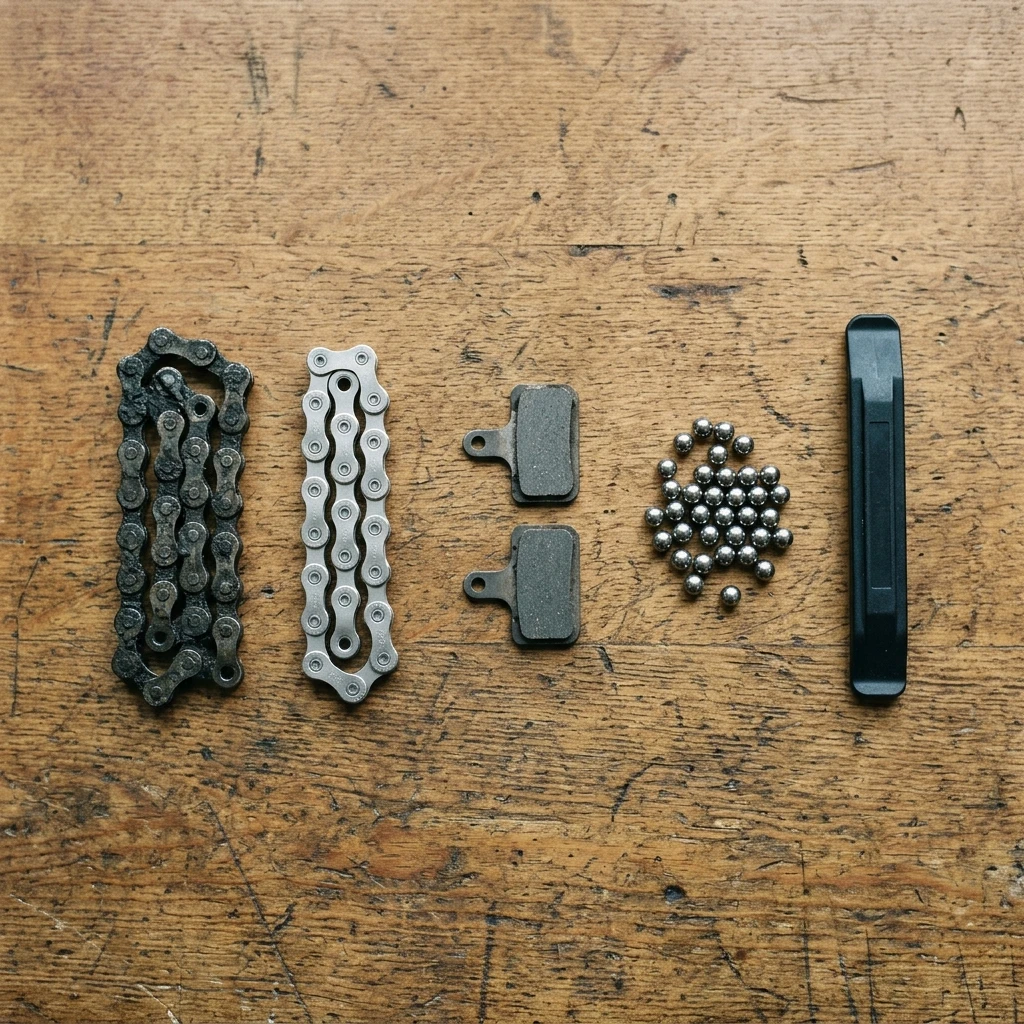
Wear parts are the chain, cassette, chainrings, brake pads and tyres. Ageing parts are brake fluid, tubeless sealant, cables and bar tape. Bearings sit in between, because grease degrades with time and contamination, and water gets in with distance.
Servicing a road bike well means knowing which clock each part is on. A rider who covers a lot of distance in dry weather will wear out a chain long before the brake fluid needs attention. A rider who commutes through winter will reach the hub and bottom bracket intervals much sooner.
The Drivetrain: Chain, Cassette and Chainrings
The chain is the part to service most often, and the cheapest part to replace on time. Park Tool and SRAM give wear limits by drivetrain: 0.5% on 11-speed and Shimano 12-speed, 0.8% on SRAM 12-speed, and 0.75% on 10-speed and below. Our chain replacement guide has the full table, and the measurement guide shows how to read a chain checker.
A cassette lasts about three chains when the chains are replaced on time. Our cassette guide puts the overall life between 10,000 and 30,000 km, and the high end only happens when the chain is never left to run long. Chainrings have no mileage figure at all. Replace them when the teeth hook, or when a new chain skips on them, as our chainring guide explains.
Wax changes the clock. A hot-melt wax lasts 300 to 400 km on dry roads, and a wax drip lube lasts 100 to 200 km, according to our wax interval guide.
Brakes: Pads, Fluid and Rotors
Brake pads are replaced by wear, and the limit depends on who sets it. Manufacturers specify 0.5 mm of friction material for hydraulic disc pads. Our brake pad guide uses 1.0 mm as a working point, which leaves a margin. That is Componentry's guidance, not a manufacturer figure.
Brake fluid follows the calendar. SRAM's service sheet recommends a DOT bleed once a year and a mineral oil bleed once every two years. Fluid has no wear gauge, so a spongy lever is the usual sign that a bleed is overdue. Our hydraulic fluid guide covers how to judge fluid by condition. Bleeding a hydraulic brake is a job to leave to a shop unless you have practised it.
Rim brake bikes follow the same wear logic with different parts. The dealer chart says to squeeze the brakes and confirm the pads strike the rim, not the tyre.
Bearings: Bottom Bracket, Hubs and Headset
Bearings are the parts riders forget, because they fail quietly. The dealer chart puts the hubs, bottom bracket and headset on a yearly check, or about 6,000 miles.
Manufacturers give more specific figures:
- Bottom bracket: CeramicSpeed lists 5,000 to 10,000 km for standard and coated bottom brackets, and 8,000 to 13,000 km for its ALPHA type, with yearly as the minimum. See our bottom bracket service guide.
- Hubs: Chris King lists every 6 to 12 months in normal, dry conditions and every 3 months in wet or muddy ones. DT Swiss recommends annual service. See our wheel bearing guide.
- Headset: check for play yearly, by rocking the bike with the front brake applied.
Treat the yearly figure as the minimum and shorten it after heavy rain.
What Is Specific to a Road Bike
Four things make road bike service intervals different from a mountain bike's.
Tubeless sealant. Stan's says its sealant lasts 2 to 6 months, depending on temperature, humidity, how often you ride and how many punctures it has sealed. It recommends refreshing it every three months.
Narrow tolerances. An 11-speed or 12-speed chain has less margin than an older one, so the wear limit is lower. Check the chain more often than you think you need to.
Carbon parts. Bars, seatposts and stems need the printed torque, so a torque wrench belongs in any road bike service. Our basic maintenance guide explains why.
Electronic shifting. Shimano recommends charging a stored bike every three to six months. SRAM says an AXS battery lasts up to 60 hours of ride time and takes about an hour to charge. Our Di2 battery guide explains how to track it.
Signs a Road Bike Needs Servicing Early
Intervals are maximums. Bring the service forward when you see any of these:
- The chain skips under load or shifting becomes slow or noisy.
- The brake lever feels spongy, or the brakes rub.
- The cranks creak or the wheels rock on the axle.
- The bike has been through heavy rain or been stored for months.
Hard conditions shorten every interval in the table. Chris King's wet-weather figure of every three months is the clearest published example.
How Componentry Tracks Road Bike Service Intervals
A road bike runs on distance, time and wear at once, and a paper schedule cannot follow all three. Componentry adds the distance and ride time from every Strava, Garmin or Wahoo ride to each part on the bike you rode. You set the interval by distance or by time, and you get a reminder before the part is due. Logging a service resets the counter.
Riders with more than one bike get a separate schedule for each. A dated service history also helps at resale, which our guide to service history and resale value covers.
Sources and Further Reading
Sources:
Related Componentry guides: