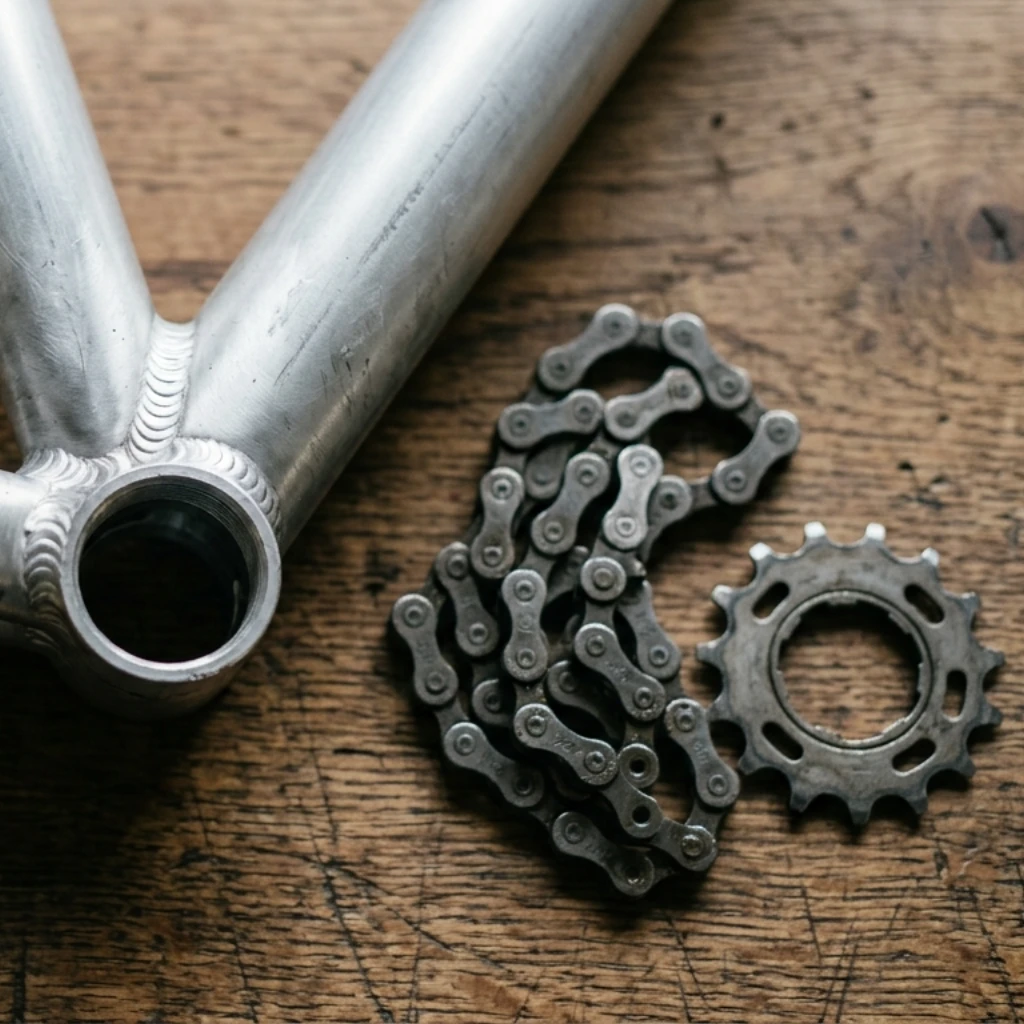
Ask "how long does a bike last" and most riders expect a number back. Ten years. Fifteen. A specific mileage figure, the way a chain has one. The honest answer is that no frame material has ever produced a reliable one, and the reason isn't a lack of testing. It's that frame failure and frame retirement are two almost completely different things, and the second one has very little to do with the first.
Why No Material Has a Fixed Lifespan Number
The most rigorous public test of this question is now nearly three decades old. In 1997, TOUR Magazine and the EFBe testing lab ran a batch of high-end road frames through repeated load cycling to measure fatigue failure, and their own conclusion was blunt: statements like "this frame will last 20,000 kilometers" cannot be made reliably from that kind of test.
"Statements such as 'this frame will last for 20,000 kilometers' cannot be made reliably on the basis of this test." Sheldon Brown: 12 High-End Frames in the EFBe Fatigue Test
That test still produced numbers, just not the kind that generalize. Several aluminum and carbon frames in that batch exceeded 200,000 load cycles with no failure. One steel frame failed at 56,690 cycles, which reads like an indictment of steel until you remember it's a single frame from a single manufacturer in a single test run, not a verdict on the material. Fatigue testing measures a specific frame under a specific load pattern. It was never built to hand back a universal "your bike will last N years" figure, and nothing since has changed that.
What has changed is that every frame sold today has to clear a fatigue test before it reaches a shop floor. ISO 4210, the international bicycle safety standard, requires frames to survive a set number of load cycles before certification, and the 2023 revision doubled the bar from 50,000 to 100,000 cycles depending on category, while adding a residual-strength test for carbon frames after a simulated impact.
"The fatigue test procedure requires the frame to withstand [a defined number of] load cycles without visible cracks, fractures, or detachment of the frame parts." ScienceDirect: Fatigue life analysis of steel bicycle frame according to ISO 4210
That's a real, verifiable fact: every frame you can legally buy has already passed a fatigue test. It's a different claim from "your specific frame will last a specific number of years," and it's the only one the engineering supports.
How Each Frame Material Actually Fails
The four common frame materials don't share a failure mode, which is exactly why one lifespan number was never going to apply to all of them.
Steel has a genuine fatigue limit. Below a certain stress threshold, it can in theory absorb an unlimited number of load cycles without ever failing from fatigue.
"Steel also has a fatigue limit — it can withstand stress below its fatigue limit an infinite number of times without resulting in failure." BikeRadar: Bike frame materials compared
The catch is that fatigue was rarely what killed a steel frame in the first place. Corrosion is. Steel rusts from the inside where nobody's looking, particularly in a frame that was never treated with an internal protective coating, and pitting corrosion can compromise a tube long before any fatigue crack would.
Aluminum doesn't get the same fatigue limit. Any repeated stress, applied for long enough, will eventually produce a fatigue crack in most aluminum alloys, with only a few exceptions. In practice, road and gravel frames are built well past any load a rider generates in normal use, which is why aluminum frames routinely rack up a decade or more of hard riding. But there's no citable engineering figure for exactly how many kilometers that overbuild is good for, and any number claiming otherwise should be treated as marketing, not data.
Carbon fiber doesn't fatigue the way metal does. Resin-and-fiber composite construction resists the kind of gradual cyclical wear that eventually cracks steel or aluminum, and manufacturers routinely describe carbon's fatigue resistance as better than any metal frame material.
"Carbon fiber offers a better fatigue life than steel, titanium, or aluminum." Calfee Design: Composite Bicycle Technical White Paper
Carbon's real vulnerability isn't slow wear, it's sudden impact. A hard hit that wouldn't dent a metal tube can delaminate carbon layers internally, with no visible sign from the outside. That failure mode shows up constantly in used-bike valuations, and it's the reason a crashed carbon frame is treated very differently from a scratched aluminum one, regardless of either one's age.
Titanium carries the strongest reputation of the four, often marketed outright as a frame for life. It resists corrosion entirely and handles repeated stress better than aluminum, which is a large part of why it holds that reputation. What's missing is a rigorous, bicycle-specific fatigue study to put a number on "far more resilient." Treat titanium's near-indefinite lifespan as an earned reputation, not a laboratory-verified figure, and it's still the right material to reach for if frame longevity is the actual priority.
What Actually Ends a Bike's Life
If material fatigue rarely kills a frame outright, something else is doing the retiring. In practice, it's almost always one of four things, and none of them are on a predictable schedule.
- Crash damage. This is the most common frame-ending event by far, and carbon's invisible internal damage makes it the highest-stakes version of it. A shop can't always tell you a crashed carbon frame is safe just by looking at it, which is why many shops decline to certify one at all and send it back to the manufacturer instead.
- Corrosion. Steel frames without internal protection and aluminum frames with weld-area pitting can both fail structurally from corrosion long before fatigue becomes relevant. It's a slow, often invisible process until it isn't.
- Recalls. Rare, but real. The US Consumer Product Safety Commission has documented actual frame-cracking recalls, including aluminum frames from Dynacraft and GT and a titanium frame line from CF Roark, each triggered by a real pattern of reported cracking rather than a theoretical failure mode.
- Standards obsolescence. A structurally sound frame can still reach the end of its practical life because the parts it needs are disappearing. Bottom bracket standards fragmented for years before partly consolidating around T47, and thru-axles have displaced quick-release as the mountain bike default over roughly the last decade. An older frame isn't broken, it's just increasingly expensive and difficult to keep supplied.
None of these show up on a maintenance calendar. A frame that would otherwise run for decades gets retired by one bad crash, one corroded chainstay, or the slow disappearance of a part it depends on.
So How Long Should You Expect a Bike to Last?
How long does a bike last, in practice, rather than in theory? Here's the part worth being honest about: there is no rigorous industry survey measuring how long people keep and ride the same bike before moving on. Bike-industry blogs commonly cite figures in the five-to-ten-year range for a well-maintained bike, with road bikes sometimes quoted higher and mountain bikes higher still, but those are rules of thumb repeated across marketing content, not numbers backed by a cited study. Anyone offering you a confident, specific figure here is doing what those blogs do: rounding an impression into a statistic.
What the actual evidence supports is narrower and more useful. Every certified frame has passed a real fatigue test. Steel and titanium resist fatigue outright and mostly fail through corrosion instead. Aluminum and carbon are built with enough margin that fatigue is rarely the practical limit. And the events that end a bike's service life, crashes, corrosion, recalls, and obsolete standards, have nothing to do with how many kilometers are on the odometer.
Why the Components Matter More Than the Frame
This is the part a frame-lifespan question usually misses: by the time fatigue becomes a realistic concern for most frames, you'll have replaced the chain a dozen times over, several cassettes, at least one set of brake pads, and possibly a bottom bracket or two. The cost of a worn drivetrain compounds quietly in the background the whole time the frame sits there unbothered.
That's the actual maintenance problem worth tracking. A frame's fatigue life is real but slow, generally outlasting the bike's practical ownership window entirely. The components riding on that frame wear out constantly, on a schedule that's specific to how and where you actually ride, not to a manufacturer's marketing copy. Componentry tracks that side of it automatically, logging wear on the chain, cassette, brake pads, and everything else that needs managing, from your connected Strava, Wahoo, or Garmin activity data, so the parts that fail long before the frame does don't catch you off guard.
If a crash does happen, keeping documented service history also matters for a different reason: it's what protects a frame's warranty claim and preserves resale value, which the resale-value math around a bike's service history covers in more detail.
Further Reading
- The Real Cost of a Worn Drivetrain — how neglected chain wear cascades into cassette and chainring replacement costs
- How Bike Service History Affects Resale Value — why documented maintenance and crash history change what a bike is worth
- How Long Does a Bike Cassette Last? — the component-level lifespan question, answered with real wear thresholds
- When to Replace Your Bike Chain — the single highest-leverage maintenance interval on the bike